- English
- ePUB (mobile friendly)
- Available on iOS & Android
eBook - ePub
About this book
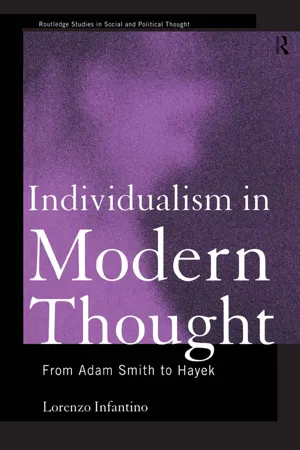
This book is a comprehensive survey of methodological individualism in social, political and economic thought from the Enlightenment to the 20th century. Exploring the works of such figures as de Mandeville, Smith, Marx, Spencer, Durkheim, Simmel, Weber, Hayek, Popper and Parsons, this study underlines the contrasts between methodological collectivism and methodological individualism. The detailed analysis offered here also reveals the theoretical presuppositions behind the collectivist and individualist traditions and the practical consequences of their applications. Infantino concludes in favour of individualism.
1
INTRODUCTION
INTRODUCTION
The ‘abuse of reason’
Friedrich von Hayek, the scholar who in this century gave most attention to the problem of the unintended consequences of intentional human actions, wrote:
Life of man in society, or even of the social animals in groups, is made possible by individuals acting according to certain rules. With the growth of intelligence, these rules tend to develop from unconscious habits into explicit and articulated statements and at the same time to become more abstract and general. Our familiarity with the institutions of law prevents us from seeing how subtle and complex a device the delimitation of individual spheres by abstract norms is. If it had been deliberately designed, it would deserve to rank among the greatest human inventions. But it has, of course, been as little invented by any one mind as language or money or most of the practices and conventions on which life rests.1
In other words: many social institutions arise unintentionally, without being planned by anyone. And yet the advance of modernity has often been accompanied by a claim to omnipotence. A culture has been established which is determined to see in social institutions the intentional result of human action. We have moved from the idea of an intentional order attributable to the will of God to that of an intentional order attributable to the designs of man. The task of planning has been ascribed to reason, that of realisation to politics, leading to the claim that it is possible to ‘reconstruct the universe through pure ideas, axioms and principles’.2 This is the origin of the extremism of Reason, which lost ‘the awareness of its own limits’ to the point of ‘annulling other influences: will, feeling, the physical body’.3 Individual and collective life have suffered in this way from the pathological attitude that Hayek called the ‘abuse of reason’,4 a ‘philosophical vice’ which propels the person affected by it towards social ‘constructivism’.5
We have been led into this attitude by ‘the rationalism of René Descartes and his followers’,6 whose ideal Voltaire, his greatest representative’,7 expressed in the following terms: ‘If you want good laws, burn those you have and make yourselves new ones’. This is the triumph of utopianism, the claim that it is possible to model social reality freely, by means of a ‘unitary direction’ entrusted to a class of ‘chosen ones’. It demonstrates that the ‘constructivist’ mentality fails to understand the difficulty of putting together a complex society by means of a centralised organisation, the sure result of which, as will be explained in more detail, is the loss of individual autonomy and of the capacity to develop.
Political economy and the discovery of unintentional order
However, there is a different tradition of thought, which has challenged the ‘abuse of reason’ and has suggested a very different answer to the problem of social order. The first to try to systematise an answer were Bernard de Mandeville and David Hume, followed by the Scottish social philosophers of the eighteenth century.8 In particular, Adam Smith, the founder of modern political economy, climbed on the shoulders of Mandeville and Hume. These authors all maintained that a ‘great society’, or, to use an expression more familiar to us, an ‘open’ or ‘extended society’ is such if it embodies an unintentional order. That is, they ‘discovered’ the possibility of rejecting the ‘unitary direction’ of collective life; they believed that order should not be ‘given’ by a superior being to subjects who operate in society, but that order can be the unintentional result of the action of individuals. From this derives a theoretical scheme which we can name briefly the ‘Mandeville—Smith model’. Let us begin with an illustration.
Beside the aims which each man pursues individually and knowingly, his actions also obtain, unintentionally, another objective: they serve the conditions (I use the term ‘conditions’ not in a juridical sense, but with the meaning that can be deduced from the theory of evolution as ‘conditions’, to which the action of Ego must adapt itself in order to fulfil its course) dictated by the Other and thus give rise to the norms which regulate social relations. In this way, order is brought into being by the very individuals who act, without their being aware of it, and without the intervention of a ‘social brain’ to coordinate their movements.
This is shown by a now classic extract from Smith:
It is not from the benevolence of the butcher, the brewer, or the baker, that we expect our dinner, but from their regard for their own interest. We address ourselves not to their humanity but to their selflove, and never talk to them of our own necessities but of their advantages. Nobody but a beggar chooses to depend chiefly upon the benevolence of his fellow citizens.9
Expressed in Mandeville’s words, this is equivalent to saying that ‘all of us, turning the vices and weaknesses of others to our own advantage, seek to obtain a living in the easiest and most direct way that our talent and capacity allow’.10
Hence, there is in our life an ineradicable ‘double entry account’,11 activated by the interest of each person to pursue his own ends. Such ends are not pursued in a social vacuum. Each person needs the intervention of the Other, and for that reason has to ‘serve’ him. Consequently, it happens that, if he wants to be able to enter what he wishes to accomplish on the credit side of his existential ‘account’, the actor has to submit himself to the conditions imposed by the Other.
The Other can, in his turn, obtain a service from the former, as a result. Thus, unintentionally, a network of conditions or norms which generalise and regulate social ‘commerce’ is born.
The first objection raised against this kind of explanation of social order is that it ‘strips’ man, exalts his less ‘noble’ aspect, and believes in the possibility of bringing about unintentional order. There is a paradox here: to formulate such a charge is to propose, as we shall see in more detail, to place the individual under the ‘guardianship’ of an intentional order, which means that his judgement of man is no less pessimistic. But that is not the point here. It is not a fault to base a model of social order on personal ‘interest’; on the contrary, it is an advantage, because it predisposes us to receive from man not the best, or perhaps the impossible, but rather what that same man can most easily give. This does not exclude the possibility of there being minorities able to do more and better; but it protects us from thinking that this ‘more’ and ‘better’ can be generalised. Mandeville wrote: ‘The most knowing, the most virtuous, and the least self-interested Ministers are the best; but in the mean time there must be Ministers’.12 Consequently, there have to be systems of control, as a counter balance to ‘interests’, because in such a case even ‘common prudence is sufficient to hinder a man of very indifferent principles from stealing’; indeed, he knows that he is in a ‘great danger of being detected, and has no manner of security that he shall not be punished for it’.13
It is thus clear that the Mandeville-Smith model gives autonomy to individuals and recognises their ‘personal interest’, which becomes the motive of action. There is no intention of suppressing this interest, a suppression which is, in any case, incompatible with the life of a ‘great society’. The mediation of interests is not performed consciously by an entity put in authority over individuals, but it happens unintentionally, by means of the very action of the individuals who act. One can say that a model of this kind points towards ‘isolating’ the minimum presuppositions of social life. That is, it impels us to activate mechanisms which drive the actor in relation to the minimum conditions required for collective living. The individual is not asked to renounce his own interests and to soar to exemplary heights of nobility; instead he is asked to submit himself to ‘conditions’ which make possible the pursuit of his own interests and the interests of others.
The birth of sociology and intentional order
What the ‘abuse of reason’ was not able to do with political economy in its early days it did with sociology, in particular with French positivist sociology with all its emphasis on the claim that no human society can exist ‘without an intelligence which directs it’.14 Saint-Simon called for ‘the coming of a unitary direction of society’.15 Comte said that ‘the exercise of a general and combined activity is the essence of society’16 Durkheim maintained that individualism does not turn ‘all wills’ towards the same ‘social’ end17 and that one can accuse the theorists of individualism of'ensuring dissolution of society’.18
Therefore, sociology was born with the idea that society ought to be an intentional order, organised and directed by a specific ‘intelligence’. Like every other form of ‘constructivism’, that of sociology demonstrates a double conceit here. It maintains that it would not be possible to give up the idea of society understood as an aware organisation of collective life, and it is the victim of the illusion that it is possible to organise consciously a complex society. On the contrary, the existence of such a society is linked to the possibility of an unintentional order, of a social dynamic which does not have to depend on ‘unitary direction’.
When considering the possibility of organising society in a conscious way, Saint-Simon did not hesitate to judge the concept of individual liberty as ‘vague and metaphysical’ and to regard it as an ‘obstacle to civilization’.19 Comte labelled individualism and liberty of conscience as ‘revolting monstrosities’.20 Durkheim equated individual autonomy with egoism, to which he attributes the sole capacity to create anomie.21
The sociology of Saint-Simon and Comte was taken to extremes by Marx, who saw in the rights of man ‘the rights of the member of civil society, i.e. of egoistic man, of man separated from other men and the community’,22 and proposed the conscious organisation of society by way of a single plan brought to fruition after the ‘strictest centralization’ of power in the hands of the State.23
However, all of these authors, with whose names the birth and early development of sociology are closely linked, displayed hostility when making comparisons with political economy, a discipline from which, as has already been stated, comes the proposition of an unintentional order, of a ‘great society’ which renounces the idea of a ‘unitary’ social direction. Saint-Simon maintained that the ‘science of production’ is not economics but politics, because only the latter knows how to pursue that common end towards which all men ought to direct their steps.24 Comte accused the economists of having dissociated economic phenomena ‘from the analysis of the intellectual, moral and political state of society’; indeed, of having created the ‘sterile aphorism’ of liberty, and of not seeing the need for a ‘special institution’ which would fulfil the fu...
Table of contents
- Cover Page
- Half Title page
- Series page
- Title Page
- Copyright Page
- Dedication
- Contents
- Preface
- 1 Introduction
- 2 Bernard De Mandeville and Adam Smith The theory of the great society
- 3 Which Method? A question about the philosophy of the social sciences
- 4 Durkheim and the Application of the Collectivistic Method
- 5 Is an ‘Individualistic' Reading of Durkheim Possible?
- 6 Economists and Sociologists Compared Carl Menger and Georg Simmel, Ludwig von Mises and Max Weber
- 7 The Early Parsons Between sociology and economics
- 8 Conclusions
- Notes
- References
- Index
Trusted by 375,005 students
Access to over 1.5 million titles for a fair monthly price.
Study more efficiently using our study tools.
Frequently asked questions
Yes, you can cancel anytime from the Subscription tab in your account settings on the Perlego website. Your subscription will stay active until the end of your current billing period. Learn how to cancel your subscription
No, books cannot be downloaded as external files, such as PDFs, for use outside of Perlego. However, you can download books within the Perlego app for offline reading on mobile or tablet. Learn how to download books offline
Perlego offers two plans: Essential and Complete
- Essential is ideal for learners and professionals who enjoy exploring a wide range of subjects. Access the Essential Library with 800,000+ trusted titles and best-sellers across business, personal growth, and the humanities. Includes unlimited reading time and Standard Read Aloud voice.
- Complete: Perfect for advanced learners and researchers needing full, unrestricted access. Unlock 1.5M+ books across hundreds of subjects, including academic and specialized titles. The Complete Plan also includes advanced features like Premium Read Aloud and Research Assistant.
We are an online textbook subscription service, where you can get access to an entire online library for less than the price of a single book per month. With over 1.5 million books across 990+ topics, we’ve got you covered! Learn about our mission
Look out for the read-aloud symbol on your next book to see if you can listen to it. The read-aloud tool reads text aloud for you, highlighting the text as it is being read. You can pause it, speed it up and slow it down. Learn more about Read Aloud
Yes! You can use the Perlego app on both iOS and Android devices to read anytime, anywhere — even offline. Perfect for commutes or when you’re on the go.
Please note we cannot support devices running on iOS 13 and Android 7 or earlier. Learn more about using the app
Please note we cannot support devices running on iOS 13 and Android 7 or earlier. Learn more about using the app
Yes, you can access Individualism in Modern Thought by Lorenzo Infantino in PDF and/or ePUB format, as well as other popular books in Business & Business General. We have over 1.5 million books available in our catalogue for you to explore.