Religion, Race, and Barack Obama's New Democratic Pluralism
eBook - ePub

Religion, Race, and Barack Obama's New Democratic Pluralism

  1. 282 pages
  2. English
  3. ePUB (mobile friendly)
  4. Available on iOS & Android
eBook - ePub

Religion, Race, and Barack Obama's New Democratic Pluralism

About this book

Contrary to popular claims, religion played a critical role in Barack Obama's 2008 election as president of the United States. Religion, race, and gender entered the national and electoral dialogue in an unprecedented manner. What stood out most in the 2008 presidential campaign was not that Republicans reached out to religious voters but that Democrats did—and with a vengeance. This tightly edited volume demonstrates how Obama charted a new course for Democrats by staking out claims among moderate-conservative faith communities and emerged victorious in the presidential contest, in part, by promoting a new Democratic racial-ethnic and religious pluralism.

Comprising careful analysis by leading experts on religion and politics in the United States, Gastón Espinosa's book details how ten of the largest segments of the American electorate voted and why, drawing on the latest and best available data, interviews, and sources. The voting patterns of Mainline Protestants, Evangelicals, Catholics, Jews, Muslims, and seculars are dissected in detail, along with the intersection of religion and women, African Americans, Latinos, and Asian Americans. The story of Obama's historic election is an insightful prism through which to explore the growing influence of religion in American politics.

Frequently asked questions

Yes, you can cancel anytime from the Subscription tab in your account settings on the Perlego website. Your subscription will stay active until the end of your current billing period. Learn how to cancel your subscription.
No, books cannot be downloaded as external files, such as PDFs, for use outside of Perlego. However, you can download books within the Perlego app for offline reading on mobile or tablet. Learn more here.
Perlego offers two plans: Essential and Complete
  • Essential is ideal for learners and professionals who enjoy exploring a wide range of subjects. Access the Essential Library with 800,000+ trusted titles and best-sellers across business, personal growth, and the humanities. Includes unlimited reading time and Standard Read Aloud voice.
  • Complete: Perfect for advanced learners and researchers needing full, unrestricted access. Unlock 1.4M+ books across hundreds of subjects, including academic and specialized titles. The Complete Plan also includes advanced features like Premium Read Aloud and Research Assistant.
Both plans are available with monthly, semester, or annual billing cycles.
We are an online textbook subscription service, where you can get access to an entire online library for less than the price of a single book per month. With over 1 million books across 1000+ topics, we’ve got you covered! Learn more here.
Look out for the read-aloud symbol on your next book to see if you can listen to it. The read-aloud tool reads text aloud for you, highlighting the text as it is being read. You can pause it, speed it up and slow it down. Learn more here.
Yes! You can use the Perlego app on both iOS or Android devices to read anytime, anywhere — even offline. Perfect for commutes or when you’re on the go.
Please note we cannot support devices running on iOS 13 and Android 7 or earlier. Learn more about using the app.
Yes, you can access Religion, Race, and Barack Obama's New Democratic Pluralism by Gaston Espinosa,Gastón Espinosa in PDF and/or ePUB format, as well as other popular books in Politics & International Relations & Politics. We have over one million books available in our catalogue for you to explore.

1
RELIGION, POLITICS, AND AMERICAN SOCIETY

Gastón Espinosa
FIGURE 1.1 President Obama takes his Presidential Oath of Office and is sworn in as the 44th President of the United States by the Chief Justice of the U.S. Supreme Court John  G. Roberts, Jr. in Washington, D.C., January 20, 2009. Prior to taking the oath, Obama asked Justice Roberts to include “so help me God” at the end of the oath, which was duly added. Courtesy: U.S. Federal Government photo by Master Sergeant Cecilio Ricardo.
FIGURE 1.1 President Obama takes his Presidential Oath of Office and is sworn in as the 44th President of the United States by the Chief Justice of the U.S. Supreme Court John
G. Roberts, Jr. in Washington, D.C., January 20, 2009. Prior to taking the oath, Obama asked Justice Roberts to include “so help me God” at the end of the oath, which was duly added. Courtesy: U.S. Federal Government photo by Master Sergeant Cecilio Ricardo.
Of all of the dispositions and habits, which lead to political prosperity, Religion and Morality are indispensable supports… In vain would that man claim the tribute of patriotism, who should labor to subvert these great pillars of human happiness. The mere Politician, equally with the pious man, ought to respect and to cherish them… Where is the security for property, for reputation, for life, if the sense of religious obligation desert the oaths?… Reason and experience both forbid us to expect that national morality can prevail in exclusion of religious principle.1
President George Washington, Farewell Address, September 19, 1796
Religious sentiment and activism have sparked some of our most powerful political movements, from abolition to civil rights… Secularists are wrong when they ask believers to leave their religion at the door before entering the public square… the majority of great reformers in American history not only were motivated by faith but repeatedly used religious language to argue their causes. To say that men and women should not inject their “personal morality” into public-policy debates is a practical absurdity; our law is by definition a codification of morality, much of it grounded in the Judeo-Christian tradition.2
President Barack Obama,The Audacity of Hope, 2006
Washington’s and Obama’s shared view of the influence of religion and morality on civil society is not accidental. All American presidents have supported the notion that religion and morality can be positive forces for promoting civic virtue and/or progressive social change. This chapter sets the larger context for those that follow by examining the role of religion in American politics; a taxonomy of U.S. religions; the history and importance of the religious, racial-ethnic, secular, and women’s voting groups in politics; and Obama’s upbringing, religious identity, and 2008 Election results.

Previous Literature on Religion and the Presidency

The influence of religion in American politics and society is ubiquitous. Almost every American president has utilized religion in his presidential campaigns and administrations. Although some argue that the manipulation of religion and morality as a political force in American presidents is new to George W. Bush, in fact it traces its roots back to the founding of the nation and to accusations in the election of 1800 by John Adam’s operatives that Thomas Jefferson was an atheist and infidel and thus unfit to govern the nation. Although the strategy did not work, it sent a signal to presidential candidates that religion and morality were key variables that shaped American public opinion, a view that holds true to this very day.3
The influence of religion in the American presidency is analyzed in biographies by Peter Lillback, Washington’s Sacred Fire (2006); Edwin Gaustad, Sworn on the Altar of God: A Religious Biography of Thomas Jefferson (1996); Kenneth Morris, Jimmy Carter: American Moralist (1997); Paul Kengor, God and Ronald Reagan: A Spiritual Life (2005); and David Aikman, A Man of Faith: The Spiritual Journey of George W. Bush (2005). It is also explored in a number of historical overviews such as Mark Rozell and Gleaves Whitney (editors), Religion and the American Presidency (2007); Randy Balmer, God in the White House (2009); Gary Scott Smith, Faith and the Presidency (2009); and David Holmes, The Faiths of the Postwar American Presidents: From Truman to Obama (2011).
Likewise, almost all of the recent biographies and autobiographies on Barack Obama, Hillary Clinton, Mike Huckabee, Mitt Romney, and John McCain have sections about their faith journeys. Many of the books on Obama are slightly partisan: Stephen Mansfield, The Faith of Barack Obama (2008); Douglas Kmiec, Can a Catholic Support Him? (2008); Marvin McMickle, Audacity of Faith: Christian Leaders Reflect on the Election of Barack Obama (2009); and John Jocelyn and Dirk Brewer, President Obama’s Broken Promises: Race, Religion & Gay Rights (2010). This book seeks to help fill this gap in the literature by taking a nonpartisan, secular, and social scientific approach to Obama, religion, and the 2008 Election.

Religion and Politics in the Twentieth Century

U.S. Religious Demography

Presidents continue to reach out to the American people through churches and religious events because they play a robust role in society. More than 92 percent of Americans believe in God or a universal spirit, and Americans have one of the highest rates of church, synagogue, and religious attendance in the world. One of the main reasons why presidents always self-identify with a Christian denomination is because Christians make up 77 to 82 percent of the U.S. population. Although the exact figures are debated, 50 to 61 percent of all Americans self-identify as Protestant and 21 to 25 percent as Roman Catholic. Almost 12 percent of Americans self-identify as nonaffiliated, 4.7 percent as other religion or do not know, 1.7 percent as Jewish, and 0.4 percent as Muslim. Protestants (54 percent) and Catholics (27 percent) made up 81 percent of the 2008 electorate. The Baptists, nondenominational/ independents, Methodists, Lutherans, Pentecostals, and Presbyterians are the largest traditions. Almost all nondenominational/independent Christians are born-again and/or Evangelical Protestant (Table 1.1).
All of this points to the rising political power of born-again and Evangelical Christianity. The born-again experience is transdenominational. This is why some mainline Protestant politicians such as Ronald Reagan (Disciples, Presbyterian), G. H. W. Bush (Episcopalian), and G. W. Bush (United Methodist) both attended mainline churches and self-identified as born-again Christian. Born-again Christians make up 38 percent (100+ million people) of the U.S. population and 25 percent of the national electorate—or one of every four American voters.
TABLE 1.1 U.S. Religious Demographic Profile
TABLE 1.2 Religious affiliation of U.S. presidents through 2004

Religious Affiliation of American Presidents
Despite Evangelical growth, the vast majority of American presidents have self-identified with mainline Protestant traditions—Episcopal, Presbyterian, Methodist, and Congregational—because they are viewed as religiously moderate and respectable upper-class traditions. There has been no Pentecostal, Lutheran, Orthodox, Jewish, Muslim, or Mormon president. There has been only one Catholic president: John F. Kennedy (Table 1.2).
Although most presidents have associated with mainline Protestantism, the only two Democrats to win the White House from 1968 to 1996 were born-again, Evangelical, and Southern Baptist Christians from the South—Jimmy Carter and Bill Clinton. During this same time, all the Republicans came from moderate-to-liberal Protestant denominations (Reagan: Disciples of Christ/Presbyterian; Nixon: Quaker; G. H. W. Bush: Episcopalian; G. W. Bush: Episcopalian/Methodist/ Presbyterian), thus underscoring the transdenominational dimension and potential political power of born-again Evangelical Christianity. The 2008 election broke this trend by electing Obama, a member of the liberal United Church of Christ (UCC), although he too reportedly walked down an aisle at church and asked Jesus to be his personal savior and lord.4
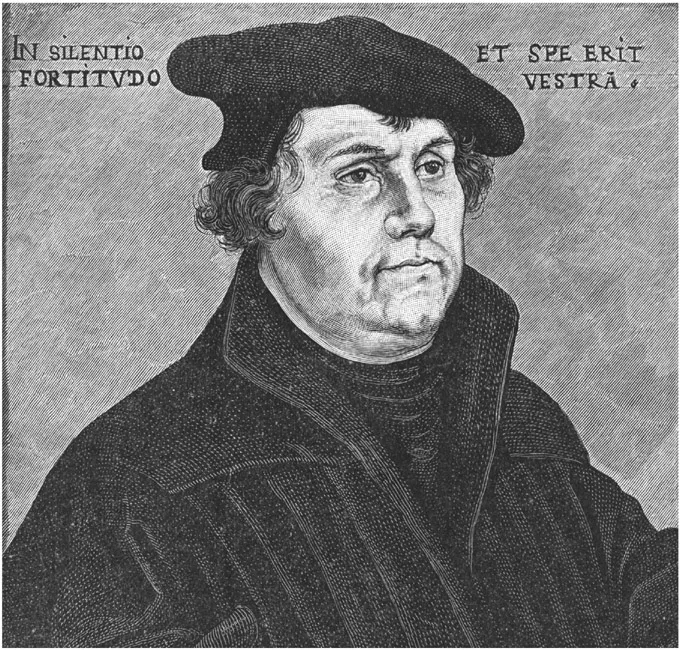
FIGURE 1.2 Martin Luther (1483–1546). Engraving by Theodor Knesing from the painting by Lucas Cranach. Courtesy: Library of Congress Prints and Photographs, LCUSZ62-106322

Religious and Racial-Ethnic Taxonomy of American Society

Mainline Protestants

The two main varieties of Protestants in America are mainline and Evangelical. Mainline Protestants trace their roots back to Martin Luther, John Calvin, John Knox, John Wesley, and the birth of the Protestant Reformation in 1517 in Europe. They arrived in America largely evangelical in theology. Most were theologically, socially, and morally conservative until the late nineteenth and early twentieth centuries, when they became increasingly influenced by Enlightenment rationalism, biblical criticism, science, evolution, and modernism. The Fundamentalist-Modernist Controversy from 1910 to the 1930s marks the crystallization and formal birth of liberal Protestantism, which tended to deny cardinal doctrines such as the inerrancy of the Bible, Jesus’ virgin birth, divinity, bodily resurrection, and salvation through Christ alone. Though mainline Protestant leaders tend to be moderate-liberal in orientation, the vast majority of rank-and-file parishioners across the nation tend to be moderate to this day. This explains why there has often been a divergence in the aggregate denominational voting patterns between leaders and parishioners.5
Mainline Protestant traditions constitute a small but important number of generally large denominations that include the UCC, Episcopalian, United Methodist (UMC), Presbyterian (PCUSA), Lutheran (ELCA), American Baptist, Reformed Church in America (RCA), African Methodist Episcopal (AME), Disciples of Christ, and Unitarian-Universalist traditions. Mainline Protestants tend to be creedal, ecumenical, theologically and morally moderate-liberal in orientation, and liturgical.6 They are much more likely than traditional Evangelicals to hold liberal social views on abortion, homosexual relations and marriage, and women’s ordination. They reject the inerrancy of the Bible but are generally committed to social justice, women in ministry, environmentalism, pacifism, and progressive social views. With higher income and educational levels than Evangelicals, they have long dominated the American political, economic, and cultural scene. However, they have voted Republican for economic rather than social or moral reasons. In the 2004 presidential election, however, they split their vote between Republicans and Democ...

Table of contents

  1. Cover
  2. Title
  3. Copyright
  4. Dedication
  5. CONTENTS
  6. CONTRIBUTORS
  7. PREFACE
  8. 1 RELIGION, POLITICS, AND AMERICAN SOCIETY
  9. 2 MAINLINE PROTESTANTS AND THE 2008 ELECTION
  10. 3 EVANGELICALS AND THE 2008 ELECTION
  11. 4 CATHOLICS AND THE 2008 ELECTION
  12. 5 JEWS AND THE 2008 ELECTION
  13. 6 MUSLIMS AND THE 2008 ELECTION
  14. 7 SECULARS AND THE 2008 ELECTION
  15. 8 WOMEN, RELIGION, AND THE 2008 ELECTION
  16. 9 AFRICAN AMERICANS, RELIGION, AND THE 2008 ELECTION
  17. 10 LATINOS, RELIGION, AND THE 2008 ELECTION
  18. 11 ASIAN AMERICANS, RELIGION, AND THE 2008 ELECTION
  19. 12 CONCLUSION
  20. INDEX