- 456 pages
- English
- ePUB (mobile friendly)
- Available on iOS & Android
eBook - ePub
About this book
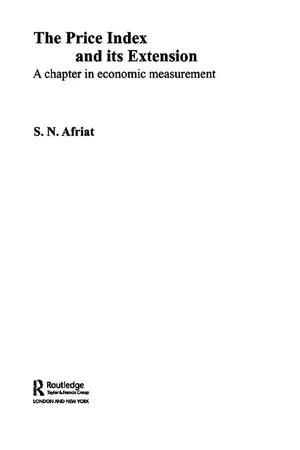
The book is not an unrestricted survey engaging a vast and repetative literature, but a systematic treatise within clear boundaries, largely a document of Afriat's own work. The original motive of the work is to elaborate a concept of what really is a price index, which, despite some kind of price-level notion having a presence throughout economics
Trusted by 375,005 students
Access to over 1.5 million titles for a fair monthly price.
Study more efficiently using our study tools.
Information
Subtopic
Business GeneralIndex
BusinessPart I
Laspeyres, Paasche and Fisher
Introduction —theory and practice
1 Comparisons
There is a dilemma in the comparison of two periods of time: they must have comparable features to bring them into a relation with each other at all, but also there is an essential separation so it is difficult to know what finally to make of the comparison. In tenth century Spain, a simple view was offered: the world is created afresh at every moment . . . This is certainly one way to abolish problems of comparison and connection. However, others, historians, economists, statisticians, or anybody else, believe things are not always so new: they dwell on connections, debts. In the other extreme, the only authority for the present is the past. In early economics, the correct price or wage is simply the price or wage that has been settled by custom and has the value which, so far as anybody can remember, it has always had. No doubt this is not as senseless as it might immediately seem from the standpoint of neoclassical economics. But it presupposes moral order, obedience to norms. There can be no price-cutting, and no charging of unexpectedly high prices. This makes sense in a steady way of life where supply and demand have created each other and settled down together. Whatever the limitations of this way of thinking, it is at least rational. Walras pursues the opposite in a logical way, but at the same time he helps foster a myth, which we have also from Adam Smith. However, with Smith it is not a deliberate and indispensable truth to be pursued with trappings of science. From him it can appear as a fantasy inadvertently inherited from predecessors. In the alternative system, which is more familiar to us at least intellectually, price-cutting and boosting is permitted freely, there is no law but competition, but out of this competition emerges the optimal result.
Here is not really a proposition that something—it is not said or known what—is at a maximum. It is an exhortation which connects, better than with anything in the differential calculus, with the tenth century philosopher: the Walrasian economy is always newly at its best at any moment. There can be no argument that it should be any different. Therefore it is pointless to do accounts which compare one moment with another. But standing out in practice is the opposite, familiarly old attitude, which is that the past has authority for the present. Price indices express respect for that authority. They offer a kind of exchange rate between £s in different periods; accounts in one period can be converted to show them as if they were accounts in another period, and then they can be compared with corresponding accounts in that other period. In particular, wages can be compared. A force acting on what a wage should be this year is what it was in some former year converted into this year’s £s. Sums today are measured by a yardstick which has reference to the past. The ‘index number problem’ can be understood as the problem of fashioning such a yardstick. There is a dilemma, because the present has to be placed in the past, but the present has a separation from the past which erases reference marks which could assist in the positioning. There are calibration difficulties. Different approaches to the problem are distinguished by the choice of calibrating instruments.
A price index signifies a special form of instrument whereby prices, though they are many, have a ‘level’ in any period. Exchange rates between periods are then ratios of price levels, these being determined by ‘price indices’. But this only gives a form and does not tell how it is to be realized, or why such a simple form should be suitable.
A change through time can be recognized only by means of some element which persists unchanged. If a material body is undergoing deformation in time, this can be known only by means of a measuring rod which is transported through time without deformation. With a price index which measures change in the ‘level’ of prices, there is dependence on a hypothetically unchanged construction, a special type of utility function. This function could be a very simpl...
Table of contents
- Cover Page
- Title Page
- Copyright Page
- Foreword
- Preface
- Acknowledgements
- Permissions
- Introduction
- Part I: Laspeyres, Paasche and Fisher
- Part II: The Cost of Living
- Appendices
- Notation
- Bibliography
Frequently asked questions
Yes, you can cancel anytime from the Subscription tab in your account settings on the Perlego website. Your subscription will stay active until the end of your current billing period. Learn how to cancel your subscription
No, books cannot be downloaded as external files, such as PDFs, for use outside of Perlego. However, you can download books within the Perlego app for offline reading on mobile or tablet. Learn how to download books offline
Perlego offers two plans: Essential and Complete
- Essential is ideal for learners and professionals who enjoy exploring a wide range of subjects. Access the Essential Library with 800,000+ trusted titles and best-sellers across business, personal growth, and the humanities. Includes unlimited reading time and Standard Read Aloud voice.
- Complete: Perfect for advanced learners and researchers needing full, unrestricted access. Unlock 1.5M+ books across hundreds of subjects, including academic and specialized titles. The Complete Plan also includes advanced features like Premium Read Aloud and Research Assistant.
We are an online textbook subscription service, where you can get access to an entire online library for less than the price of a single book per month. With over 1.5 million books across 990+ topics, we’ve got you covered! Learn about our mission
Look out for the read-aloud symbol on your next book to see if you can listen to it. The read-aloud tool reads text aloud for you, highlighting the text as it is being read. You can pause it, speed it up and slow it down. Learn more about Read Aloud
Yes! You can use the Perlego app on both iOS and Android devices to read anytime, anywhere — even offline. Perfect for commutes or when you’re on the go.
Please note we cannot support devices running on iOS 13 and Android 7 or earlier. Learn more about using the app
Please note we cannot support devices running on iOS 13 and Android 7 or earlier. Learn more about using the app
Yes, you can access The Price Index and its Extension by Sydney N. Afriat in PDF and/or ePUB format, as well as other popular books in Business & Business General. We have over 1.5 million books available in our catalogue for you to explore.