- 224 pages
- English
- ePUB (mobile friendly)
- Available on iOS & Android
eBook - ePub
About this book
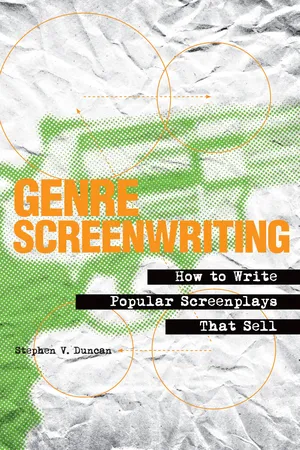
It's simple: films need to have commercial value for the studios to produce them, distributors to sell them, and theater chains to screen them. While talent definitely plays a part in the writing process, it can be the well-executed formulaic approaches to the popular genres that will first get you noticed in the industry.
Genre Screenwriting: How to Write Popular Screenplays That Sell does not attempt to probe in the deepest psyche of screenwriters and directors of famous or seminal films, nor does it attempt to analyze the deep theoretic machinations of films. Duncan's simple goal is to give the reader, the screenwriter, a practical guide to writing each popular film genre. Employing methods as diverse as using fairy tales to illustrate the 'how to' process for each popular genre, and discussing these popular genres in modern television and its relation to its big screen counterpart, Duncan provides a one-stop shop for novices and professionals alike.
Genre Screenwriting: How to Write Popular Screenplays That Sell does not attempt to probe in the deepest psyche of screenwriters and directors of famous or seminal films, nor does it attempt to analyze the deep theoretic machinations of films. Duncan's simple goal is to give the reader, the screenwriter, a practical guide to writing each popular film genre. Employing methods as diverse as using fairy tales to illustrate the 'how to' process for each popular genre, and discussing these popular genres in modern television and its relation to its big screen counterpart, Duncan provides a one-stop shop for novices and professionals alike.
Trusted by 375,005 students
Access to over 1 million titles for a fair monthly price.
Study more efficiently using our study tools.
Information

THERE ARE MANY COMPREHENSIVE BOOKS on the fundamentals of writing a screenplay.1 However, I want to begin by establishing the broad concepts that are germane and key to my later explanations of how to write popular film genres. My intention is not to be all-inclusive here, but rather to give you a short course in the chief storytelling concepts.
This is important because in order to write strong genre screenplays, you must be able to write a good old fashion drama. Look at the drama as the chassis on which to build all the popular film genres: action-adventure, thriller, science-fiction-fantasy, comedy/romantic comedy and horror-fantasy all begin with a strong dramatic framework.
Create an Enticing Film Premise
Nearly every film studio executive will tell you he or she is interested in purchasing screenplays based on a high-concept premise. But exactly what does this phrase mean? Basically, in a high-concept premise, the situation in the premise is more important than the characters in the story. I will provide specific examples of this in each genre that I discuss because nearly every screenplay written in a popular genre is based on a high-concept premise.
Since moving into the twenty-first century, film studio executives have realized that the “high-concept” approach to screenplay development is getting a bit stale. So they have come up with a new approach to widen their search for unique film premises. The search is now on for what’s being called the low-high-concept premise. This is a simple variation that takes character into account more than the situation of the story but still relies on a unique situation in which the characters are involved. Essentially, the low-high-concept premise is a focused drama. Since actors love drama because it gives them a chance to strut their stuff on screen, this approach has become a way for the studios to help dramas earn more money at the box office. That’s a big reason why high-profile-popular actors tend to be involved on the production side of these films, and not just on the screen. Just look at the top drama films made since 2000, and you’ll find that the most successful of them involve high-profile actors who also work behind the scenes as directors and/or producers. Two excellent illustrations of this are George Clooney’s Good Night & Good Luck (2005)—which he co-wrote, acted in and directed—and Clint Eastwood’s Million Dollar Baby (2004), in which he acted and which he directed. Both of these movies won Academy Awards and made money for the studios. They’re both based on low-high-concept premises.
Use Theme in Your Story
What’s the story really about? What’s the big, shiny idea underneath the story? Answer this and you’ll have the theme of the story. If you analyze all the great films, both past and present, you’ll find that they all have strong and important themes that are life-affirming. What does that mean? Life-affirming themes reassure the audience that their own existence matters. Films, more often than not, offer the audience a chance to go through the perils of life—both physical and emotional—as spectators, allowing them to learn from the experience without the jeopardy. I know that sounds a bit pretentious, but deep down you know it’s true when you experience a well-made film.
One technique is to start with a one-word theme that broadly describes what your story is about. An excellent source for a thematic word is Roget’s Thesaurus. Go to the Table of Contents and look under Class Eight: Affections. Of special interest is the section on morality—that’s where you’ll find the themes most used in storytelling. The struggle between right and wrong—morality—is eternal and universal, because people and films are about people. So this is a natural and very organic approach.
There are other sources of themes, and the most popular are:
•The Seven Deadly Sins
•The Seven Heavenly Virtues
•The Ten Commanders
•Popular Bible Stories
Once you’ve decided which one-word theme applies to what you want to write, come up with a cliché that would be appropriate for what you’re trying to say. Here are few examples:
•As Good as It Gets: Trust. . . “No man is an island.”
•Jerry Maguire: Honesty . . . “Honesty is the best policy.”
•Titanic: Dishonesty . . . “If you’ll lie, you’ll steal.”
•Shrek: Tolerance . . . “Don’t judge a book by its cover.”
This is the only time when using a cliché is really helpful in creative writing. Otherwise, avoid them.
Next, develop the physical theme for your story. This involves giving the audience a clear sense of what the story’s main character is up against—a problem/predicament. So, if your main character is a police detective, then her physical goal in the story needs to have an underlying theme. In this case, it could be to stop a serial killer who preys only on young women, which is an underlying theme that embraces feminism or the idea that women are objectified in American culture (and, to be fair, elsewhere on the planet, too).
Next there should be a metaphysical theme for your story. This involves the audience in an emotional sensation that underlines a more universal idea in the story, exemplified by the main character’s efforts to solve the problem/predicament in which she finds herself. So, following the female police detective, the more universal theme could embrace the idea that women must act on their own behalf in order to level the playing field and not sit around waiting and hoping that men will see the light. Of course, this theme could go in other directions as well.
This theory may strike you as highbrow, but you can easily bring it down to earth by converting both the physical and meta-physical themes into concrete central questions that are to be answered (or not) by the story’s end.
For example:
Female Police Detective’s physical central question: Can she catch the serial killer before he or she kills another young woman?
Female Police Detective’s metaphysical central question: Must women take more control of their lives in order to protect themselves?
Now let’s look at a real-life example of this, using the drama Brokeback Mountain, which received an Oscar for Writing–Adapted Screenplay in 2006. (Brokeback Mountain also won two more Oscars and was nominated in five other categories2):
Ennis’ (Heath Ledger) physical central question could be: Can he have a secret homosexual relationship with Jack (Jake Gyllenhaal) while maintaining his heterosexual life with his wife?
Ennis’ metaphysical central question could be: Can a person live happily by hiding his or her true self from the ones he or she loves?
No matter what genre you’re writing in, don’t forget that theme plays a vital role in the storytelling. It also serves as a guiding light throughout the writing process.
Create Interesting Characters
Stories are, first and foremost, about people. Here’s my definition of a screenstory:
One person with a problem who is trying to solve that problem through other people, and the more other people get involved, the more complicated the problem and its solution become.
Your primary goal as a writer is to create a main character with whom the audience can sympathize. Note that I didn’t say agree with, because the most important feeling you want the audience to have is that of understanding the characters, no matter how they feel or what they do in the story.
One way to accomplish this is to think of the specific role each character plays in the story The three primary roles are:
Protagonist: Who the story is about; the main character.
Antagonist: The person who opposes the protagonist’s efforts.
Pivotal Characters: Those people who help or hinder the protagonist’s (and/or antagonist’s) efforts and/or bring a different point of view to the story’s problem/predicament, regardless of whose side they’re on.
Often, new or less-experienced writers consider a protagonist’s problem in a story to be the antagonist. For example, you might say that alcoholism is the antagonist. But technically, the love of booze is actually the problem that serves to fuel the kind of behavior that creates conflict in the story. So, in this case, a better way to create an antagonist would be to add a loved one—a wife, girlfriend, brother, doctor—who wants the character to quit drinking, thus opposing the use of alcohol. In this way, you turn the inner conflict into an outer conflict through a living, breathing person with whom the protagonist interacts. This technique is called personification.
Use Character Triangles
When analyzing most well-written screenplays and films, you’ll find that at their core is what I call character triangles. There are two basic triangles: one for the mainplot and one for the subplot. Here’s a visual representation of the concept.

Note that the two triangles are connected by the protagonist. This prov...
Table of contents
- Cover
- Title Page
- Dedicaion
- Contents
- Introduction
- 1 The Basic Concepts of Dramatic Screenwriting
- 2 Writing the Action-Adventure Genre
- 3 Writing the Thriller Genre
- 4 The Science-Fiction-Fantasy Genre
- 5 The Horror-Fantasy Genre
- 6 Comedy-Centered & Romantic Comedy Genres
- 7 Marketing Your Finished Popular Genre Screenplay
- Appendix ACharacter Development Template
- Appendix B Action-Adventure Worksheet
- Appendix C Thriller Worksheet
- Appendix D Science-Fiction-Fantasy Worksheet
- Appendix E Horror-Fantasy Worksheet
- About the Author
- eCopyright
Frequently asked questions
Yes, you can cancel anytime from the Subscription tab in your account settings on the Perlego website. Your subscription will stay active until the end of your current billing period. Learn how to cancel your subscription
No, books cannot be downloaded as external files, such as PDFs, for use outside of Perlego. However, you can download books within the Perlego app for offline reading on mobile or tablet. Learn how to download books offline
Perlego offers two plans: Essential and Complete
- Essential is ideal for learners and professionals who enjoy exploring a wide range of subjects. Access the Essential Library with 800,000+ trusted titles and best-sellers across business, personal growth, and the humanities. Includes unlimited reading time and Standard Read Aloud voice.
- Complete: Perfect for advanced learners and researchers needing full, unrestricted access. Unlock 1.4M+ books across hundreds of subjects, including academic and specialized titles. The Complete Plan also includes advanced features like Premium Read Aloud and Research Assistant.
We are an online textbook subscription service, where you can get access to an entire online library for less than the price of a single book per month. With over 1 million books across 990+ topics, we’ve got you covered! Learn about our mission
Look out for the read-aloud symbol on your next book to see if you can listen to it. The read-aloud tool reads text aloud for you, highlighting the text as it is being read. You can pause it, speed it up and slow it down. Learn more about Read Aloud
Yes! You can use the Perlego app on both iOS and Android devices to read anytime, anywhere — even offline. Perfect for commutes or when you’re on the go.
Please note we cannot support devices running on iOS 13 and Android 7 or earlier. Learn more about using the app
Please note we cannot support devices running on iOS 13 and Android 7 or earlier. Learn more about using the app
Yes, you can access Genre Screenwriting by Stephen V. Duncan in PDF and/or ePUB format, as well as other popular books in Media & Performing Arts & Film Screenwriting. We have over one million books available in our catalogue for you to explore.