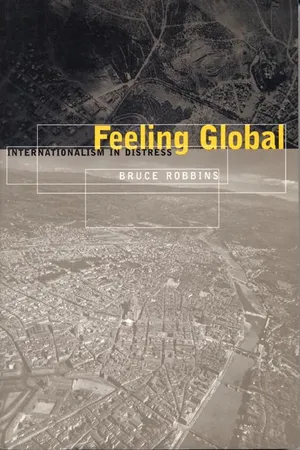
Is global culture merely a pale and sinister reflection of capitalist globalization? Bruce Robbins responds to this and other questions in Feeling Global, a crucial document on nationalism, culturalism, and the role of intellectuals in the age of globalization.
Building on his previous work, Robbins here takes up the question of the status of international human rights. Robbins' conception of internationalism is driven not only by the imperatives of global human rights policy, but by an understanding of transnational cultures, thus linking practical policymaking to cultural politics at the expense of neither. Robbins' cultural criticism, in other words, affords us much more than an understanding of how culture "shapes our lives." Instead, Robbins shows, particularly in his discussions of Martha Nussbaum, Richard Rorty, Susan Sontag, Michael Walzer and others, how "culture" itself has become a term that blocks—for commentators on both the right and the left—serious engagement with the contemporary cosmopolitan ideal of a nonuniversalist discourse of human rights.
Rescuing "cosmopolitanism" itself from its connotations of leisured individuals loyal to no one and willing to sample all cultures at will, Feeling Global presents a compelling way to think about the ethical obligations of intellectuals at a time when their place in the new world order is profoundly uncertain.
- 224 pages
- English
- ePUB (mobile friendly)
- Available on iOS & Android
eBook - ePub
About this book
Trusted by 375,005 students
Access to over 1.5 million titles for a fair monthly price.
Study more efficiently using our study tools.
Information

1
INTERNATIONALISM
IN DISTRESS
SUSAN SONTAG ON BOSNIA
In December 1995, Susan Sontag published an article in The Nation titled “A Lament for Bosnia: ‘There’ and ‘Here.’ ” Back in New York in the days after the Bosnian peace agreement in Dayton, Ohio, after her ninth stay in Sarajevo, Sontag finds herself “angry” that “people don’t want to know what you know, don’t want you to talk about the sufferings, bewilderment, terror, and humiliation of the city you’ve just left” (818). She is horrified at the “widespread indifference, or lack of solidarity … with the victims of an appalling historical crime, nothing less than genocide” (819). But her harshest words are reserved for the intellectuals, who have become “morosely depoliticized.” Why didn’t they go to Bosnia as George Orwell and Simone Weil went to antifascist Spain? Their “cynicism” and “nationalist complacencies,” their “reluctance to inconvenience themselves for any cause, their devotion to personal safety” are all signs of “a vertiginous decay of the very notion of international solidarity” (820).1
Anecdotal evidence suggests that for many readers, Sontag’s article occasioned a curious ambivalence. Most were inclined to agree about the tragedy in Bosnia—how much room for disagreement was there? Yet alongside respect for Sontag’s extraordinary individual effort, many also reacted with acute exasperation, and sometimes something worse. These mixed feelings are worth inquiring into. They seem likely to reveal something important about the resistance to internationalism, or why, as Sontag says, “only domestic political commitments seem plausible now” (820). They also point to some interesting questions about internationalism itself. How is it that so many versions of internationalism preach in a manner that inadvertently turns even the converted into sullen, gutlevel apostates? Is it possible to imagine an internationalist ethic that would be less distressing and more compelling?
The fact that genocide has happened and could happen again is a powerful argument in favor of international solidarity. But for this very reason, it cannot be representative of the case for international solidarity. Its power makes it too subject to abuse. The extreme case demands a special tact. When action is absolutely urgent, it is always already too late to indulge much curiosity about the details of the relevant site or to listen to the distracting variety of its voices. Any knowledge beyond the bare, accusing facts of recent atrocity seems beside the point. In Sontag’s Nation article, for example, actual Bosnians fade into the background; Sontag does not feel any need to quote them, even as survivors or witnesses.2 Who can blame her? But if this neglect of local perspectives were generalized, “cosmic” urgency would make internationalism itself provincial. The extreme case distorts the rest. Urgency also creates impatience with analogies to not-quite-genocidal situations such as those in Somalia and Haiti, where suffering and injustice were widespread but where the interventions that did happen were problematic in more than one respect. And it discourages memories of a previous moment when Sontag called for international solidarity: with Poland’s Solidarnosc (Solidarity) in 1982. That appeal included her declaration (self-evident for some, for others notorious) equating communism with fascism.3 Fascism produced genocide. Does it follow that, in Sontag’s eyes, support for Lech Walesa was as morally imperative as support for the Bosnians?
Claiming genocide’s moral absoluteness as her authority, Sontag does some sentimental bullying. She strong-arms the reader with an instant and powerfully simplifying exhortation: you must act! Or rather, now that it is too late: you must have acted. I have acted, Sontag tells us. I have gone to Sarajevo, not once but nine times. Not trips or visits but “stays”—nine of them. What about you? Were you “almost killed” (820), like Orwell and Weil when they went to Spain?4 Did you go without a bath for “several weeks” (818)? No, you did not, and there are reasons. Your moral lethargy is proportional to your affluence. You are a creature of “comfortable upper-bourgeois apartments and weekend country houses” (820), and you are loath to leave them. “In the era of shopping, it has to be harder for intellectuals, who are anything but marginal and impoverished, to identify with less fortunate others” (820).
For a prosperous intellectual celebrity, there is a real point here. It does not seem to have occurred to Sontag, however, that though some of her readers may possess luxurious and multiple residences, the majority do not. And very few are likely to enjoy the time, the personal autonomy, and the disposable income necessary for even one or two trips to Sarajevo, let alone nine. To a majority of readers, someone who has been to Sarajevo nine times, even to stage Waiting for Godot, is going to look pretty well off—certainly within that range of financial ease that “upper-bourgeois apartments and weekend country houses” indicate. Sontag suggests it is the poor who go and the rich who stay home. But her ethics presupposes a very different sociology: everyone must act, she implies, as if they were as free and as privileged as I am.
Some people suggested that self-interest lay behind Sontag’s stand, that her altruistic gesture disguised an opportunistic use of the sufferings of others. The phrase “photo op” came up in conversation with some frequency. Such insinuations tended to offer no evidence and seemed to assume that none was required. Yet they are something more than illustrations of contemporary cynicism. Sontag may be said to invite, if not necessarily to deserve, the mean-spirited, excessively personal treatment she receives. Trying, no doubt, only to put her personal newsworthiness to good use, she pushes herself on her readers as an explicit and unavoidable point of comparison with themselves. But when the moral authority behind Sontag’s exacting appeal to others is her account of her own behavior, that account becomes a legitimate and alluring target. Moreover, questioning Sontag’s motives is the reader’s almost inevitable line of self-defense when the demand for extraordinary sacrifice that Sontag claims to embody includes the risk of the reader’s life on behalf of a faraway conflict that little else in that life has prepared the reader to care about.
Such resistance to internationalism is all the more logical and predictable because extraordinary personal sacrifice is not obviously the best solution to the urgencies that Sontag announces. At least as Sontag presents and embodies it, such sacrifice has very little to do with effective action to stop the slaughter. Sontag herself is interested in going “there” and in the difficulty of telling us “here” what it feels like to be “there.” In other words, she is interested in travel, in self-exposure, and in how both should be narrated to the underexposed nontraveler. But her juicy experience of hardship and danger—an experience that she must walk away from in order to retell it afterward—seems a strange substitute for any analysis of possible or actual interventions. Should the United Nations have a standing army? Should the United States have acted without its NATO allies? How much did it matter that Bosnia in the 1990s, unlike Spain in the 1930s, no longer had a Communist (or Trotskyist or anarchist) movement giving to international solidarity a concrete organizational basis? The inconvenient fact that those who backed the Bosnians with more than empty words did so as Muslims has no place in her argument. Why should they not count as internationalists? Sontag gives no evidence of concern about political action—that is, about the agents, options, modes and costs of an effectual response, one that might make, or might have made, a difference.5
Who is supposed to answer Sontag’s call for intervention? Sontag doesn’t say. She leaves open the possibility that her intended interlocutor is, among others, the U.S. government. But intervening here, the U.S. government might also feel emboldened to intervene elsewhere, perhaps less benevolently. Thus “international solidarity” might do as much to reinvent post–cold war American nationalism as to help Bosnia. (This is by no means the end of the discussion, as I hope my Introduction suggested, but the possibility is worth raising.) There is something a bit sinister about concluding, as Sontag does, with a quotation from Émile Durkheim on the necessary role of idealism in the formation of societies. Sontag does not say that Durkheim lost his son during the First World War—as it happens, fighting in Bosnia. She does not say that though Durkheim spoke in favor of cosmopolitanism (rendered by his English translator as “world patriotism”), he also favored France’s entry into that war.6 Nor does she say that the idealistic intervention of the French state in Bosnia, which cost Durkheim and so many others their sons, betrayed a prior pan-European determination among social democratic parties not to let their respective populations be dragged into what they saw would be a meaningless and prolonged slaughter.7 Walter Lippmann, another pro-cosmopolitan who supported full participation in the First World War, offers an American parallel. Both figures suggest why a principled call for intervention by the U.S. or French states might be perceived as continuous or complicit with familiar and devastating forms of nationalism.
Instead of channeling her readers toward the dilemmas of appropriate political action, Sontag urges them to compare their everyday routines with her traveling. Her traveling is a process of alienation from ordinary life: an experience, as she says, of “bewilderment, terror, and humiliation.” Sontag complains of this, but she also presents it with some pride as rare and revealing. Such experience could have been presented otherwise. In the first chapter of his book Slaughterhouse, David Rieff describes his own return from Sarajevo and how he, too, felt “like an alien” in trying to take up his own life again. Yet he notes that he is “not alone in this,” that it is the usual case even for “seasoned war correspondents” (25).8 Sontag’s alienation is more likely to be perceived as self-aggrandizement, for it does not merely define her as a special sort of person but reaffirms the specialness for which she was already known. As she tells it, her sojourn in Bosnia becomes a model of avant-garde aesthetic experience. Its aim is the modernist aim of disorientation, defamiliarization, making strange. It is exotic, rare, uncomfortable. Like modernism in general, it is open only to the few, and it takes its aesthetic value—in part at least—from that very inaccessibility, that critical remoteness from the habits of the benumbed multitude. Sontag’s contempt for the stay-at-home is the contempt of the coterie tastemaker for the mass of the tasteless or insensitive, those who are incapable of the latest, deepest, most strenuous self-alienation, the most rigorous self-problematizing—those incapable, in short, of modernism’s version of aesthetic experience.
In sum, Sontag puts a number of more or less irritating distractions between her American reader and engagement with Bosnia. But are such distractions merely inconsequential flaws in one understandably fervent and perhaps hastily composed text? Or are they and the ambivalence they provoke to some extent constitutive of internationalism itself as a rhetorical and political enterprise—one that oddly joins ethical urgency with aesthetic and geocultural distance, normative pressure with emotional eccentricity, self-privileging with the impulse to expand the geography of democracy?
Each of the points I raise about Sontag—points that help explain the resistance to her version of internationalism—marks an unresolved question, an area in which one cannot simply refuse Sontag’s option or espouse its opposite. If her universalism combines with the urgency of action to produce a certain absence of curiosity about the cultural diversity of the world, it is also true that respect for cultural diversity alone provides neither a guide or an incentive to action, on the one hand, nor the sort of common ground that would raise a pluralism of internationalisms above the pluralism of nationalisms that posed the original problem, on the other hand. Sontag’s internationalism is based on a problematic domestic sociology, one that adds to already existing tensions between “elites” and “nonelites” as well as tensions within the category of intellectuals. But it also appeals to celebrity intellectuals to follow her example—surely one of the better things that might be done with celebrity. Taking one’s distance from Sontag is by no means as easy as it may appear.
GLOBAL CULTURE IS ORDINARY
The term internationalism has a number of diverse and overlapping meanings. In its standard international relations sense, it can be defined as the belief, to quote Kjell Goldmann, “that international peace and security benefit if international institutions are strengthened and cooperative ties multiply across borders.”9 As Goldmann notes, this meaning, while widely shared among policy makers and political scientists around the world, is distinct from the most frequent sense in the United States: internationalism as support for an active foreign policy, for the state’s foreign entanglements and interventions—that is, “the opposite of isolationism” (2).10 And both meanings must be distinguished from a more ethical or sentimental, less policy-oriented sense of the word that is also current and that comes closest to Sontag: “concern with far-away peoples in distress” (2).
Each of these meanings has a record of creating distress in its domestic addressees. Internationalism in the first, global-governance sense is high on the hate list of the paranoid militias, who associate it with an imminent takeover of the United States by the United Nations or some other agent of transnational conspiracy. But it causes unease in many of the rest of us as well. The American, state-centered sense also tends to sound paternalistic, insensitive to ordinary experience, too oriented—this is the price paid for its privileged intimacy with “real” politics—to the viewpoint of the world’s decision makers. Both conceptions of internationalism provoke a hostility among the ruled, in part because they assume the viewpoint of those with the power to dictate action at or beyond the level of the state and fail to address the feelings and values of those who cannot easily or naturally adopt that viewpoint.
In the first two senses, then, internationalism needs help. Thus the ethical and sentimental dimensions that Sontag adds are not a diversion into the luxuries of philanthropy. There may well be a problem of “people knowing so little and feeling so much” (42), as Rieff puts it, but for better or worse, internationalism demands feeling as well as knowing, or feeling combined in some proportion with knowing, if it is going to rouse any support. At minimum, a transnationally shaped and educated sentiment is a necessary means of winning democratic consent for a particular set of policies.11 This is what Richard Falk had in mind when he noted, apropos of Bosnian intervention in 1993, the “absence of a compassionate ethos—even in relation to Europe itself… Serious intervention presupposes a different political ethic than currently exists in any country, and if leaders attempted to mount such a campaign without a convincing strategic justification, they would encounter overwhelmingly hostile public opinion” (758).12 Without an internationalist ethic or culture, an internationalist politics will not emerge, or will have little power to diverge creatively or generously from the national interest as the latter is narrowly and strategically construed. Instead of beating Sontag’s internationalism over the head for being moral or sentimental—in other words, for not being policy—it is useful to recognize that the moral and sentimental domain is a constituent and precondition of policy and thus to set about discriminating and criticizing the styles or options for internationalism within that domain.
The third sense of internationalism might be called cultural internationalism or cosmopolitanism. The term cosmopolitanism is ordinarily taken to differ from internationalism in its emphasis on individuals rather than collectivities, and on aesthetic spectatorship rather than political engagement. For better or worse, it is correspondingly accorded greater independence than internationalism from the system of nation-states, and it is judged to waver between an antinationalist politics, a specifically cultural politics, and no politics at all. These ambiguities are not simply liabilities. They help respond to the further question of whether, by its historical associations, the contrasting term internationalism is not too strongly political to describe recognitions and solidarities that are perhaps less organized, more ad hoc than the word politics usually implies. The worldliness into which we are now hesitantly venturing mixes the ethical, the political, and the cultural in proportions that are too obscure, too unstable, and too novel to allow any easy escape from such dilemmas. To focus on the hypothesis of a political or protopolitical mobilizing of feeling and effort at the international scale, I use the terms cosmopolitanism and cultural internationalism here as rough synonyms.
As I have suggested, Sontag’s cultural internationalism, too, creates distress nearby while (or by) pointing at the need to relieve it in the distance. Her internationalism can be described as cultural in several senses: first, it is centered on the staging of a play, Waiting for Godot, a monument of modern European culture that reaffirms the common membership in that culture of the secular, cosmopolitan Bosnian society that was under attack; second, it uses publicity as its main weapon; third, it addresses morals and sentiments rather than agents and policies. One might argue that, to some extent, it creates distress merely by being cultural—in other words, by working in a mode that is visibly severed from other, larger possibilities of remedial or revolutionary action. This is Sontag’s own argument against photography: “Photographing is essentially an act of non-intervention. Part of the horror of such memorable coups of contemporary photojournalism as the pictures of the Vietnamese bonze reaching for the gasoline can, of a Bengali guerrilla in the act of bayoneting a trussed-up collaborator, comes from the awareness of how plausible it has become, in situations where the photographer has the choice between a photograph and a life, to choose the photograph.”13 It is also her case against the cosmopolitan hero of her novel The Volcano Lover, a cultivated aesthete and collector who fails the crucial test of intervention that Naples’s 1798 revolution drops in his lap. The cosmopolitan does not go to Sarajevo.
But in another sense, the point is not that Sontag’s internationalism is too cultural but rather that it is inadequately or ...
Table of contents
- Cover Page
- Title Page
- Copyright Page
- Dedication
- Contents
- Acknowledgments
- Introduction
- 1. Internationalism in Distress
- 2. Some Versions Of U.S. Internationalism
- 3. The Weird Heights
- 4. Feeling Global
- 5. Upward Mobility in the Postcolonial Era
- 6. Secularism, Elitism, Progress, and Other Transgressions
- 7. Sad Stories in the International Public Sphere
- 8. Root, Root, Root
- Afterword
- Notes
- Index
- About the Author
Frequently asked questions
Yes, you can cancel anytime from the Subscription tab in your account settings on the Perlego website. Your subscription will stay active until the end of your current billing period. Learn how to cancel your subscription
No, books cannot be downloaded as external files, such as PDFs, for use outside of Perlego. However, you can download books within the Perlego app for offline reading on mobile or tablet. Learn how to download books offline
Perlego offers two plans: Essential and Complete
- Essential is ideal for learners and professionals who enjoy exploring a wide range of subjects. Access the Essential Library with 800,000+ trusted titles and best-sellers across business, personal growth, and the humanities. Includes unlimited reading time and Standard Read Aloud voice.
- Complete: Perfect for advanced learners and researchers needing full, unrestricted access. Unlock 1.5M+ books across hundreds of subjects, including academic and specialized titles. The Complete Plan also includes advanced features like Premium Read Aloud and Research Assistant.
We are an online textbook subscription service, where you can get access to an entire online library for less than the price of a single book per month. With over 1.5 million books across 990+ topics, we’ve got you covered! Learn about our mission
Look out for the read-aloud symbol on your next book to see if you can listen to it. The read-aloud tool reads text aloud for you, highlighting the text as it is being read. You can pause it, speed it up and slow it down. Learn more about Read Aloud
Yes! You can use the Perlego app on both iOS and Android devices to read anytime, anywhere — even offline. Perfect for commutes or when you’re on the go.
Please note we cannot support devices running on iOS 13 and Android 7 or earlier. Learn more about using the app
Please note we cannot support devices running on iOS 13 and Android 7 or earlier. Learn more about using the app
Yes, you can access Feeling Global by Bruce Robbins in PDF and/or ePUB format, as well as other popular books in Social Sciences & Sociology. We have over 1.5 million books available in our catalogue for you to explore.