“Cherry and Lerman have written a compelling book that challenges the orthodoxies of both the political ‘left’ and ‘right’, and that promotes a set of policies to improve the economic status of lower-to-middle income working families. All who care about the well-being of working families will learn a great deal from their analysis.”
—Harry Holzer, Professor of Public Policy, Georgetown University
“Offers highly sophisticated proposals for helping working families advance in the wake of welfare reform. Cherry and Lerman are very expert, and they write very well.”
—Lawrence M. Mead, Professor of Politics and Public Policy, New York University
Even as our political system remains deeply divided between right and left, there is a clear yearning for a more moderate third way that navigates an intermediate position to address the most pressing issues facing the United States today. Moving Working Families Forward points to a Third Way between liberals and conservatives, combining a commitment to government expenditures that enhance the incomes of working families while recognizing that concerns for program effectiveness, individual responsibility, and underutilization of market incentives are justified.
Robert Cherry and Robert Lerman provide the context to understand the distinctive qualities of Third Way policies, focusing on seven areas that substantially affect working families: immigration, race and gender earnings disparities, education, housing, strengthening partnerships, and federal taxes. Balancing empirical studies with voices of working class people, they offer an important perspective on how public policies should be changed. A timely approach, Moving Working Families Forward makes policy recommendations that are both practical and transformative.
eBook - ePub
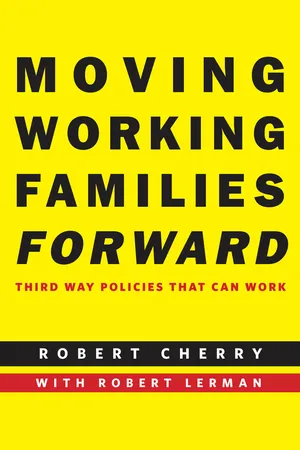
Moving Working Families Forward
Third Way Policies That Can Work
- 263 pages
- English
- ePUB (mobile friendly)
- Available on iOS & Android
eBook - ePub
About this book
Information
Subtopic
Politique1
A Third Way Perspective
Deep conflicts over public policy persist not simply between Republicans and Democrats but also within the Democratic Party. This book highlights these intra-Democratic differences. It points to a “Third Way” between the left-liberal wing of the Democratic Party and conservatives who dominate the Republican Party. These policies are crucial given the current economic malaise that persists, and the divided Congress that must find common ground.
With persistent near-double-digit official unemployment rates, with record levels of long-term joblessness, more must be done to aid working families. But almost from the start, the Obama administration has had to struggle with Congress. In the middle of 2010, almost a year after the recession was officially over and economic growth had begun, there were almost five unemployed workers for every job opening. This was almost double the ratio during the worst of the economic slowdown at the beginning of the decade. Despite this, Republican senators balked at extending unemployment insurance. As a result, over 2 million of the more than 5.5 million unemployed workers who qualified for unemployment insurance had their benefits temporarily halted. Thankfully, Democrats were able to successfully extend benefits for another four months.1
But even when President Obama has been successful at extending federal benefits, state and local officials did not follow suit. While the number of families receiving federally funded food stamps increased substantially at the beginning of the recession, states minimally increased the number of families collecting cash assistance. “There is ample reason to be concerned here,” said Ron Haskins, a former Republican congressional aide who helped write the 1996 law overhauling the welfare system. “The overall structure is not working the way it was designed to work. We would expect, just on the face it, that when a deep recession happens, people could go back on welfare. When we started this, Democratic and Republican governors alike said, ‘We know what’s best for our state; we’re not going to let people starve,’” said Mr. Haskins, who is now a researcher at the Brookings Institution in Washington. “And now that the chips are down, and unemployment is going up, most states are not doing enough to help families get back on the rolls.”2
Much of this resistance reflects a conservative ideology that emphasizes individual responsibility. This was most clear when some state and local officials refused to adjust policies even when the cost would be picked up by the federal government. Texas and South Carolina governors rejected federal stimulus funds that required them to relax unemployment compensation rules that would have allowed more unemployment workers to qualify for benefits. These proposed procedures were already in place in twenty states and were helping many lower-waged workers.
Even the more moderate Mayor Michael Bloomberg of New York City refused federal funds for a food stamp expansion because it conflicted with his notion of encouraging self-sufficiency. Cognizant of the economic downturn, the federal stimulus plan entitled able-bodied single adults without dependents to remain eligible to receive food stamps until September 2010. This overturned present law, which limited these recipients to a guaranteed food stamp entitlement of only three months in a three-year period. Mr. Bloomberg would extend benefits beyond three months only if these adults enrolled in the city’s workfare program, which offers some training, some internships, and some low-level work. A New York Times editorial lamented, “We can understand the mayor’s ideal of ‘work, not welfare,’ but this is not a time to be stingy with food, especially if Washington is picking up the tab.”3
These conservative responses to the problems faced by the less fortunate can be callous, but some left-liberal responses are also questionable. In our view, they overly emphasize the need for more government spending and too often minimize the importance of influencing individual behavior. As a result, we believe that the necessary policies to advance the economic well-being of working families must reflect a Third Way.
There are three important parameters that distinguish the Third Way: the importance of personal responsibility, structural impediments, and financial incentives. On one end of the political spectrum are conservatives. They emphasize the importance of personal responsibility and believe that individuals should rely on and will benefit from a competitive free-market system.
At the other end of the political spectrum are left liberals. While there are certainly variations among them, most left liberals generally minimize any notion of personal responsibility, which they characterize as “blaming the victims,” and instead see profit-seeking motives as the source of problems. They focus on examples of market exploitation: underpayment of workers, overcharging of consumers, and predatory lending in low-income areas.
The Third Way navigates an intermediate position between these two poles. While supporting policies to limit market excesses, Third Way proponents also find opportunities to use market incentives to aid working people. While personal responsibility should be encouraged, Third Way proponents believe that the government must provide significant supports that enable working people to move forward—supports that require substantial government resources.
Third Way proponents also identify important structural impediments that will hold back personal advancement in the absence of government initiatives. Most important has been the potentially damaging impact that poverty has on the long-term outlook for children, especially those living in single-parent households. As a result, Third Way proponents support a range of policies to strengthen low-income families.
Third Way proponents also contend that technological changes have created important impediments to the upward mobility of many working people. These changes have made most manufactured goods cheaper to produce in suburban industrial parks or abroad rather than in central cities, where most low-income families still live. In addition, technological innovation, by increasing the sophistication of machines, has increased the educational requirements for even those who are employed in traditional blue-collar vocations. Thus, these skill and locational changes have added to employment difficulties, particularly those faced by less educated central-city workers.
More generally, the Third Way has a left-liberal commitment to government funding that enhances the incomes of working families while at the same time recognizing that conservative concerns for program effectiveness and individual responsibility are sometimes justified. Government must be both compassionate and competent. In addition, including conservative recommendations can avoid some of the contentious distractions that reliance on ideological purity often causes, something that is particularly important with a divided Congress.
New York Times columnist David Brooks noted that the conservative perspective, which rejects the role of government, has lost its hold on the American populace. He wrote, “The emphasis on freedom and individual choice may work in the sparsely populated parts of the country. People there naturally want to do whatever they want on their own land. But it doesn’t work in the densely populated parts of the country: the cities and suburbs where Republicans are getting slaughtered. People in these areas understand that their lives are profoundly influenced by other people’s individual choices.”
He then pointed out that there are two relevant visions of the role of government within the Democratic Party. One vision—what we have labeled left liberalism—rejects reliance on the market and instead has “teams of experts draw up plans to engineer order wherever problems arise. And there is the more centrist vision in which government sets certain rules, but mostly empowers the complex web of institutions in which the market is embedded.”4
In each of the policy areas to be discussed the Third Way approach will contrast with the recommendations made by most conservatives and left liberals. Our recommendations will rely heavily on research findings. Let us simply state here some of these differences so that the reader can better understand the Third Way perspective. For example, we reject the nativist if not racist sentiment that energizes many within the anti-immigration movement. We are also uncomfortable, however, with left liberals who dismiss the legitimate grievances against legalizing and expanding low-wage immigration. We take seriously the unintended harmful effects that this pattern of immigration has on state and local budgets and on the employment of less educated native-born workers.
Similarly, we reject conservative attempts to stifle government-funded educational programs that would help many blacks and women gain a foothold in the middle class. We believe, however, that some of the initiatives emphasized by left liberals are inconsistent with benefit-cost assessments: too much money will be spent with few positive results. In particular, we believe that four-year college degree goals have been overly emphasized at the expense of occupational training at community colleges. We find that many students who fail out of academic programs could have succeeded at occupational ones.
One final example is the workings of the labor market. Conservatives believe that competition forces firms to pay workers fairly. If one employer seeks to underpay his workers, other less exploitive firms will bid these workers away. They believe that wage disparities reflect solely differences in skills and motivation. As a result, they reject government interference with employment decisions, such as through Equal Employment Opportunity (EEO) regulations or legislation to facilitate unionization.
By contrast, most left liberals believe that race and gender wage gaps are dominantly the result of direct and indirect discrimination so that they focus on strengthening government antidiscrimination efforts. In addition, many believe that wages are determined by a struggle between capital and labor so that unions and government-mandated wage policies, including living-wage and minimum-wage legislation, are the most important ways to raise the economic well-being of working people.
The Third Way certainly believes that EEO policies have been an important vehicle for limiting discriminatory labor market behavior and should be strengthened in labor markets for less educated workers. And unions and government-mandated wage policies have played a positive role. But Third Way advocates also believe that in large part race and gender wage gaps reflect behavioral and structural factors. In particular, improving both soft and hard skills among black men can substantially reduce racial earnings disparities among men with less than four-year degrees. Similarly, Third Way advocates focus on policies that enable working-class women to better balance work and family. These policies include better child care arrangements and strengthening partnerships relationships to encourage marriage or long-term cohabitation.
Most important, Third Way advocates believe that there has been too great an emphasis on maximizing the number of four-year college graduates. In pursuit of this goal, left liberals discourage occupational training in high schools and community colleges. They fear that providing attractive occupational programs will inevitably track low-income students into low-wage, dead-end jobs, reproducing poverty in another generation. They ignore evidence that weakly prepared high school graduates do not have the academic skills necessary to pursue college-level work, resulting in very low college graduation rates. They ignore evidence that when community colleges do not provide these programs, many low-income blacks and Latinos seek them at private, for-profit schools that often saddle students with loans and problematic employment credentials.
Finally, Third Way advocates believe that left liberals focus too much on raising wages through either government mandates or union efforts. By contrast, Third Way advocates believe that because of firm mobility and the skill deficiency of workers, government supplements like the Earned Income Tax Credit (EITC) may be a more effective way to raise incomes of struggling working families.
Targeting Working Families
Now that we have given some sense of the perspective that will underpin the policy recommendations to be proposed in this book, some understanding of the target population will be useful. Every politician espouses concern for working families, but few explicitly identify whom they exclude. For example, President Obama’s working families only exclude those making more than $250,000—less than 5 percent of all families. This book identifies a much smaller subset of families: those that have annual incomes below $70,000. This subset includes the officially poor—those with incomes below $20,000; the near-poor—those with incomes between $20,000 and $40,000; and the lower middle class—those with incomes above $40,000 but no higher than $70,000.
In 2007, 55 percent of all families but only 46 percent of married-couple families had incomes below $70,000 so that this threshold reflects a rough calculation of the median income of all families nationally. The $20,000 figure closely matches the current government income threshold for judging the official poverty rate. In 2009, families with one adult and two children were officially poor if their income was below $17,285; for families with two adults and two children, the poverty-line threshold was $21,756.5
In 2009, 43.6 million people, or 14.3 percent of all U.S. residents, were classified as poor. Virtually all researchers believe that the official poverty-line thresholds are outmoded. Indeed, the Census Bureau calculates poverty rates for a number of alternative measures, all of which are higher than the official cutoffs. Depending upon how out-of-pocket medical expenses and adjustments for geographic location are treated, alternative poverty measures can be significantly higher than the official rate.
It should also be noted that the government’s measure of family income may be too low. Specifically, it does not include current refundable tax benefits like the EITC and child credit that add substantially to the purchasing power of low-income families. If the government used a measure of disposable income, with its current income cutoffs, poverty rates would decline by about 25 percent.6
According to a range of studies, the share of families that experience material hardships declines as income increases. Material hardships persist, however, in a significant share of families until income rises above twice the poverty-line thresholds.7 These material hardships include going without a meal because of lack of income at least once in the past month or having some utility turned off for lack of payment during the last year. Thus, the $40,000 threshold was chosen to identify near-poor households whose incomes are above the poverty cutoffs but less than what is necessary to fully escape material hardships.
Not surprisingly, the distribution of income is different for families headed by a married couple and those headed by a woman with no husband present. In 2007, 34.3 percent of female-headed families but only 6.6 percent of married-couple families were poor (figure 1.1). By contrast, 32.6 percent of married-couple families but only 6.3 percent of female-headed families are in the upper middle class: those families with incomes over $100,000. Indeed, only 15.2 percent of female-headed families had incomes above $70,000.8

Figure 1.1. The share of each family type across income groups, 2007

Figure 1.2. Characteristics of married families across income groups, 2007
Married couple families constitute 39.6 percent of all poor households and 62.4 percent of all near-poor households (figure 1.2). These low-income married-couple families are characterized by very low employment of wives. In poor and near-poor married-couple families, the share of wives who are employed is 20.6 and 33.0 percent, respectively. By contrast, for lower-middle-class and middle-class married-couple families, the share is 61.7 and 77.6 percent, respectively.
For many of these married couples, the low income that they are experiencing may ...
Table of contents
- Cover Page
- Title Page
- Copyright Page
- Dedication
- Contents
- Acknowledgments
- 1 A Third Way Perspective
- 2 Employment Growth: Its Strengths and Limitations
- 3 Evaluating Targeted Policies
- 4 Combating Racial Earnings Disparities
- 5 Combating Gender Earnings Disparities
- 6 Refocusing Community College Programs
- 7 Strengthening Partnerships
- 8 Revising Government Tax Policies
- 9 Redirecting Immigration Policies
- 10 Recasting Housing Subsidies
- 11 The Politics of Reform
- Notes
- Index
- About the Authors
Trusted by 375,005 students
Access to over 1.5 million titles for a fair monthly price.
Study more efficiently using our study tools.
Frequently asked questions
Yes, you can cancel anytime from the Subscription tab in your account settings on the Perlego website. Your subscription will stay active until the end of your current billing period. Learn how to cancel your subscription
No, books cannot be downloaded as external files, such as PDFs, for use outside of Perlego. However, you can download books within the Perlego app for offline reading on mobile or tablet. Learn how to download books offline
Perlego offers two plans: Essential and Complete
- Essential is ideal for learners and professionals who enjoy exploring a wide range of subjects. Access the Essential Library with 800,000+ trusted titles and best-sellers across business, personal growth, and the humanities. Includes unlimited reading time and Standard Read Aloud voice.
- Complete: Perfect for advanced learners and researchers needing full, unrestricted access. Unlock 1.5M+ books across hundreds of subjects, including academic and specialized titles. The Complete Plan also includes advanced features like Premium Read Aloud and Research Assistant.
We are an online textbook subscription service, where you can get access to an entire online library for less than the price of a single book per month. With over 1.5 million books across 990+ topics, we’ve got you covered! Learn about our mission
Look out for the read-aloud symbol on your next book to see if you can listen to it. The read-aloud tool reads text aloud for you, highlighting the text as it is being read. You can pause it, speed it up and slow it down. Learn more about Read Aloud
Yes! You can use the Perlego app on both iOS and Android devices to read anytime, anywhere — even offline. Perfect for commutes or when you’re on the go.
Please note we cannot support devices running on iOS 13 and Android 7 or earlier. Learn more about using the app
Please note we cannot support devices running on iOS 13 and Android 7 or earlier. Learn more about using the app
Yes, you can access Moving Working Families Forward by Robert Cherry,Robert Lerman in PDF and/or ePUB format, as well as other popular books in Politique et relations internationales & Politique. We have over 1.5 million books available in our catalogue for you to explore.