The uneasy link between tourism and collective memory at Holocaust museums and memorials
Each year, millions of people visit Holocaust memorials and museums, with the number of tourists steadily on the rise. What lies behind the phenomenon of "Holocaust tourism" and what role do its participants play in shaping how we remember and think about the Holocaust?
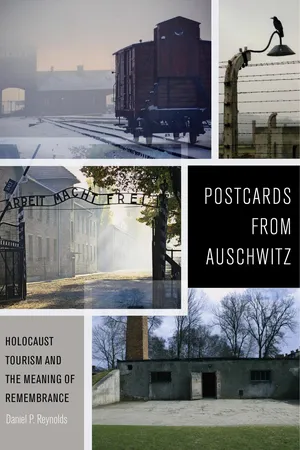
In Postcards from Auschwitz, Daniel P. Reynolds argues that tourism to former concentration camps, ghettos, and other places associated with the Nazi genocide of European Jewry has become an increasingly vital component in the evolving collective remembrance of the Holocaust. Responding to the tendency to dismiss tourism as commercial, superficial, or voyeuristic, Reynolds insists that we take a closer look at a phenomenon that has global reach, takes many forms, and serves many interests.
The book focuses on some of the most prominent sites of mass murder in Europe, and then expands outward to more recent memorial museums. Reynolds provides a historically-informed account of the different forces that have shaped Holocaust tourism since 1945, including Cold War politics, the sudden emergence of the "memory boom" beginning in the 1980s, and the awareness that eyewitnesses to the Holocaust are passing away. Based on his on-site explorations, the contributions from researchers in Holocaust studies and tourism studies, and the observations of tourists themselves, this book reveals how tourism is an important part of efforts to understand and remember the Holocaust, an event that continues to challenge ideals about humanity and our capacity to learn from the past.
eBook - ePub
Postcards from Auschwitz
Holocaust Tourism and the Meaning of Remembrance
- 336 pages
- English
- ePUB (mobile friendly)
- Available on iOS & Android
eBook - ePub
Postcards from Auschwitz
Holocaust Tourism and the Meaning of Remembrance
About this book
Trusted by 375,005 students
Access to over 1.5 million titles for a fair monthly price.
Study more efficiently using our study tools.
Information
PART I
Tourism at the Camp Memorials
1
Listening to Auschwitz
A dozen SS men stood around, legs akimbo, with an indifferent air. At a certain moment they moved among us, and in a subdued tone of voice, with faces of stone, began to interrogate us rapidly, one by one, in bad Italian.… And on the basis of the reply they pointed in two different directions.
Everything was silent as an aquarium, or as in certain dream sequences. We had expected something more apocalyptic: they seemed simple police agents. It was disconcerting and disarming.
—Primo Levi, Survival in Auschwitz (1996), describing his arrival at Auschwitz in January 1944
It is a stunningly beautiful sunny day with a light refreshing breeze. The mountains in the distance—which we came through yesterday on the train—can be seen through a light mist; just as the prisoners here could have seen them.
—Martin Gilbert, Holocaust Journey (1997), describing a visit to Auschwitz-Birkenau in the summer of 1996
In June 2007, a group of colleagues and I traveled to some of the most important Holocaust memorials in Europe, including the Auschwitz-Birkenau Memorial and Museum. For most of us, myself included, it would be our first trip to Poland, let alone to an extermination camp. A few days before our tour of Auschwitz, we met in Warsaw with Konstanty Gebert, a prominent Polish journalist and a member of the local Jewish community. Gebert was known for his antigovernment activism during Communist Party rule, and since the end of Communism he has worked persistently to improve relations between Poland’s majority Catholics and its estimated 20,000–30,000 Jews, about 5,000 of whom live in the capital today.1 While discussing his ongoing work with us, Gebert ended our conversation with an unexpected admonition about our itinerary: “Don’t go to Auschwitz,” he told us. When we asked him to elaborate, he expressed dismay at the conversion of the most notorious death camp into a tourist destination. He shared with us his concern that many tourists were poorly prepared for the visit and thus unable to appreciate either the spiritual or historical import of a site that was, in essence, a massive cemetery. He referred also to the heavy traffic of noisy school groups and vacationing tourists arriving in caravans of buses that, in his view, brought irreverence to a place of immeasurable suffering. The presence of tourists in all their vulgarity was, for Gebert, inappropriate to the site’s significance as a cemetery, a place that demanded piety and respect.
In an article describing an invitation to lead a group of Jewish tourists from the United Kingdom on a day trip to Auschwitz in 1999, the art historian Griselda Pollock anticipates Gebert’s misgivings about tourism and describes her reasons for ultimately deciding not to go. Her explanation echoes Gebert’s, but she frames it in more personal terms: “Many considerations constrained me: The short notice, the responsibility for ‘education’ for such a group of British Jewish visitors to these sites, the condition of travel.… Most of all, there was a conviction that I should never go to Auschwitz.”2 In a footnote, Pollock also notes her misgivings about being “taken around by Polish guides, with little special attention or sensitivity to the meaning the site has for visitors who are Jewish.”3 Pollock elaborates on her conviction to stay away:
I am certainly too scared. At a personal level, the terror of being that close to that danger threatens me too unbearably. At a less unpredictable level, I am perplexed at the ethics of going to, visiting, touring a place whose all too real and still powerfully symbolic function was to be a horrific terminus, the end of a line, the factory of death, a place from which none was intended to return.4
Pollock’s reasons for declining the invitation are abundantly clear. Her sense of fear at the proximity to terror identifies an anxiety shared to varying degrees by many who consider such travel, whether they go in the end or not. She articulates the heightened sense of threat faced by many Jewish travelers to the site, who arrive knowing that the place would have meant their own death at another time or that it was the place where friends or relatives were indeed murdered. But Pollock’s understandable existential fears about the horror of Auschwitz are accompanied by other anxieties related to the appropriateness of tourism. By placing the word “education” in scare quotes, she doubts whether a day trip to the camp can truly deepen tourists’ understanding about the Holocaust; by doing so, she reflects a common skepticism toward tourism as insufficiently intellectual. Above all, it is the notion that the tourist enters and leaves, almost casually, that Pollock finds incompatible with the meaning of that site, resulting in her ethical concerns about tourism to Auschwitz.
To be fair, Pollock does not condemn all travel to Auschwitz. She contrasts the day trip she declined with the experience of her son, who traveled to Auschwitz as “part of a planned educational tour of formerly Jewish Eastern European sites, organized for teenagers.”5 Acknowledging the preparation that informs these travels, Pollock suggests a spectrum between tourism and pilgrimage, with educational tours located at some “intermediary subject position” between the two.6 Intertwined in her ethical considerations are two related yet different questions. Alongside the question of whether to go is the question of who should go. Implicit in Pollock’s distinction between tourists and pilgrims is a presumed lack of preparation or inappropriate motivation on the part of the former in comparison to the latter. Her chief concern is that tourists, those unreflecting consumers of mass culture, lack the ability to appreciate the distinction between the site as it exists today and the historical event it commemorates. Pollock positions the “touristic” as the “default condition to which representation will recur unless a crucial distinction is made between the place that can be visited and left, and the problematic burned into Western European culture by what Paul Celan simply called ‘that which happened’, the event.”7 In other words, tourists conflate the place of Auschwitz as it currently exists with its operation as an extermination camp roughly seventy years ago; legitimate visitors, on the other hand, somehow appreciate that the current place is a representation of the past, not the past itself.8 Her characterization consigns the tourist to the superficial endpoint of a spectrum whose other end is the deep historical and ethical awareness embodied by visitors with a legitimate reason for being there. Beyond the stereotypically diminished intellect Pollock ascribes to tourists, there is also a barely concealed exclusivity in her approach to the question of who should go to Auschwitz, whereby only those connected to the site through family history, group identity, or formalized education are ethical actors. All others who travel to Auschwitz are tourists, exemplifying the worst aspects of a superficial, consumerist approach to history. Pollock asks important questions, but her conclusions seem to be based on unflattering—and ultimately unsatisfying—assumptions about tourism, assumptions that are widely shared.
Shared, in fact, by our own group as we planned our trip to Poland. While my colleagues and I asked ourselves many of the same questions about seeing Auschwitz, we ultimately decided to go. Our itinerary had been planned months before Gebert’s admonition, and we had spent considerable time reflecting on our reasons for going well before our meeting with him in Warsaw. Like Pollock’s validation of her son’s visit, we justified ours in the name of education. At some level our trip was based on the belief that there was something to be gained by being there, something perhaps to be learned and subsequently shared with our students and with those who read our work. We knew we wanted to see the place, but first we felt we had to legitimate our gaze.
Without knowing it, our search for a label other than “tourist” had repeated a trope that typifies many academic reflections on travel not only to Auschwitz but also to other places where tourists go. Characterized by the anthropologist David Brown in the formula “They are tourists, I am not,” the distinction between legitimate travelers (scholars, students, pilgrims) and casual travelers exemplifies an almost ritualized exercise in self-justification that my group was reenacting.9 By cleansing oneself of any affiliation with tourism, one legitimates travel by invoking more respectable terms. That is not to erase any distinctions between the anthropologist’s extended immersion in a non-native culture, a historian’s immersion in a distant archive, or a language student’s immersion in a foreign tongue, on the one hand, and the (presumably typical) tourist’s often-cursory encounter, on the other. Rather, it is to ask in greater specificity how they are different, but also how they are the same. What goes unacknowledged in the invocation of the “They are tourists, I am not” formula is that tourism can vary in lengths of stay, degrees of preparation, and impact on the traveler’s life. Furthermore, given the growth of tourism worldwide and the emergence of new forms of it, such as eco-tourism or service tourism, the reliance on stereotypical characterizations of tourists that deny the legitimacy of their travels appears increasingly simplistic.10

Figure 1.1. The gathering point for the tour at the Auschwitz-Birkenau Memorial and Museum, just outside the main entrance at Auschwitz I, July 2012. Tourists have already entered the terrain once occupied by the Nazi camp, as illustrated by enlarged aerial photos on large placards at the back left. A concession stand and bookstore are at the rear right. Photo by the author.
The remainder of this chapter explores in greater depth the “who” question as it relates to tourism at Auschwitz. If, as Pollock suggests, the ethics of Holocaust tourism asks travelers to consider their subject position, I would argue that dichotomies between the tourist and the pilgrim, the tourist and the educator, or other modulations of the “they are tourists, I am not” formula are inadequate to capture the motives, identities, and experiences of visitors to this site. Such formulations put tourism into an all-too-predictable binary relationship with other roles that are presumed to be more legitimate. I will argue instead for a concept of the tourist that is inclusive of numerous, fluid, and even contradictory subjectivities, ranging from the pilgrim and the researcher to the uninformed and the morbidly curious. To arrive at a more complex view of present-day tourism to Auschwitz, I explore how the site itself has developed over time. The aim is to demonstrate that the space of Auschwitz is itself fluid, meaning that it has developed over time and that it continues to respond to both the ethical imperatives of history and the political/economic exigencies of the tourist industry. This condition of flux is, I contend, apparent to tourists in a number of ways because the memorial openly acknowledges its ongoing evolution.
After summarizing the history of Auschwitz as a memorial, I shift into a discussion of the kinds of insights tourists can gain by visiting Auschwitz today. This approach relies in part on a phenomenology of tourism that emphasizes how sensory perception of the space can produce knowledge. As many scholars have acknowledged, tourism relies heavily on vision, but it would be a mistake to reduce the perceptions available to tourists to sight—smells, sounds, temperatures, and other non-visual sensory experiences shape the tourist’s experience at Auschwitz as well, and not necessarily in expected ways.11 By giving an account of the tourist’s encounter with the memorial space of Auschwitz, I examine how tourists are invited to reflect on their relationship to the Holocaust, both in terms of the event experienced by those who were there from 1941 to 1945 and as a collective memory in the present. I frame this reflection in terms of bearing witness, asking how tourists to places like Auschwitz receive and process testimony from the past. Tourists do not arrive as blank slates but as socially and politically situated subjects with different degrees of historical knowledge who bring expectations to Auschwitz and other such memorials, hoping that they will acquire some new or deeper understanding of the murder of six million Jews. By hoping to access the space of an event that is temporally beyond reach, tourists search for an immediacy they may not find in literature, film, or other media. The degree to which expectations are fulfilled affects the nature of bearing witness through tourism.
Historically, tourists to Auschwitz have embodied multiple and even contradictory identities, both over time and across its terrain. This variety of tourist experiences belies the categorization in so much scholarship of visitors as either tourists or pilgrims (or some other term in a binary opposition). Instead of the stale tourist/pilgrim (or tourist/student, tourist/scholar, tourist/artist) dichotomy, which merely recapitulates the “they are tourists, I am not” scheme, witnessing offers a framework that is especially relevant for Auschwitz and possibly explanatory of its evolution as a memorial site. The focus on witnessing does not magically resolve the tension between the tourist and the pilgrim; instead, it focuses on what the visitor perceives at Auschwitz in relation to the suffering of prisoners, the brutality of perpetrators, or the indifference of others. Since tourists arrive after the event being memorialized, actual witnessing seems at first to be impossible. But if we explore the concept somewhat further, thinking of witnessing as an intersubjective, communicative mode of transferring knowledge, there is some merit in characterizing tourism to Auschwitz as such.12 The claim of witnessing needs to overcome the inescapable temporal gap that separates tourists from the perpetrators and victims. If tourists are called to bear witness, what or who takes the place of the dead whose testimony they seek? The history of the memorial may offer clues that begin to answer that question.
Auschwitz as Memorial and Museum: The Postwar Era
Like other Nazi concentration and extermination camps, Auschwitz has existed as a memorial and museum far longer than it functioned as a center for torture and killing. Obviously the evacuation of the camp by the Nazis and its liberation by the Red Army mark a definitive moment in the site’s history, the end of the Nazis’ largest and, by the end, most developed site of genocide and repression. The Red Army arrived to witness a camp that had been abandoned by the SS, who had attempted ...
Table of contents
- Cover
- Half Title
- Title Page
- Copyright
- Contents
- Preface and Acknowledgments
- Introduction
- Part I. Tourism at the Camp Memorials
- Part II. Urban Centers of Holocaust Memory
- Conclusion
- Notes
- Bibliography
- Index
- About the Author
Frequently asked questions
Yes, you can cancel anytime from the Subscription tab in your account settings on the Perlego website. Your subscription will stay active until the end of your current billing period. Learn how to cancel your subscription
No, books cannot be downloaded as external files, such as PDFs, for use outside of Perlego. However, you can download books within the Perlego app for offline reading on mobile or tablet. Learn how to download books offline
Perlego offers two plans: Essential and Complete
- Essential is ideal for learners and professionals who enjoy exploring a wide range of subjects. Access the Essential Library with 800,000+ trusted titles and best-sellers across business, personal growth, and the humanities. Includes unlimited reading time and Standard Read Aloud voice.
- Complete: Perfect for advanced learners and researchers needing full, unrestricted access. Unlock 1.5M+ books across hundreds of subjects, including academic and specialized titles. The Complete Plan also includes advanced features like Premium Read Aloud and Research Assistant.
We are an online textbook subscription service, where you can get access to an entire online library for less than the price of a single book per month. With over 1.5 million books across 990+ topics, we’ve got you covered! Learn about our mission
Look out for the read-aloud symbol on your next book to see if you can listen to it. The read-aloud tool reads text aloud for you, highlighting the text as it is being read. You can pause it, speed it up and slow it down. Learn more about Read Aloud
Yes! You can use the Perlego app on both iOS and Android devices to read anytime, anywhere — even offline. Perfect for commutes or when you’re on the go.
Please note we cannot support devices running on iOS 13 and Android 7 or earlier. Learn more about using the app
Please note we cannot support devices running on iOS 13 and Android 7 or earlier. Learn more about using the app
Yes, you can access Postcards from Auschwitz by Daniel P Reynolds,Daniel P. Reynolds in PDF and/or ePUB format, as well as other popular books in History & Holocaust History. We have over 1.5 million books available in our catalogue for you to explore.