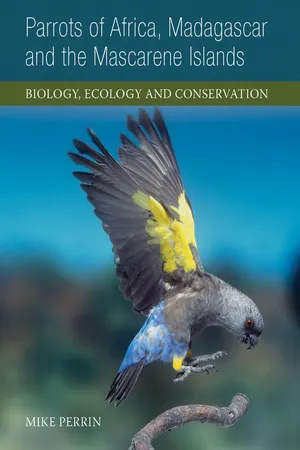
Parrots' colour and charisma, coupled with the fact that they mimic human speech, make them fascinating to many people. They are ancient birds with unique bill and foot structures that enable them to forage on fruits in the canopy of forest trees as well as on seeds in grasslands. Because they depend on fruits and seeds all year round, most species are confined to the tropics or sub-tropics, where the world's biodiversity is at its greatest. There are over three hundred species of parrots, of which more than one hundred are recognised as rare, endangered, vulnerable or threatened with extinction.Parrots are largely distributed in tropical areas of developing countries where economies are weak and uncertain, and where there is great dependence on the exploitation of natural resources, particularly hard wood evergreen forests, which are preferred parrot habitats. Unfortunately, high levels of corruption are common to these regions, with much illegal trade in animals and little or no law enforcement. Collectors of parrots in the first world pay huge sums for rare parrots. However, research, education and conservation actions are greatly reducing illegal trade in African parrots.This book provides complete coverage of all aspects of the biology of extant African, Malagasy and Mascarene parrots, and reviews our knowledge of extinct and fossil parrots from the region. Particular themes include the behavioural and ecological characteristics of parrots, their species characteristics and conservation biology. Current concepts in avian and conservation biology are also discussed.Parrots of Africa, Madagascar and the Mascarene Islands is aimed at ornithologists, conservation biologists, avian ecologists, academics, bird watchers and parrot fans alike. It is well illustrated, with high quality original photographs, and includes distribution maps, figures and tables.
eBook - PDF
Parrots of Africa, Madagascar and the Mascarene Islands
Biology, ecology and conservation
- 640 pages
- English
- PDF
- Available on iOS & Android
eBook - PDF
Parrots of Africa, Madagascar and the Mascarene Islands
Biology, ecology and conservation
About this book
Information
Subtopic
ZoologyIndex
Biological SciencesTable of contents
- Cover
- Title
- Copyright
- Contents at a glance
- Contents
- Acknowledgements
- List of Tables
- List of Figures
- Abbreviations
- Chapter 1: Introduction
- Chapter 2: Conservation biology
- Chapter 3: Systematics
- Chapter 4: Biogeography and niche separation
- Chapter 5: Intelligence, communication and behaviour
- Chapter 6: Breeding biology
- Chapter 7: Diet and metabolism
- Chapter 8: Case study – the Cape Parrot
- Chapter 9: Trade in African parrots
- Chapter 10: African parrot conservation
- The Parrot Species of Africa
- Iucn Categories
- Chapter 11: Long-tailed and fossil parrots
- Chapter 12: True parrots
- Chapter 13: Lovebirds
- Chapter 14: Field techniques in parrot research
- Species lists
- Glossary
- Bibliography
- Index
Trusted by 375,005 students
Access to over 1.5 million titles for a fair monthly price.
Study more efficiently using our study tools.
Frequently asked questions
Yes, you can cancel anytime from the Subscription tab in your account settings on the Perlego website. Your subscription will stay active until the end of your current billing period. Learn how to cancel your subscription
No, books cannot be downloaded as external files, such as PDFs, for use outside of Perlego. However, you can download books within the Perlego app for offline reading on mobile or tablet. Learn how to download books offline
Perlego offers two plans: Essential and Complete
- Essential is ideal for learners and professionals who enjoy exploring a wide range of subjects. Access the Essential Library with 800,000+ trusted titles and best-sellers across business, personal growth, and the humanities. Includes unlimited reading time and Standard Read Aloud voice.
- Complete: Perfect for advanced learners and researchers needing full, unrestricted access. Unlock 1.5M+ books across hundreds of subjects, including academic and specialized titles. The Complete Plan also includes advanced features like Premium Read Aloud and Research Assistant.
We are an online textbook subscription service, where you can get access to an entire online library for less than the price of a single book per month. With over 1.5 million books across 990+ topics, we’ve got you covered! Learn about our mission
Look out for the read-aloud symbol on your next book to see if you can listen to it. The read-aloud tool reads text aloud for you, highlighting the text as it is being read. You can pause it, speed it up and slow it down. Learn more about Read Aloud
Yes! You can use the Perlego app on both iOS and Android devices to read anytime, anywhere — even offline. Perfect for commutes or when you’re on the go.
Please note we cannot support devices running on iOS 13 and Android 7 or earlier. Learn more about using the app
Please note we cannot support devices running on iOS 13 and Android 7 or earlier. Learn more about using the app
Yes, you can access Parrots of Africa, Madagascar and the Mascarene Islands by Mike Perrin in PDF and/or ePUB format, as well as other popular books in Biological Sciences & Zoology. We have over 1.5 million books available in our catalogue for you to explore.