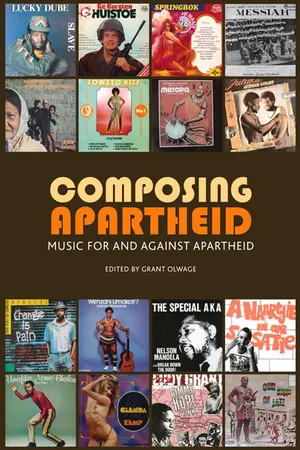
Composing Apartheid is the first book ever to chart the musical world of a notorious period in world history, apartheid South Africa. It explores how music was produced through, and was productive of, key features of apartheid's social and political topography, as well as how music and musicians contested and even helped to conquer apartheid. The collection of essays is intentionally broad, and the contributors include historians, sociologists and anthropologists, as well as ethnomusicologists, music theorists and historical musicologists. The essays focus on a variety of music (jazz, music in the Western art tradition, popular music) and on major composers (such as Kevin Volans) and works (Handel's Messiah). Musical institutions and previously little-researched performers (such as the African National Congress's troupe-in-exile, Amandla) are explored. The writers move well beyond their subject matter, intervening in debates on race, historiography, and postcolonial epistemologies and pedagogies.
eBook - ePub
Composing Apartheid
Music for and against apartheid
- 320 pages
- English
- ePUB (mobile friendly)
- Available on iOS & Android
eBook - ePub
Composing Apartheid
Music for and against apartheid
About this book
Trusted by 375,005 students
Access to over 1 million titles for a fair monthly price.
Study more efficiently using our study tools.
Information
Subtopic
Music1
BACK TO THE FUTURE?
IDIOMS OF ‘DISPLACED TIME’ IN SOUTH AFRICAN COMPOSITION
CHRISTINE LUCIA
INTRODUCTION
One evening in August 1997 I played a composition by a young black choral composer to one of my colleagues in the Fine Art Department at Rhodes University, Grahamstown, South Africa.1 After listening to the strangely familiar yet unfamiliar language of the music, my colleague commented, ‘it’s postmodern’. It seemed to have arrived at a state of postmodernism without having been through European modernism, eschewing reference to art music of the early twentieth century (Schoenberg, Stravinsky, Bartók) and ignoring serial or post-serial techniques. What it lacked most conspicuously, however, made it what it was. It rearranged the codes and conventions from an earlier tonal era but projected them onto a flatter surface. Hence it sounded, to a colleague schooled in contemporary art but not music theory or composition, postmodern.
The codes this piece did employ belong to a substantial history and repertoire of written black South African choral music, but one transmitted half-orally because scores are scarce and choirs taught mainly by rote (see Lucia, 2005: xxvi). This is a tradition going back more than 125 years, with John Knox Bokwe (1855-1922) usually seen as colonial founding father (Olwage, 2006). The repertoire in this part of Africa has developed among hundreds of composers scattered throughout the region, adding idioms from various musical discourses encountered, including jazz, dance music, European classical, popular and folk music, African ‘traditional’ music, and church music of various kinds. Especially it feeds off its own histories; and along the way it has produced major composers and ‘classics’. The annual national competitions in which it is mainly performed, a culmination of local and regional competitions held throughout the year, make it seem as if there is a unitary history of such music; but the surviving repertoire comes from several historical periods and many areas of a large country, and is far from homogeneous in style and especially language, since the texts of choral songs are composed in all eleven official languages. Text and musical language articulate the experiences of black South Africans from colonial times to the present, and thus these pieces are valuable social documents.
On the production side: where scores have been preserved (and many have not) they are invariably hand-me-down copies of copies of manuscripts or typescripts. Traditionally composers wrote in tonic sol-fa notation because this was prescribed in ‘native’ mission schools, and under apartheid’s Bantu Education policy in the 1960s to 1980s choral singing and sol-fa continued to provide so-called ‘music education’ in approximately 67 percent of black schools.2 On the reception side: choral music’s history has been shaped by the church, school, and community choirs that have always sung it. The best composers have almost the same status as national poets or soccer heroes, but the music is seen as belonging to all, in much the same way as congregational music is. Hence composers have benefited little from royalties, and their music is illegally reproduced with abandon. The reception has taken a new turn since the 1980s, with the music’s increased exposure to white South African adjudicators, composers, and audiences, and also to scholars. More pieces are appearing in print, often in dual (staff/sol-fa) notation, and with the publication of eight ‘classics’ in what amounts to the first ‘critical edition’ (the South African Music Rights Organisation (SAMRO) South Africa Sings Volume 1 (Khumalo, 1998)), the possibility arises for analytical scrutiny of such pieces in the academy. The need to investigate and critique reasons why such music has for so long been marginalised or misread as ‘composition’ also becomes more urgent.
For the choral repertoire has been dogged by mis-readings, mainly those of whites who see it as a poor imitation of Western music, a ‘travesty’ as someone remarked from the floor at a South African musicology conference in 1997.3 As Veit Erlmann pointed out in 1991, in his study of the composer Reuben Caluza:
Percival Kirby and other South African musicologists [have claimed] that Bokwe’s, Sontonga’s, and Caluza’s compositions were ‘without a trace of the devices used by European composers to mitigate the ‘squareness’ of the design or to inject vitality into the melody or character into the harmony’ (Kirby, 1979: 94 [93]). Such harsh criticism was of course motivated by racial prejudice and misinterpreted the composers’ intentions (121).
The foundations for such misinterpretations were laid down long before the National Party’s victory in 1948, continued through the 1950s when HF Verwoerd coined the term ‘apartheid’, throughout legislation that consolidated his philosophy, through to the official end of apartheid in 1994, and beyond it to the present day. This is largely because the misinterpretations are tied to notions of composition that stem from the academy, rather than from the music in question and its contexts. The move to classicise choral music in the post-apartheid era – calling it ‘[s]erious music in an African context’ (Khumalo, 2003/4 and 2005/6: 13) – does historicise it in new ways, which is to be welcomed, but this also brings with it the dangers of a formalist analytical discourse being applied in order to prove this music’s (new) status as art music. The danger is that it will be read using paradigms learned through an education system not in harmony with the music, that its musical syntax will be compared to the norms of Western music, to the detriment not only of the musical tradition itself but to all its acquired meanings, performative contexts, and other aspects of production and reception, not least of which are the texts it uses.
Words are integral to the meaning choral works hold for black communities. Composers usually write their own, adapted from liturgical or other ritual contexts or from folk music, often drawn from the Bible or other literature close at hand.4 The words of songs are allegories of a personal or collective experience of history, notable examples from different periods being Caluza’s ‘iLand Act’,5 Tyamzashe’s ‘Zweliyabanzi’,6 Matyila’s ‘Bawo, Thixo Somandla’,7 or Madlopha’s ‘Kwenzenjani maAfrika’.8 Given those experiences – hundreds of scattered authors voicing in many languages a century of political violence and social displacement, in which apartheid was one particularly brutal episode – the deconstruction of song texts alone would fill many pages.
It is not texts that I focus on here, but rather the music of three songs written at different moments in this indigenous composing tradition, moments framing the era of ‘official’ apartheid but underscoring the point that what choral music did under apartheid was set in motion long before, and continues now. I attempt through a brief reading of Joshua Pulumo Mohapeloa’s ‘U Ea Kae?’ (‘Where Are You Going?’) (1935), Percival Kirby’s ‘A Sotho Lament’ (1939), and Michael Mosoeu Moerane’s ‘Barali Ba Jerusalema’ (‘Daughters of Jerusalem’) (1950s?9) to suggest how the musical idiom of such pieces reflects their experience of the ‘contemporary’ at different times, problematising the way such pieces are often seen as untrained attempts to compose in an old-fashioned idiom, and suggesting they might rather be seen as ‘foreshadowing’ (to use Jacques Attali’s notion) a new compositional order, even a new socio-political one.10 In short, I argue that in the way they displace notions of time-periods by not comfortably belonging in South African music history and sounding a-modern or postmodern, they can be said to ‘look back to the future’.
‘U EA KAE?’
Mohapeloa’s ‘U Ea Kae?’ (Ex. 1) is based on a traditional Sotho threshing song,11 although interestingly it is now known principally in Mohapeloa’s version, which according to Mzilikazi Khumalo has been accepted as the ‘clan-song of the Moletsanes’ (1998: 28). The song has an ‘A’ section of 12 bars and repeated ‘B’ section of 11 bars: 44 bars in all. I suggest that because it has been carefully notated as a piece for four-part choir, is prescribed as an ‘indigenous composition’ in choral competitions rather than as a traditional piece and is therefore sung without traditional dance movements, and because it is one of the ‘classics’ included by Khumalo in South Africa Sings12 – all of this points to reading it as composition rather than ‘mere’ arrangement.
There is no evidence that when Mohapeloa used traditional music he thought of it as only arranging. It seems as if some of his early uses of traditional material (in the 1930s) even met with disapproval because they did not represent traditional music in the way arrangements normally would. In an interview in 2004 Mohapeloa’s brother Josias Makibinyane noted that when JP started writing songs based on folk music ‘he did not know that they were going to be singeable [sic]’ because of ‘criticisms that arose saying that they did not quite depict proper Basotho music’ (Mot’soane, 2004: 2). ‘Singable’ here implies acceptable as well as vocally manageable, the implication being that there were parts that singers might not manage (rarely true of traditional music), and that there were elders who disapproved of change. When he came to publish the small song collection Khalima-Nosi tsa ’Mino oa Kajeno in 1951, Mohapeloa stated his case very clearly.13 The following is an extract from his ‘Preface’:
Authorities on African music uphold the old type of folk song as the only sound basis for further development. While for purposes of research this view holds good, it is however not always applicable to work intended principally for recreation. Here one has to bear in mind the fact that music is a thing of fashions and, as far as possible, incorporate[s] in the work the idiom of the time. This old type of African folk music has receded into the background in most parts, and the people who really appreciate it are quietly dropping out of the scene. In certain aspects African folk music has undergone many changes, and we cannot with any more justice stigmatize current practice as foreign for its taint of European influence than we could be justified in ostracising the modern African youth on the grounds of sartorial fashions (2002: [2]).


Ex. 1. ‘U Ea Kae?’ by J Mohapeloa © SAMRO. Bars 1-17.
Translation:
[Bars 1-12] Take your stick, and let us go to Taung, home of the Moletsanes; let us go and see how corn is threshed. The small boys have knobkerries [knobbed sticks] in their hands. They thresh hard with a flashy rhythmic stroke.
[Bars 13-23] Where are you going [x2], without even a knobkerrie? Here admission is with a knobkerrie; here [at Taung], home of the Moletsanes, we have brought ours. Fa-la-la-la [x2] (Khumalo, 1998: 10).
Mohapeloa kills several birds with one stone here: first, ‘authorities’ (in 1951 foremost among these would be ethnomusicologists Percival Kirby and Hugh Tracey) who condemn the development of the ‘tainted’ modern African composer with their preservationist attitude to African music; second, the old folks at home ‘quietly dropping out of the scene’; third, the idea that folk music does not change. It is a complex and not fully worked out argument which continues, frustratingly, only for another two paragraphs, about the need for composition to reflect the new rather than the old. But many songs like ‘U Ea Kae?’ were just as concerned with ‘the idiom of the time’ as they were with the past, aimed at (in Mohapeloa’s words) ‘reflecting the feelings of the people who are actively alive today and not those of the dead and dying … [in order to] serve as a record of the popular trend in musical development today’ (Ibid.; my emphasis).
What struck me on first hearing this song was the dramatic nature of the melodic line, from which the piece derives a major part of its expressive power, the fluid treatment of texture and rhythm, the use of new ma...
Table of contents
- Cover
- Title Page
- Copyright Page
- Dedication
- Contents
- Acknowledgements
- Introduction
- Chapter 1. Back to the Future? Idioms of ‘displaced time’ in South African composition
- Chapter 2. Apartheid’s Musical Signs: Reflections on black choralism, modernity and race-ethnicity in the segregation era
- Chapter 3. Discomposing Apartheid’s Story: Who owns Handel?
- Chapter 4. Kwela’s White Audiences: The politics of pleasure and identification in the early apartheid period
- Chapter 5. Popular Music and Negotiating Whiteness in Apartheid South Africa
- Chapter 6. Packaging Desires: Album covers and the presentation of apartheid
- Chapter 7. Musical Echoes: Composing a past in/for South African jazz
- Chapter 8. Singing Against Apartheid: ANC cultural groups and the international anti-apartheid struggle
- Chapter 9. ‘Nkosi Sikelel’ iAfrika’: Stories of an African anthem
- Chapter 10. Whose ‘White Man Sleeps’ Aesthetics? and politics in the early work of Kevin Volans
- Chapter 11. State of Contention: Recomposing apartheid at Pretoria’s State Theatre, 1990-1994. A personal recollection
- Chapter 12. Decomposing Apartheid: Things come together
- Chapter 13. Arnold van Wyk’s Hands
- Contributors
- Index
Frequently asked questions
Yes, you can cancel anytime from the Subscription tab in your account settings on the Perlego website. Your subscription will stay active until the end of your current billing period. Learn how to cancel your subscription
No, books cannot be downloaded as external files, such as PDFs, for use outside of Perlego. However, you can download books within the Perlego app for offline reading on mobile or tablet. Learn how to download books offline
Perlego offers two plans: Essential and Complete
- Essential is ideal for learners and professionals who enjoy exploring a wide range of subjects. Access the Essential Library with 800,000+ trusted titles and best-sellers across business, personal growth, and the humanities. Includes unlimited reading time and Standard Read Aloud voice.
- Complete: Perfect for advanced learners and researchers needing full, unrestricted access. Unlock 1.4M+ books across hundreds of subjects, including academic and specialized titles. The Complete Plan also includes advanced features like Premium Read Aloud and Research Assistant.
We are an online textbook subscription service, where you can get access to an entire online library for less than the price of a single book per month. With over 1 million books across 990+ topics, we’ve got you covered! Learn about our mission
Look out for the read-aloud symbol on your next book to see if you can listen to it. The read-aloud tool reads text aloud for you, highlighting the text as it is being read. You can pause it, speed it up and slow it down. Learn more about Read Aloud
Yes! You can use the Perlego app on both iOS and Android devices to read anytime, anywhere — even offline. Perfect for commutes or when you’re on the go.
Please note we cannot support devices running on iOS 13 and Android 7 or earlier. Learn more about using the app
Please note we cannot support devices running on iOS 13 and Android 7 or earlier. Learn more about using the app
Yes, you can access Composing Apartheid by Lara Allen,Gary Baines,Ingrid Byerly,Christopher Cockburn,David Coplan,Bennetta Jules-Rosette,Michael Drewett,Shirli Gilbert,Christine Lucia,Carol Muller,Stephanus Muller,Grant Olwage,Brett Pyper,Martin Scherzinger, Grant Olwage in PDF and/or ePUB format, as well as other popular books in Media & Performing Arts & Music. We have over one million books available in our catalogue for you to explore.