eBook - ePub
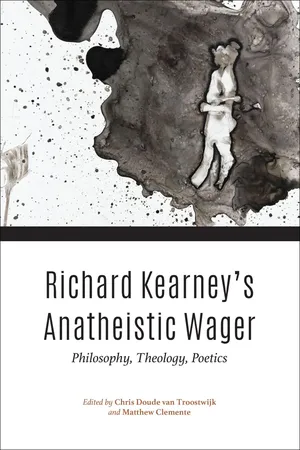
Richard Kearney's Anatheistic Wager
Philosophy, Theology, Poetics
- 264 pages
- English
- ePUB (mobile friendly)
- Available on iOS & Android
eBook - ePub
Richard Kearney's Anatheistic Wager
Philosophy, Theology, Poetics
About this book
This anthology of fifteen essays provides a variety of critical perspectives on the influential ideas in Richard Kearney's Anatheism.
Blaise Pascal famously insisted that it was better to wager belief in God than to risk eternal damnation. More recently, the distinguished philosopher Richard Kearney has offered a wager of his own—the anatheistic wager, or return to God after the death of God. In this volume, an international group of contributors consider what Kearney's spiritual wager means.
This volume examines what is at stake with such a wager and what anatheism demands of the self and of others. The essays explore the dynamics of religious anatheistic performativity, its demarcations and limits, and its motives.
A recent interview with Kearney focuses on crucial questions about philosophy, theology, and religious commitment. As a whole, this volume interprets and challenges Kearney's philosophy of religion and its radical impact on contemporary views of God.
Trusted by 375,005 students
Access to over 1.5 million titles for a fair monthly price.
Study more efficiently using our study tools.
Information
Topic
PhilosophySubtopic
Philosophical CriticismPART I: CONVERSATIONS AFTER GOD
1Theism, Atheism, Anatheism
James Wood and Richard Kearney
I
JW: I’d like to ask you about the personal nature of your relationship to God—your own religious path.
RK: Sure. I’ll tell you a story about something I did on Irish radio. It’s a program called Miriam Meets that’s on every Sunday. Usually two members of a family are invited. So I did it with my brother, Tim, who works with the Communauté de l’Arche, founded by Jean Vanier. Vanier is a very committed Christian who works with disabled people—kind of a hero and a saint. I played the “bad guy” and my brother, Tim, was the “good guy.” We get along extremely well, but we were teasing each other and so on. He was being pitched as the theist and me [sic] as the more wayward one—in other words, the anatheist. A week later, I was walking in the fields near our house in West Cork, and I came to the top of this hill. I was trespassing on a farmer’s land, and he drove up with his tractor and hopped out, and I thought, “Oh dear, he’s going to get me for trespassing and disturbing his cattle.” But he just wanted to talk about God. “Are you the atheist?” he asks right away. So I said, “What do you mean?” And he said, “I heard you on the radio. Your brother—he was very good, but you were very confused.” In Ireland, an “anatheist” is an atheist—and atheists are very confused.
JW: Is there a tension between the openness, the emptiness of the name, “God”—God as the name for the “more,” the “surplus,” the “surprise,” that humans seek—between that emptying out and the need to keep on talking of “God”? In his book Saving God: Religion after Idolatry, the Princeton philosopher Mark Johnston says, in effect, “Let’s stop using the word ‘God.’ I will call him ‘the Highest One’ from now on”—which is good, proper anti-idolatry, but nevertheless he’s managed to write an entire book about this indescribable Highest One. So if there are all sorts of words that we have to retire because language is too absolute to adequately represent this unfinished, unfinalizable, God, then from a nonbeliever’s point of view, a question quickly emerges: “Well, why not just retire God himself? You’ve retired most of the language; why not retire the concept itself and just stop talking about God, the Highest One, and all the rest of it?” Which is another way of asking, “Why does Kearney need God in order to achieve his ethics?”
RK: I’m sympathetic at one level—doing away with the word “God” and eventually doing away with the terms “theism” and “atheism.” Anatheism is just a term for the critical revisiting of that language in order to try and upset it, challenging the old dogmatic antithesis between theism and atheism. Anatheism is no more than a strategic, terminological tool to carve open a middle space that is, as the prefix ana- suggests, both before and after the theism/atheism divide. In a way, its unfamiliarity as a neologism serves initially to confound readers’ expectations—some people think it’s theism, others atheism (“an-atheism,” as it sometimes mispronounced), and others again something altogether different. It depends how you read it. But at the outset, confronted with the term, no one is meant to be entirely sure—perhaps not even me. And the fact that it also means “back” and “forward” interests me. The “ana” is not readily locatable in either time or space. It is a special moment, a strange space that I do not hesitate to call sacred. So I’m using this odd prefix, ana-, to try to trouble the old dichotomy of God versus anti-God, and to do this in favor of a middle realm, a milieu, where some new kind of thinking about this ageless yet still urgent question might occur. Such a middle space is not some wishy-washy, lukewarm ambivalence—which one would be correct to “spit out” as Scripture suggests. It is not facile syncretism—a little bit of this and that without ever committing yourself to anything at all. The doubleness of “ana” is not duplicity, but rather a deeply productive tension. The idea of “ana” with its double a can be read in two ways: as in the colloquial a-dieu, it can mean both “hello” and “good-bye.” One connotes a moving away from or a departure, the a of the deus absconditus—or, more radically, atheism (mystical or secular). While the other a is the “adieu” of “hello”—ad deum. Excuse the Latin, but one finds echoes of this in the colloquial usage of French and English also. And for me this double a says something important about our contemporary relationship with the sacred.
JW: Why keep the word “sacred”?
RK: I use the word “sacred” because it is generous—or, at least, more capacious than the often-exclusivist understanding of terms like “theism,” “religion,” and “God.” Many people who might have a real problem with the traditional notions of God have little trouble saying “This is sacred to me” when referring to a certain person, place, or time. So the initial a of ana signals a first movement of abstention and absolution whereby one absolves oneself of the preconceptions of the old God of power and might, in a sort of apophatic (negative theology) or anti-idolatrous (iconoclasm) gesture. And this preliminary move, akin if not identical with a certain salutary atheist scruple, may then open the possibility—never the necessity—of a return to something more, other, transcendent: a surplus that was always there though we didn’t see it. This is what I call ana-theos, or the God after God. Something “called” God—for God is a name that means different things to different people. The best response, at least for me, to the question “do you believe in God?” is, “It depends what you mean by God.” In other words, “Tell me what you understand about God, and I’ll tell you whether I believe it.”
JW: So, tell me something about what God means to you. Tell me something about your own childhood in religious terms. Your father was a sort of observant Catholic, wasn’t he?
RK: Yes, he was. Silently observant. He never came to mass with us.
JW: Oh, he didn’t?
RK: No. He went often to his own mass. He was a silent observer and rarely took the Eucharist. He felt unworthy and would go on a penitential pilgrimage to Lough Derg in Northern Ireland once a year; only then would he take communion. Whereas my mother was very devotional and very partial to the sacraments. So to put it in terms he would never have used himself, my father was more “apophatic”—he rarely spoke about religion and never about theology. He was educated and intelligent—a professor of surgery—but never articulated his religious or spiritual beliefs. In fact, at his funeral, a medical nun from one of the Cork hospitals came up to me and said, “You know, every day we saw your father at the back of the chapel. He never went into surgery without saying a prayer.” But it was like a revelation to us. We would never have imagined it.
JW: He went on his own?
RK: Yes.
JW: Interesting.
RK: By contrast, my mother was full of spiritual pathos and very involved with helping suffering and homeless people in the city. Both parents were incredibly tolerant—moral but never moralistic or moralising. My mother would say, “Just be good to people.” To take a somewhat dramatic example, when contraception was outlawed in Ireland, she would encourage all six of her sons to bring condoms when we dated girls. She knew that boys would be boys and wanted us to be responsible and never cause our girlfriends any harm. My sister became pregnant when she was still in her teens and suffered the consequences of a punishing Catholic community. But my father and mother stood by her and her baby, right through the terrible ordeal when she had to give up her studies and lost her first job as a trainee teacher in a girls’ school for “fear of scandal.” My parents were amazingly strong and protective. I respected that and learned early on that religious people could be the best as well as the worst.
JW: So your mother was a churchgoer and took you along?
RK: She took all seven of her children. My brothers and I were altar boys. We went through the whole thing, and it was very beautiful. Sacramental, richly liturgical, something magical, not at all censorious or punishing. It may have been somewhat atypical of most Irish Catholic culture of the time; I don’t know. But when I later heard and read about what so many of my contemporaries lived through as young Catholics—a punitive, fear-filled, guilt-ridden religion—I felt fortunate to have had the parents I did.
JW: The punitive element, that wasn’t there at all for you?
RK: For the most part, no. I was, of course, beaten by the Christian “brothers” in primary school—nobody escaped that—but fortunately, my parents sent me to secondary school in a Benedictine Abbey called Glenstal. The monks there had a deep culture of tolerance, an openness to interreligious dialogue inspired by pioneering Benedictine missionaries like Abhishiktananda and Bede Griffiths in India; and a real sense of critical questioning informed by Vatican II theologians like Yves Congar and Henri De Lubac. Glenstal Abbey was also a place of ecumenical reconciliation in a sectarian Ireland, where the Northern troubles smouldered and raged in the late sixties and seventies.
JW: As a teenager, did you struggle with inherited belief or was the inherited belief not a large enough pressure that you had to struggle with it?
RK: It was a mixture of inheritance and struggle. Glenstal Abbey, where I went when I was twelve, provided a forum for this that was not, as I mentioned, very typical of Ireland in the late sixties. And then there was my equally atypical family situation—with a very apophatic father and a very cataphatic mother. And, of course, my mother’s devotion to the poor and needy—we’d pray for them and for my father’s critically ill patients every night before bed. It was basically my mother who shared my father’s work with us. He never said a word about it himself. And then three of my brothers started working with the disabled community as teenagers—they were much better than me in that regard. I was reading Nietzsche and Heidegger while they were pushing wheelchairs in Lourdes and Knock. They were very inspired by Jean Vanier’s movement L’arche, which was set up to care for the mentally disabled by taking them out of awful psychiatric hospitals, known as “looney bins” in Cork, and living with them in ordinary houses. Vanier, originally a philosophy professor in Canada and a good friend of the family, was extremely liberal, open, ecumenical, wise, and caring. So I saw all the good side of Catholic caritas and caring for the broken and wounded—along with the more oppressive side infamously epitomised by some perverted clergy in Ireland, as elsewhere, and in much of the Catholic-imposed social intolerance (regarding divorce, homosexuality, premarital sex, unmarried mothers, contraception, abortion, and so on). So, although I remained informed by a spiritually rich religious life on a personal level with my own family and educational experience, at a public level, I was extremely angry with the official Church. But my antiecclesiastical indignation did not prevent me from struggling to retrieve what I considered to be certain valuable—perhaps invaluable—treasures of my spiritual heritage. I felt I could be furious with the bishops while continuing to worship something called “God.”
JW: You weren’t struggling through theodicy questions?
RK: Of course, but not for long. Theodicy never made sense to me. I was incensed by the very idea from early on. I could never believe in a divinity that willed or allowed evil if it had the power to do otherwise. That seemed like sheer cruelty or casuistry. I never gave credence to a deity of omnipotence. My God was one of nonsovereignty, vulnerability, fragility, and unknowability. A God of service, who preferred washing feet, healing the sick, giving bread, dying for his friends and enemies alike. In fact, the washing of the disciples’ feet was always my favorite Easter liturgy. Jean Vanier used to do that. He’d go around and wash the feet of those—both abled and disabled—at his Easter table. That to me epitomised the divine as a servant—not servile, but in the service of others, strangers, outcasts. So, when you mention Mark Johnson defining the monotheistic God as the Highest One, I would rather say the “lowest one.” My God is an anti-God in that sense, God as outsider, guest, vagrant, the one who hungers and thirsts for justice—“the least of these,” as he says in the gospels, the elachistos. Not the God above us but, as Paul Claudel put it, the God beneath us.1
JW: Now, what if an ethically, politically engaged atheist had turned up alongside you while you were doing those good, Vanier-inspired works? And this ethical chap was as ethical and motivated as you but turned out to have a Dawkins-like lack of belief. Where, then, do the distinctions fall? What would separate you, if anything, from him? What would be the difference?
RK: Well, the first thing for me would be what doesn’t separate us—the fact that we’re both in service to something radically other than ourselves. If you look at Matthew 25 . . .
JW: It is a foundational text for you, isn’t it?
RK: Yes. Matt 25:31–44 is radical. But its radicality is so often neglected in practical and theological terms. It’s crucial. Christ identifies here with the hospes, the stranger in the street, the last person in the world you think could be God. And that is where and how the kingdom comes—incarnate in the one who gives or receives a cup of water. I mean, that is the exclusion of exclusion par excellence. So if the worst of religion is its exclusiveness—“we have the revealed truth and the rest of you are damned”—the great thing about this passage (and I believe one finds certain equivalents in Judaism, Buddhism, and other religions) is that no one need be excluded, except those who exclude themselves by choosing not to give or receive bread. Atheists are not at all excluded here—but I will come back to this. In fact, the asking—acknowledging one’s need for bread and water—is as important as giving the bread and water (or wine, as the case may be). So anatheist practice, as I understand it, would be the exclusion of exclusion, not the contrary. Or, to put it in more technical terms, when it comes to serving strangers, orthopraxis trumps orthodoxy.
JW: I see.
II
RK: But let’s get back to your example of the nonbelieving student who is doing the same thing as the believing student. What is the difference? When I’m washing people’s feet with this guy as we’re working together with the homeless in downtown Dublin or out in Somalia, the first and most important thing is that we’re doing the work (facere veritatem as Augustine says, “do the truth”); the second thing might be that, as we are working, we have a conversation. And the conversation begins with the questions, “What do you say that you’re doing? And why are you doing it? What is your narrative about this shared action?” In short, what is the story behind your being here? Or the history behind the story? The why, who, wherefrom, whereto? I recount my story and listen to the other’s story as well.
JW: You trade narratives.
RK: Yes. We trade narratives, and then we ask questions about those narratives: The atheist might say, “Why do you call that God?” And the anatheist would say, “Well, actually, I call it the suffering servant.” And the reply might be, “But that’s not my view of God.” And...
Table of contents
- Cover
- Halftitle
- Series Page
- Title
- Copyright
- Dedication
- Contents
- Acknowledgments
- Abbreviations of Kearney’s Works
- Introduction: The Risk of the Wager (Chris Doude van Troostwijk and Matthew Clemente)
- Part I. Conversations After God
- 1 Theism, Atheism, Anatheism (James Wood and Richard Kearney)
- 2 A Conversation after God (Chris Doude van Troostwijk and Richard Kearney)
- 3 Mysticism and Anatheism: The Case of Teresa (Julia Kristeva and Richard Kearney)
- 4 An Anatheist Exchange: Returning to the Body after the Flesh (Emmanuel Falque and Richard Kearney)
- Part II. At the Limits of Theology
- 5 The Anatheistic Wager: faith after Faith (Brian Treanor)
- 6 Kin and Stranger: Kearney and Desmond on God (Richard J. Colledge)
- 7 Is it Possible to Be a Reformed Anatheist? (Helgard Pretorius)
- 8 Anatheism and Inter-Religious Hospitality: Reflections from a Catholic Comparative Theologian (Marianne Moyaert)
- 9 Buddhist Anatheism (Joseph S. O’Leary)
- 10 The Wager That Wasn’t: An Education in Shady Chances (L. Callid Keefe-Perry)
- Part III. Poetics of the Sacred
- 11 Recognition and Hospitality: Coming Back to Odysseus’s Coming Home (Pierre Drouot, trans. Sarah Horton)
- 12 The Twofold Face of God: An Anatheistic Reading of the Sacrifice of Abraham (Jacob Rogozinski)
- 13 The Apparent God: Biblical Poetics and the End of Time (Theo L. Hettema)
- 14 Kearney’s Other and the Anatheist Shadow (Patrick Burke)
- 15 Trauma, Resurrection, and the Anatheistic Wager (Shelley Rambo)
- Epilogue: From Wager to Art and Back Again (Chris Doude van Troostwijk and Matthew Clemente)
- Bibliography
- Index
- Back Cover
Frequently asked questions
Yes, you can cancel anytime from the Subscription tab in your account settings on the Perlego website. Your subscription will stay active until the end of your current billing period. Learn how to cancel your subscription
No, books cannot be downloaded as external files, such as PDFs, for use outside of Perlego. However, you can download books within the Perlego app for offline reading on mobile or tablet. Learn how to download books offline
Perlego offers two plans: Essential and Complete
- Essential is ideal for learners and professionals who enjoy exploring a wide range of subjects. Access the Essential Library with 800,000+ trusted titles and best-sellers across business, personal growth, and the humanities. Includes unlimited reading time and Standard Read Aloud voice.
- Complete: Perfect for advanced learners and researchers needing full, unrestricted access. Unlock 1.5M+ books across hundreds of subjects, including academic and specialized titles. The Complete Plan also includes advanced features like Premium Read Aloud and Research Assistant.
We are an online textbook subscription service, where you can get access to an entire online library for less than the price of a single book per month. With over 1.5 million books across 990+ topics, we’ve got you covered! Learn about our mission
Look out for the read-aloud symbol on your next book to see if you can listen to it. The read-aloud tool reads text aloud for you, highlighting the text as it is being read. You can pause it, speed it up and slow it down. Learn more about Read Aloud
Yes! You can use the Perlego app on both iOS and Android devices to read anytime, anywhere — even offline. Perfect for commutes or when you’re on the go.
Please note we cannot support devices running on iOS 13 and Android 7 or earlier. Learn more about using the app
Please note we cannot support devices running on iOS 13 and Android 7 or earlier. Learn more about using the app
Yes, you can access Richard Kearney's Anatheistic Wager by Chris Doude van Troostwijk, Matthew Clemente, Chris Doude van Troostwijk,Matthew Clemente in PDF and/or ePUB format, as well as other popular books in Philosophy & Philosophical Criticism. We have over 1.5 million books available in our catalogue for you to explore.