- 224 pages
- English
- ePUB (mobile friendly)
- Available on iOS & Android
eBook - ePub
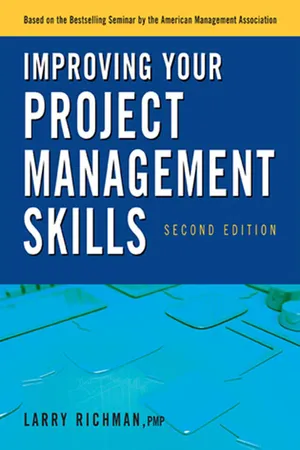
Improving Your Project Management Skills
About this book
Based on the bestselling American Management Association seminar! If a full-fledged project management course doesn't fit your schedule or your budget, check out the new edition of Improving Your Project Management Skills. Based on the hugely popular American Management Association seminar of the same name, this ultra-practical reference offers powerful and repeatable project initiatives that improve processes, streamline productivity, and cut costs dramatically. You'll get tools, tips, charts, lists, and never-fail advice for: Planning and budgeting • Defining project scope • Project scheduling • Implementation • Performance measurement • Leadership and staff issues • Work breakdown structures • Alignment with business goals • Risk assessment and management • Communication • Project closure • And much more Now completely revised and updated, the book is consistent with the most recent edition of A Guide to the Project Management Body of Knowledge (PMBOK®) and includes dozens of current practices and real-world examples. Equal parts learning tool and workplace reference, Improving Your Project Management Skills puts the power of a world-class project management seminar right in your hands!
Trusted by 375,005 students
Access to over 1.5 million titles for a fair monthly price.
Study more efficiently using our study tools.
Information
Subtopic
Human Resource ManagementIndex
BusinessPART 1
Project Management Foundations
CHAPTER 1
The Core Concepts
PROJECTS ARE AN ESSENTIAL PART of human history. Some projects arise in myth, some in wartime, some from faith, and others from science and commerce. Some projects are monumental, and others are more modest. Ancient Egypt created the Great Pyramids, the Sphinx, the Library, and the Lighthouse of Alexandria. China’s Great Wall, which still stands today, took over 1,000 years to build. Peru’s Incan culture left us the lingering splendor of Machu Picchu. In our own time, we have placed men on the moon and returned them safely. We have developed drugs that target specific diseases. We have responded to environmental incidents, managed failures at nuclear sites, and responded to natural disasters. We have linked individuals and organizations through the miracle of the Internet. We have fulfilled the promise of integrated business systems that embrace enterprise resource planning, inventory management, production and control, human resources, and financial systems. This history of accomplishment will not end.
Some projects are ambitious and far-reaching in their social, economic, and political impacts. Others are less grand and more self-contained. Some require advances in basic science, and others deploy proven technology or best practices. Some projects challenge deeply held beliefs, and others uphold traditional values. And some projects fail.
The goal is always to achieve some beneficial change. Every project is an endeavor. Every project is an investment. Every project will end. Some will end when the goal is achieved, and others when the time or cost is disproportionate to the value. Some projects will be cancelled. In all cases, the project manager serves as the focal point of responsibility for the project’s time, cost, and scope.
Project Management Vocabulary
Success requires that the project manager serve as the focal point of effective, timely, and accurate communication. To do this well, the project manager must master a new vocabulary and must use it consistently to communicate successfully. The definitions introduced in this chapter are the project manager’s methods of art—words and terms used in the context of planning, scheduling, and controlling projects.
A project is “a temporary endeavor undertaken to create a unique product, service, or result.” * Projects are temporary because they have a definite beginning and a definite end. They are unique because the product, service, or result is different in some distinguishing way from similar products, services, or results. The construction of a headquarters building for ABC Industries is an example of a project. The unique work is defined by the building plans and has a specific beginning and end.
Project management is “the application of knowledge, skills, tools, and techniques to project activities to meet the project requirements” (Ibid., p. 6).
In mature organizations, multiple projects may be grouped and managed together in a program to obtain benefits and control not available from managing them individually (see Ibid., p. 9). Multiple programs may be grouped and prioritized into portfolios aligned around larger strategic organizational objectives. Portfolio management is the “centralized management of one or more portfolios, which includes identifying, prioritizing, authorizing, managing, and controlling projects, programs, and other related work, to achieve specific strategic business objectives” (Ibid., p. 9).
Why Project Management?
Project management stems from the need to plan and coordinate large, complex, multifunctional efforts. History provides us with many project examples. Noah’s project was straightforward—build an ark. The material requirements indicated that the ark should be built with gopher wood and to prescribed dimensions. Ulysses built the Trojan horse. Medieval cathedrals were designed and built over the course of centuries. However, not one of these projects deployed a consistent, coherent methodology of management techniques aimed at schedule development, cost control, resource acquisition and deployment, and risk management.
Project management, as we have come to know it, was the solution to a practical problem. Governmental communications in the latter part of the twentieth century, unfortunately, often involved technical staff speaking only with their technical counterparts in defense-contractor organizations. Each discipline conferred with its own colleagues. Changes in one aspect of a system—say, payload weight—were not always communicated to other interested and affected parties, such as avionics or engine design. Too often, the results were cost and schedule overruns, as well as systems that failed to meet expectations.
The concept of the project manager emerged as a focal point of integration for time, cost, and product quality (see Figure 1-1). This need for a central point of integration was also apparent in many other types of projects. Architectural, engineering, and construction projects were a logical place to use project management techniques. Information systems design and development efforts also were likely candidates to benefit from project management. For projects addressing basic or pure research, principal investigators were no longer only the best scientists, but were also expected to manage the undertaking to one degree or another.
Figure 1-1 Evolution of Project Management.

If project management is indeed a solution, then we have to recognize how it reacts and adapts to workplace and marketplace needs such as the following:

Classic Functions of Project Management
Management is routinely understood to be accomplishing work through the expenditure of resources. More rigorously, management is the science of employing resources efficiently in the accomplishment of a goal. The classic functions of management are planning, directing, organizing, staffing, controlling, and coordinating.
Planning
Planning is a process. It begins with an understanding of the current situation (the “as-is” state) and the desired future (the “to-be” state). The gap between these two states causes the project manager to identify and evaluate alternative approaches, recommend a preferred course of action, and then synthesize that course of action into a viable plan. Planning raises and answers the questions shown in Figure 1-2.
Directing
Directing communicates the goals, purposes, procedures, and means to those who will do the work. Directing is the process of communicating the plan, whether orally or in writing.
Figure 1-2 Planning Questions.

Organizing
Organizing brings together the nonhuman resources needed to achieve the project’s objectives. To organize is to manage the procurement life cycle. It begins with the need to define requirements for materials, equipment, space, and supplies. It also identifies sources of supply, ordering, reception, storage, distribution, security, and disposal activities.
Staffing
Staffing brings together the human resources. From a managerial perspective, human resources are first seen as the number and mix of individuals in terms of skills, competency levels, physical and logical location, and costs per unit of time.
Controlling
Controlling is the process of measuring progress toward an objective, evaluating what remains to be done, and taking the necessary corrective action to achieve the objectives. In project management terms, it involves determining variances from the approved plan, then taking action to correct those variances.
Coordinating
Coordinating is the act of synchronizing activities to ensure they are carried out in relation to their importance and with a minimum of conflict. When two or more entities compete for the same resource—time, space, money, or people—there is a need for coordination. The primary mechanism of coordination is prioritization.
Processes in the Life of a Project
The Project Management Institute, an organization dedicated to advocating the project management profession, has produced a valuable document called A Guide to the Project Management Body of Knowledge (PMBOK® Guide). This publication provides a broad view of what project management professionals should know and what they do in performing their work. This guide identifies and de...
Table of contents
- Cover Page
- Title Page
- Copyright Page
- Contents
- Introduction to the Second Edition
- Part 1: Project Management Foundations
- Part 2: Initiating
- Part 3: Planning
- Part 4: Executing, Monitoring, and Controlling
- Part 5: Closing
- Appendix A: Learning Resources
- Appendix B: Glossary
- Index
Frequently asked questions
Yes, you can cancel anytime from the Subscription tab in your account settings on the Perlego website. Your subscription will stay active until the end of your current billing period. Learn how to cancel your subscription
No, books cannot be downloaded as external files, such as PDFs, for use outside of Perlego. However, you can download books within the Perlego app for offline reading on mobile or tablet. Learn how to download books offline
Perlego offers two plans: Essential and Complete
- Essential is ideal for learners and professionals who enjoy exploring a wide range of subjects. Access the Essential Library with 800,000+ trusted titles and best-sellers across business, personal growth, and the humanities. Includes unlimited reading time and Standard Read Aloud voice.
- Complete: Perfect for advanced learners and researchers needing full, unrestricted access. Unlock 1.5M+ books across hundreds of subjects, including academic and specialized titles. The Complete Plan also includes advanced features like Premium Read Aloud and Research Assistant.
We are an online textbook subscription service, where you can get access to an entire online library for less than the price of a single book per month. With over 1.5 million books across 990+ topics, we’ve got you covered! Learn about our mission
Look out for the read-aloud symbol on your next book to see if you can listen to it. The read-aloud tool reads text aloud for you, highlighting the text as it is being read. You can pause it, speed it up and slow it down. Learn more about Read Aloud
Yes! You can use the Perlego app on both iOS and Android devices to read anytime, anywhere — even offline. Perfect for commutes or when you’re on the go.
Please note we cannot support devices running on iOS 13 and Android 7 or earlier. Learn more about using the app
Please note we cannot support devices running on iOS 13 and Android 7 or earlier. Learn more about using the app
Yes, you can access Improving Your Project Management Skills by Larry Richman in PDF and/or ePUB format, as well as other popular books in Business & Human Resource Management. We have over 1.5 million books available in our catalogue for you to explore.