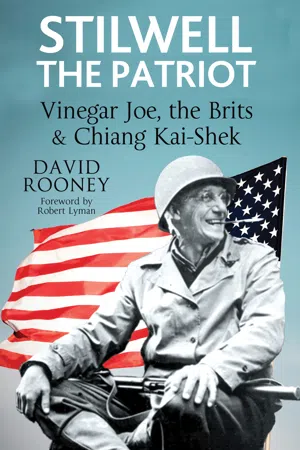
This meticulously researched biography of the controversial American commander Joe Stilwell presents an intimate account of his career and the complex story of the Burma campaign.Stilwell was stationed in Burma during the Second World War working as Chinese military leader Chiang Kai-Shek's chief of staff, the commander of the Chinese divisions in Burma and the deputy supreme commander of the SE Asia Command. Known as 'Vinegar Joe' for his caustic personality, he famously differed in strategy from other commanders in his division.Stilwell and George Marshall had planned to have 90 Chinese divisions armed by the USA. Had they succeeded, in 1945 they would have been strong enough to defeat the Communists and would have changed the course of Chinese, and indeed, world history. Although Chiang had Stilwell dismissed, he recognized his contribution to the Burma Road campaign by renaming part of it the Stilwell Road.This sympathetic but critical account analyzes the passions of an American patriot, infuriated by Chiang's dishonesty and chicanery, and looks at the possible outcome had Stilwell's views prevailed.
- 256 pages
- English
- ePUB (mobile friendly)
- Available on iOS & Android
eBook - ePub
About this book
Trusted by 375,005 students
Access to over 1.5 million titles for a fair monthly price.
Study more efficiently using our study tools.
Information
Subtopic
World War IIIndex
HistoryCHAPTER 1
Early Days
Joseph W. Stilwell – known for several decades of his military service as Vinegar Joe – was a lieutenant general commanding III Corps in California when the Japanese attacked Pearl Harbor. A gifted linguist, fluent in French and Spanish, he had served in China on different postings and in different capacities on and off since 1911. No senior American officer had Stilwell’s wealth of experience in China, yet in the weeks after Pearl Harbor it appeared that he was destined for the European or North African theatre of operations. He was called to Washington and had urgent discussions with Eisenhower about possible landings at Dakar or Casablanca.
We know his thoughts and his acerbic comments about every aspect of the war because, during a career characterised by prolonged and acute frustration, he kept a diary, which he used to let off steam and ease his frustrations. The diary was never intended for publication but, fortunately for posterity, after his death in 1946, which occurred tragically soon after his retirement, it was published as The Stilwell Papers,* which have been used extensively since. They have contributed substantially to the image of a tough, competent, irascible, colourful and opinionated commander who reserved his fiercest criticism for Chiang Kai-Shek and, equally, for the snooty upper-class English officers – the ‘Limeys’ – with whom he came into contact. This image is unfortunate, for although his colourful comments are indisputable, he was an outstandingly able commander with an unrivalled knowledge of the whole China situation, and if he had not been sacrificed by Roosevelt in 1944 for political expediency he could have saved the American administration from major and costly blunders in the years after 1945.
Stilwell was born in 1883 into a wealthy and old-established American family. Bright and precocious, he was expelled from school for a prank, and this led to him joining the army. From his entry to West Point in 1900 he was always a loner, rejecting the heavy-drinking group and becoming a fitness fanatic. He was commissioned into the infantry in 1904. Substantial changes in army administration were then taking place as a result of the blunders that happened during the Cuban campaign of 1898.
Fighting still continued in the Philippines, and Stilwell volunteered to serve there as the only place he was likely to see action. He rapidly established a reputation as a highly professional officer who was fiercely concerned for the welfare of his men. He took part in several campaigns in jungle territory against rebel groups and was commended for leadership and initiative.
He studied Spanish seriously, and in 1906 he returned to West Point as a language instructor and then spent summer leaves visiting the downtrodden areas of South America and Mexico. He always took an intense interest in the conditions of the people and made notes about every aspect of their lives. He fiercely criticised the corrupt and uncaring regimes, usually backed by American big business, that kept the people in abject poverty – a view shared by Che Guevara some fifty years later.
At this stage of his career he was eager for overseas postings and, after marrying in 1910, he and his wife Winifred (Win) sailed for the Philippines in 1911. After a short stay there, while his wife returned home he briefly visited Japan and then travelled on to China, the country that was destined to be the backdrop to the most dramatic part of his career. He arrived in Shanghai, the largest of the so-called Treaty ports, lying on the Yangtze river, which to his surprise had the appearance of a western city. From the start he studied and took notes on every aspect of this new and fascinating experience and began the difficult task of learning the language.
During the nineteenth century when, after the Opium Wars, the European powers grabbed the Treaty ports, China’s isolation was slowly broken down and her weakness exposed to the predatory powers of the West. In the 1880s, with European arrogance, France took part of Indo-China, Britain took part of Burma, and Japan, already emerging as a threat, took Korea, Formosa and a foothold on the mainland of Manchuria. Greedy western nations grabbed commercial concessions and naval bases, and the United States joined in with economic penetration and vigorous missionary activity. 1899 witnessed a wild flare-up by the Chinese against western domination, and the rebels, in the Boxer Rebellion, launched powerful attacks on the foreign legations in Peking. European armies rescued the legations, spread fire and destruction, and exacted further humiliating concessions. The uprisings, some led by Sun Yat-Sen, caused widespread chaos across the country. This was the historical background to the situation which Stilwell found when he arrived in 1911.
Always eager to eschew the cocktail-party circuit, Stilwell obtained permission to travel from Shanghai to the far south to visit Canton and Wuchow, where there had been serious uprisings, and also Hong Kong. Here he admired the British soldiers but made the first of many critical comments about the foppish upper-class English officers. He returned to Shanghai with a valuable collection of meticulous observations and colourful comments. In December 1911 he returned to the Philippines, and then to the USA.
His intellectual, academic and linguistic ability had been recognised and in 1912 he was reappointed to the staff of West Point. He always disliked the humdrum routine of army life, and almost immediately he obtained a transfer to Madrid to brush up his Spanish. He was still in Spain when he heard the news of the murder in Sarajevo of the Austrian Archduke Franz Ferdinand in June 1914. When war was declared, seeing the chance to observe war at first hand, he applied – unsuccessfully – for a posting as an observer with the French army.
The American public, accustomed to seeing war as a frontier skirmish or modest foreign adventure in Cuba or the Philippines, with no likelihood of a threat to the homeland, had never accorded the military a high priority, and in 1914 the army was ill-prepared to take part in a modern war. Something of a dress-rehearsal had taken place in 1916 when General Pershing led a punitive expedition against Mexico with infantry, cavalry, artillery and even some air squadrons, but their enemy, the Mexican insurgent Pancho Villa, was hardly of the calibre of the German army. By 1916 the US forces had increased to more than 200,000, but, in addition to the task of training huge numbers of officers and men, the whole apparatus of command and staff had to be created almost from scratch. There had been little organisation for action at division level, let alone at corps or army level, and no machinery existed for the co-ordination of infantry, artillery and cavalry. It was a remarkable achievement that within a few months of the USA entering the war in April 1917, seven divisions were able to cross the Atlantic and hurry forward to bolster the Allies on the western front. Pershing, an aggressive cavalryman, saw the American task as conducting a war of movement, and he correctly and resolutely refused the urgent pleas from the Allied commanders to use American units to plug the gaps in their ranks caused by the hundreds of thousands of casualties.
Stilwell arrived in France with the main force late in 1917. Early in 1918, after a brief liaison with a British division – which stimulated some pithy comments – he joined a French unit near Verdun. He was about to witness and take part in the dramatic finale of the war. Despite the sickening casualties of the previous years, in March 1918 Ludendorff launched an offensive with forty divisions released from the eastern front by Russia’s withdrawal from the war after the Bolshevik revolution. Ludendorff hoped to use the eastern divisions to achieve victory before the American forces could be fully and effectively mobilised on the western front, and he nearly succeeded. Under the pressure of the crisis created by the Ludendorff offensive the Allies at last agreed to a unified command under Foch, and Pershing, always sensitive to issues of independence, reluctandy agreed.
Frustration played a large part in Stilwell’s later life, and it started on the western front when, because of his fluent French and staff experience, he was forced to undertake the necessary staff work and his applications to join a combat unit were refused. An ambitious professional soldier, it galled him to see officers who were considerably junior to him rising to higher ranks because of the losses in the fighting units.
In spite of his frustrations, Stilwell played a significant role in the major American operation of the war. Promoted to lieutenant colonel, he supervised the training and organised the main intelligence briefings in preparation for the attack of the American First Army that took place at St Mihiel on 7 September 1918. Described by John Keegan as ‘an undoubted victory’,* the American divisions not only defeated the opposing German units but captured 13,000 prisoners. This operation, in which Stilwell, Marshall, MacArthur and Patton all took part, showed that the American forces were trained and ready to play an effective part in the war. With the ultimate failure of the Ludendorff offensive, this American battle had a significant impact on the German attitude to surrender.
In January 1918, President Woodrow Wilson had put to Congress his idea of an honourable settlement at the end of the war based on his Fourteen Points, and this was the basis on which Germany and other countries approached the Allies with peace feelers. In October Ludendorff, who had come so close to achieving victory, publicly advocated the rejection of the Fourteen Points, and was dismissed. By the beginning of November 1918, from the Baltic states in the north that sought nationhood, through eastern Europe threatened by Bolshevik revolution, through the ramshackle Hapsburg dominions stretching across the Balkans, most countries and aspiring countries sued for peace. In Germany, against the threat of red revolution supported by soldiers and sailors, the Kaiser abdicated, and the future of the country lay in untried hands. Facing this chaotic background, Wilson came to the Versailles Conference with his Fourteen Points, in response to which the cynical but realistic French premier Clemenceau commented, ‘The Good Lord needed only ten.’ Against the hard determination of Clemenceau and Lloyd George to ‘squeeze Germany till the pips squeak’, Wilson’s idealism was doomed. Throughout much of the world, expectations of justice and self-determination were raised only to be bitterly disappointed, and fudged decisions laid up dire peril for the future. The hopes of Ireland under Michael Collins were dashed. Lawrence of Arabia, who had masterminded the Arab revolt against the Turks based on a British promise of independence, saw those promises broken, and the foundation was laid for a century or more of conflict in the Middle East. Wilson, who commented ruefully that new nations were popping up every day that he had never heard of, had no solution to the cauldron of expectations and disappointments.
Stilwell, serving as part of the occupation force in the pleasant wine-growing area of the Mosel valley and, like most serving soldiers at the end of a war, impatient to get home, made his usual stark comments. He regarded Wilson as ‘an addle-pated boob’ and showed little interest in the deliberations at Versailles. However, one part of those deliberations was to influence his career directly.
When the war started in 1914, in the Far East both China and Japan joined the Allied cause hoping that the Allies would win and that the eventual peace settlement would bring them valuable benefits. In China the chaos and upheavals, which Stilwell had witnessed during his informative visit in 1911, had spread across the country as the so-called warlords profited from the lack of central control. The feeble government in Peking continued to clash with the Kuomintang, the government led by Sun Yat-Sen, which was based in the south and centred on Canton. Japan, which had already given evidence of its expansionist aims, clearly hoped that the war would provide the opportunity to increase its severe demands on China and, as well, to take over the Russian and German concessions. Under considerable Japanese pressure at the peace conference, Wilson unwisely agreed to the Japanese demand for Shantung. This small but crucial peninsula, pointing across the Yellow Sea towards Korea, lay just south of Peking. It had immense tactical and strategic military significance. The Shantung award caused riots and violent protest across China, which went some way to making the rival factions overcome their differences. In America, outbursts of strong anti-Japanese feeling were led by the already powerful Chinese lobby in Washington and by the widespread Chinese missionary support groups.
In both the American and British armies many officers who had survived the carnage and gained higher rank were, when the war ended, reduced to their substantive rank and faced years of stagnation and frustration. Stilwell, back home in 1919 and reduced to the rank of captain, was relatively fortunate. Because of the excellent reports from both corps and divisional headquarters about his work in the final operations on the western front, together with his earlier successful posting to China, he was appointed as a military attaché in China. First, however, he had to spend a year at Berkeley to learn Chinese. Always fascinated by systems and methods – and usually able to suggest ways of improving them – he commented that although the course was adequate it should have taken place in China. In August 1920, after successfully completing the course and before they left for Peking, he and his wife Win bought a piece of land at Carmel near Monterey in California, intending to build a home for their family and retirement.
The situation in China had seriously deteriorated since Stilwell’s visit in 1911. Rival military gangs led by bandits roamed the towns and countryside, and bullets and shells often landed in the affluent areas of Peking where the expatriates lived. Fighting raged over much of northern China, and Sun Yat-Sen, with the Kuomintang, tried without success to establish nationwide control. He felt he had been shamefully let down by the Allies in the post-war settlement, and he turned, briefly, to an alliance with the new Russian Communist party.
Stilwell found routine headquarters life in Peking both boring and stultifying, and he was delighted when he had the opportunity to join a road-building operation in Shensi Province, about 400 miles southwest of Peking. A famine relief committee, backed by the Red Cross, supported the scheme, which was designed to assist the distribution of food during famines. He spent several months working on the project as an engineer adviser, living a hard life, little different from the Chinese coolies who formed his workforce. He revelled in the total immersion in Chinese life and language. At the time China was suffering from a severe famine, and Stilwell described the thousands of gaunt skeletons roaming the countryside and the putrefying corpses left by the roadside. He commented vividly on the suffering of the local people from starvation and also on the effect of opium, to which vast numbers were addicted. He castigated local officers and rulers for not dealing with the opium problem. His views were generally ignored, but he did meet one governor who was making a sincere attempt to improve the conditions of his people – although even his work was overwhelmed and destroyed by the usual warring factions.
While Stilwell was stationed in Peking in 1922, the Five Power Conference met in Washington and made significant decisions. Agreement was reached to ban the use of poison gas in war and attacks by submarines on merchant ships. Japan agreed to give up all rights and territories in China that had been acquired through the defeat of Germany and also agreed to the limitation of her naval rearmament. These decisions had a direct effect on Stilwell, who was sent to observe how well the provisions of the Washington Agreement were being carried out. He revelled in the opportunity and travelled, recording his acute observations, to Manchuria, Korea and Japan. Wherever he went in the Japanese-occupied areas he found the Japanese to be obstructive and unpleasant. He compared them to the Germans, though without the ability, summing them up as ‘arrogant little bastards’. After this fascinating and enlightening period of travel, which also took in the Yangtze valley, he, his wife and their young family returned home in 1923.
* Theodore White (ed.), The Stilwell Papers, Macdonald, London, 1949. Unless otherwise stated, Stilwell’s quotations in this book are from The Stilwell Papers.
* John Keegan, The First World War, Hutchinson, London, 1998, p. 441.
CHAPTER 2
The China Station
On his return home in 1923, Stilwell spent several years improving his military credentials and qualifications, first at Fort Benning in Georgia and then at the more demanding General Staff School at Fort Leavenworth. Here he tackled a highly pressurised staff course in a more relaxed fashion than most. Eisenhower passed out first. After sharing in the 1918 victories, America seemed to breathe a sigh of relief, with the result that army numbers were reduced, finance for defence was whittled down and prospects of promotion almost disappeared. Stilwell faced this situation with foreboding, but his outstanding previous work in China and reputation gained in 1918 as a dedicated professional officer brought him an opportunity which he seized enthusiastically. He was offered the command of a battalion in the American force at Tientsin, the port city close to Peking, and, after a summer leave at Carmel in 1924, he and his family embarked again for China.
Every time Stilwell returned to China he found dramatic and unexpected changes. While he had been back in the USA the turmoil caused by irresponsible warlords and bandits had worsened, and the influence of Russia on Sun Yat-Sen and the Kuomintang had grown more powerful.With few options open to him, Sun Yat-Sen had gone along with the Russian advisers and had initiated a political policy, but in 1925 he suddenly died of cancer. The removal of his restraining hand created the chance for the advancement of Chiang Kai-Shek. Chiang had joined Sun Yat-Sen’s party in 1918. He became Commandant of the Whampoa Military Academy in 1923, and after Sun’s death in 1925 took over the Kuomintang. Several bloody incidents in 1925 and an effective left-wing propaganda campaign had whipped up countrywide fury against American and British influence and against the superior, condescending attitude of Christian missionaries.

When the Stilwell family arrived in Tientsin in 1926, the Kuomintang forces were driving north towards Nanking and Shanghai. The period of uneasy alliance between the Communists – among whom MaoTse-Tung was prominent – and the Kuomintang leaders was soon to end. Mao, whose insistence that guerrilla fighters should respect the people had contributed to the success of the revolutionary forces, now left the Kuomintang – just before Chiang turned on his erstwhile allies and wiped out most of the leadership in Shanghai. The expatriate communities became gravely and increasingly concerned as the warring Chinese troops approached Shanghai. In Nanking angry crowds attacked foreign people and property, and while the leaders dithered a massive exodus of expatriates took place – especially missionaries, of whom there were 12,000 in the country. Missionaries faced a dilemma, for they tended to support the Kuomintang because Sun Yat-Sen had been a Christian, and they faced embarrassment when Chiang’s nationalist forces demanded that people and companies in the Treaty Ports should be taxed and that the unjust Treaty regulations should be changed.
Expatriate groups in Tientsin watched these developments with growing apprehension, and serious plans were made by the American army and marines to rescue expatriates from Peking should it be necessary. Somewhat to the chagrin of the army, the marines arrived with guns, tanks and planes. In a highly volatile situation the American forces needed reliable, accurate information, and they chose Major Stilwell as the obvious person to travel through the wartorn area to observe and gather information. Glad to escape the stuffy and static mi...
Table of contents
- Cover
- Title
- Copyright
- Contents
- List of Illustrations
- List of Maps
- Foreword
- Preface
- 1 Early Days
- 2 The China Station
- 3 Pearl Harbor and After
- 4 The Retreat from Burma
- 5 Taking Stock
- 6 Regrouping
- 7 1943: More Frustration
- 8 The Cairo Conference
- 9 Back to Burma
- 10 March-April 1944: Crisis
- 11 The Drive to Myitkyina
- 12 The Battle for Myitkyina
- 13 Wider Issues
- 14 Showdown in Chungking
- 15 Finale
- 16 Retrospect
- Select Bibliography
- Plate section
Frequently asked questions
Yes, you can cancel anytime from the Subscription tab in your account settings on the Perlego website. Your subscription will stay active until the end of your current billing period. Learn how to cancel your subscription
No, books cannot be downloaded as external files, such as PDFs, for use outside of Perlego. However, you can download books within the Perlego app for offline reading on mobile or tablet. Learn how to download books offline
Perlego offers two plans: Essential and Complete
- Essential is ideal for learners and professionals who enjoy exploring a wide range of subjects. Access the Essential Library with 800,000+ trusted titles and best-sellers across business, personal growth, and the humanities. Includes unlimited reading time and Standard Read Aloud voice.
- Complete: Perfect for advanced learners and researchers needing full, unrestricted access. Unlock 1.5M+ books across hundreds of subjects, including academic and specialized titles. The Complete Plan also includes advanced features like Premium Read Aloud and Research Assistant.
We are an online textbook subscription service, where you can get access to an entire online library for less than the price of a single book per month. With over 1.5 million books across 990+ topics, we’ve got you covered! Learn about our mission
Look out for the read-aloud symbol on your next book to see if you can listen to it. The read-aloud tool reads text aloud for you, highlighting the text as it is being read. You can pause it, speed it up and slow it down. Learn more about Read Aloud
Yes! You can use the Perlego app on both iOS and Android devices to read anytime, anywhere — even offline. Perfect for commutes or when you’re on the go.
Please note we cannot support devices running on iOS 13 and Android 7 or earlier. Learn more about using the app
Please note we cannot support devices running on iOS 13 and Android 7 or earlier. Learn more about using the app
Yes, you can access Stilwell: The Patriot by David Rooney in PDF and/or ePUB format, as well as other popular books in History & World War II. We have over 1.5 million books available in our catalogue for you to explore.