- 162 pages
- English
- ePUB (mobile friendly)
- Available on iOS & Android
eBook - ePub
TOGAF® Version 9.1 - A Pocket Guide
About this book
Note: This book is available in several languages: Brazilian Portuguese, English, Spanish, French.
This is the official Open Group Pocket Guide for TOGAF Version 9.1 and is published in hard copy and electronic format by Van Haren Publishing on behalf of The Open Group. TOGAF®, an Open Group Standard, is a proven enterprise architecture methodology and framework used by the world's leading organizations to improve business efficiency. It is the most prominent and reliable enterprise architecture standard, ensuring consistent standards, methods, and communication among enterprise architecture professionals. Enterprise architecture professionals fluent in TOGAF standards enjoy greater industry credibility, job effectiveness, and career opportunities. TOGAF helps practitioners avoid being locked into proprietary methods, utilize resources more efficiently and effectively, and realize a greater return on investment.
Trusted by 375,005 students
Access to over 1 million titles for a fair monthly price.
Study more efficiently using our study tools.
Information
Topic
EducationSubtopic
Business DevelopmentChapter 1
Introduction
This chapter provides an introduction to TOGAF, an Open Group Standard.
Topics addressed in this chapter include:
• An Introduction to TOGAF
• TOGAF, its structure and content
• The kinds of architecture that TOGAF addresses
1.1 Introduction to TOGAF
TOGAF is an architecture framework. Put simply, TOGAF is a tool for assisting in the acceptance, production, use, and maintenance of architectures. It is based on an iterative process model supported by best practices and a re-usable set of existing architectural assets.
TOGAF is developed and maintained by The Open Group Architecture Forum. The first version of TOGAF, developed in 1995, was based on the US Department of Defense Technical Architecture Framework for Information Management (TAFIM). Starting from this sound foundation, The Open Group Architecture Forum has developed successive versions of TOGAF at regular intervals and published each one on The Open Group public web site.
This document covers TOGAF Version 9.1, referred to as “TOGAF” within the text of this document. TOGAF 9.1 was first published in December 2011, and is a maintenance update to TOGAF 9 that was published in January 2009. This latest version is an evolution from TOGAF 8.1.1 and a description of the changes is provided in Appendix A. TOGAF can be used for developing a broad range of different enterprise architectures. TOGAF complements, and can be used in conjunction with, other frameworks that are more focused on specific deliverables for particular vertical sectors such as Government, Telecommunications, Manufacturing, Defense, and Finance. The key to TOGAF is the method – the TOGAF Architecture Development Method (ADM) – for developing an enterprise architecture that addresses business needs.
1.2 Structure of the TOGAF Document
The TOGAF document is divided into seven parts, as summarized in Table 1.
Table 1: Structure of the TOGAF Document
Part I: Introduction | This part provides a high-level introduction to the key concepts of enterprise architecture and, in particular, to the TOGAF approach. It contains the definitions of terms used throughout TOGAF and release notes detailing the changes between this version and the previous version of TOGAF. |
Part II: Architecture Development Method | This part is the core of TOGAF. It describes the TOGAF Architecture Development Method (ADM) – a step-by-step approach to developing an enterprise architecture. |
Part III: ADM Guidelines and Techniques | This part contains a collection of guidelines and techniques available for use in applying the ADM. |
Part IV: Architecture Content Framework | This part describes the TOGAF content framework, including a structured metamodel for architectural artifacts, the use of re-usable Architecture Building Blocks (ABBs), and an overview of typical architecture deliverables. |
Part V: Enterprise Continuum and Tools | This part discusses appropriate taxonomies and tools to categorize and store the outputs of architecture activity within an enterprise. |
Part VI: TOGAF Reference Models | This part provides two architectural reference models, namely the TOGAF Technical Reference Model (TRM), and the Integrated Information Infrastructure Reference Model (III-RM). |
Part VII: Architecture Capability Framework | This part discusses the organization, processes, skills, roles, and responsibilities required to establish and operate an architecture practice within an enterprise. |
1.3 What is Architecture in the Context of TOGAF?
ISO/IEC 42010:20072 defines “architecture” as:
“The fundamental organization of a system, embodied in its components, their relationships to each other and the environment, and the principles governing its design and evolution.”
TOGAF embraces and extends this definition. In TOGAF, “architecture” has two meanings depending upon the context:
1. A formal description of a system, or a detailed plan of the system at a component level to guide its implementation
2. The structure of components, their inter-relationships, and the principles and guidelines governing their design and evolution over time
1.4 What kinds of Architecture does TOGAF deal with?
TOGAF covers the development of four related types of architecture. These four types of architecture are commonly accepted as subsets of an overall enterprise architecture, all of which TOGAF is designed to support. They are shown in Table 2.
Table 2: Architecture Types Supported by TOGAF
Architecture Type | Description |
Business Architecture | The business strategy, governance, organization, and key business processes. |
Data Architecture3 | The structure of an organization’s logical and physical data assets and data management resources. |
Application Architecture | A blueprint for the individual applications to be deployed, their interactions, and their relationships to the core business processes of the organization. |
Technology Architecture | The logical software and hardware capabilities that are required to support the deployment of business, data, and application services. This includes IT infrastructure, middleware, networks, communications, processing, and standards. |
1.5 What does TOGAF Contain?
TOGAF reflects the structure and content of an architecture capability within an enterprise, as shown in Figure 1.
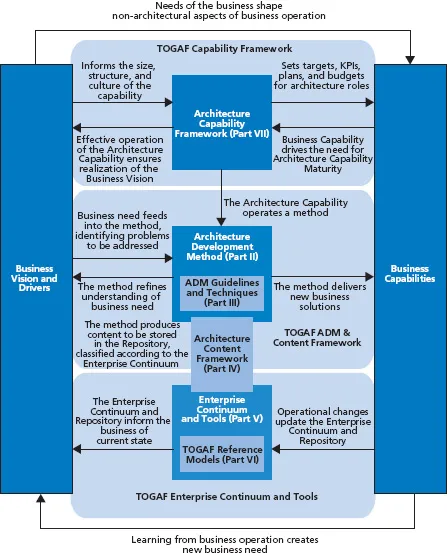
Figure 1: TOGAF Content Overview
Central to TOGAF is the Architecture Development Method (documented in TOGAF, Part II). The architecture capability (documented in TOGAF, Part VII) operates the method. The method is supported by a number of guidelines and techniques (documented in TOGAF, Part III). This produces content to be stored in the repository (documented in TOGAF, Part IV), which is classified according to the Enterprise Continuum (documented in TOGAF, Part V). The repository is initially populated with the TOGAF Reference Models (documented in TOGAF, Part VI).
1.5.1 The Architecture Development Method (ADM)
The ADM describes how to derive an organization-specific enterprise architecture that addresses business requirements. The ADM is the major component of TOGAF and provides guidance for architects on a number of levels:
• It provides a number of architecture development phases (Business Architecture, Information Systems Architectures, Technology Architecture) in a cycle, as an overall process template for architecture development activity.
• It provides a narrative of each architecture phase, describing t...
Table of contents
- Cover
- Title Page
- Copyright
- Contents
- Preface
- Trademarks
- About the Authors
- Acknowledgements
- 1 Introduction
- 2 The Architecture Development Method
- 3 Key Techniques and Deliverables of the ADM Cycle
- 4 Guidelines for Adapting the ADM
- 5 Architecture Content Framework
- 6 The Enterprise Continuum
- 7 TOGAF Reference Models
- 8 Architecture Capability Framework
- Appendix A Migration Summary
- Glossary
- Index
Frequently asked questions
Yes, you can cancel anytime from the Subscription tab in your account settings on the Perlego website. Your subscription will stay active until the end of your current billing period. Learn how to cancel your subscription
No, books cannot be downloaded as external files, such as PDFs, for use outside of Perlego. However, you can download books within the Perlego app for offline reading on mobile or tablet. Learn how to download books offline
Perlego offers two plans: Essential and Complete
- Essential is ideal for learners and professionals who enjoy exploring a wide range of subjects. Access the Essential Library with 800,000+ trusted titles and best-sellers across business, personal growth, and the humanities. Includes unlimited reading time and Standard Read Aloud voice.
- Complete: Perfect for advanced learners and researchers needing full, unrestricted access. Unlock 1.4M+ books across hundreds of subjects, including academic and specialized titles. The Complete Plan also includes advanced features like Premium Read Aloud and Research Assistant.
We are an online textbook subscription service, where you can get access to an entire online library for less than the price of a single book per month. With over 1 million books across 990+ topics, we’ve got you covered! Learn about our mission
Look out for the read-aloud symbol on your next book to see if you can listen to it. The read-aloud tool reads text aloud for you, highlighting the text as it is being read. You can pause it, speed it up and slow it down. Learn more about Read Aloud
Yes! You can use the Perlego app on both iOS and Android devices to read anytime, anywhere — even offline. Perfect for commutes or when you’re on the go.
Please note we cannot support devices running on iOS 13 and Android 7 or earlier. Learn more about using the app
Please note we cannot support devices running on iOS 13 and Android 7 or earlier. Learn more about using the app
Yes, you can access TOGAF® Version 9.1 - A Pocket Guide by Andrew Josey in PDF and/or ePUB format, as well as other popular books in Education & Business Development. We have over one million books available in our catalogue for you to explore.