eBook - ePub
ISO 21500 Guidance on project management - A Pocket Guide
- 154 pages
- English
- ePUB (mobile friendly)
- Available on iOS & Android
eBook - ePub
ISO 21500 Guidance on project management - A Pocket Guide
About this book
This pocket guide explains the content and the practical use of ISO 21500 - Guidance on project management, the latest international standard for project management, and the first of a family of ISO standards for project, portfolio and program management.
ISO 21500 is meant for senior managers and project sponsors to better understand project management and to properly support projects, for project managers and their team members to have a reference for comparing their projects to others and it can be used as a basis for the development of national standards.
This pocket guide provides a quick introduction as well as a structured overview of this guidance and deals with the key issues within project management:
• Roles and responsibilities
• Balancing the project constraints
• Competencies of project personnel
All ISO 21500 subject groups (themes) are explained: Integration, Stakeholder, Scope, Resource, Time, Cost, Risk, Quality, Procurement and Communication.
A separate chapter explains the comparison between, ISO 21500 and PMBOK® Guide PRINCE2, Agile, Lean, Six Sigma and other methods, practices and models.
Finally, it provides a high level description of how ISO 21500 can be applied in practice using a generic project life cycle.
Proper application of this new globally accepted project management guideline will support organizations and individuals in growing their project management maturity consistently to a professional level.
Trusted by 375,005 students
Access to over 1.5 million titles for a fair monthly price.
Study more efficiently using our study tools.
Information
Topic
DidatticaSubtopic
Sviluppo di business1 Introduction
1.1 Purpose of this pocket guide to ISO 21500
ISO 21500 provides generic guidance on the concepts and processes of project management that are important for the successful realization of projects. This pocket guide is intended as a brief reference to assist in quickly understanding the purpose, background and key elements.
What is the value of ISO 21500? This new globally accepted project management standard is recognized as a foundational reference for the application of project management knowledge and good practices. Research has confirmed that, when managing projects, the structured application of this fundamental knowledge and good practices clearly enhances successful delivery. Project environments that consistently apply this fundamental project management good practice approach not only show better project performance in terms of lower costs and shorter delivery times, but they also demonstrate higher levels of customer satisfaction. The application of the project management good practices, as described in ISO 21500, will support you in realizing these benefits.
In addition to the above, when working in a project management environment, for which the organization is far more dynamic than ‘normal’ operations, there is an increased need for good communication. To achieve this, it is important to use ‘one common language’ within your project management environment, which is understood by everyone involved, particularly the key stakeholders of the project. This pocket guide aims to quickly establish a shared vocabulary and terminology on the project management fundamentals and create a common understanding about the basic project management processes together with the key roles and responsibilities. Moreover the guide provides a high level description of how the ISO 21500 guideline can be applied in practice, using a ‘generic’ project life cycle as a reference.
What it’s not? It is definitely not ‘the’ solution for all challenges when managing projects. The project manager and the team remain ultimately responsible for deciding what good practices shall be applied to the specific project at hand, in close cooperation with the project sponsor and the management of the line organization or sponsoring entity.
In a nutshell, this pocket guide is intended as a key contributor and tangible asset when introducing and reinforcing concepts of project management in your organization for improved communication and cooperation. It supports an organization-wide implementation of a project management culture, bringing you the benefits of ‘your projects executed right the first time’! At the organizational level this can be enhanced by implementing a project management approach, based on these good practices.
1.2 Practical tips for using this pocket guide
On the fold out at the back cover of this book, all subject areas and applicable processes and chapter numbers are listed. Key project management terms and definitions are explained in the Glossary of the ISO 21500 terminology, in Appendix B.
1.3 Why apply project management?
Every organization has its unique culture and faces diverse challenges. Also, organizations start with a different situation and set of problems to be resolved. In order to define the value of project management, we firstly need to define exactly what is meant by project management, as this is a broad concept. Then we can look at the various aspects of project management and show the value associated with each aspect.
Project management – ISO 21500 definition:
Project management is the application of methods, tools, techniques and competences to a project. Project management includes the integration of the various phases of the project life cycle. Project management is accomplished through processes.
Research shows that, with the increasing complexity and faster changing environments that businesses are faced with, projects managed by the structured application of good practice-based processes show consistently better performance in areas such as, but not limited to:
• ‘Deliver as promised’ by realistic expectation-setting through up-front project definition, planning, and estimation;
• Faster delivery through the reuse of common and known project management processes;
• Less ‘surprises’ during project execution, utilizing proactive project management processes;
• Improved customer satisfaction and less rework by delivering the right product or service, right, the first time.
These opportunities together with the savings offered by organizational project management excellence are all tangible. But the value proposition for project management is much greater and also includes less tangible benefits like:
• A highly committed and motivated team that can work together through effective communication and goal setting;
• An inspiring project environment with a ‘can-do’ mentality through ambitious yet realistic commitments;
• Transparent and improved decision-making at all organizational levels through more effective communication.
These qualitative benefits will even reinforce the quantitative advantages, which will guarantee that an organization is able to excel.
Many organizations have built a good reputation for being able to consistently deliver top quality projects. However, a majority of organizations are still struggling with this. Do you recognize the following characteristics?
• Projects mostly deliver late, over-budget, or without meeting the functionality requirements of the project sponsor and end-users;
• Project managers do it ‘their way’ as there are no, or poor, standards for project management processes and techniques;
• Project management is regarded as an overhead instead of being recognized as providing business value;
• The project work undertaken by resources from within the line organization is not carefully planned for as part of the operations planning, but is typically regarded as ‘next to your primary function’;
• Project budgets do not include the cost of the internal workforce as they are ‘already paid for’;
• There is no overall insight available on all the projects being undertaken in the organization, nor their cost versus the added value;
• The required work for managing projects proactively is not included in the project plan;
• Projects may be somehow ‘successful’ in the end but only through heavy stress and overtime work.
Do you recognize the above in your project environments? Having more disciplined project management is the way to overcome these shortcomings. The value of a good project management practice, using common project management processes, will enable better communication to deal with contingencies pro-actively. This will substantially and continuously increase the chances of project success. It will establish new management procedures and processes. It will enable you to run your organization as an economic enterprise.
1.4 Successfully fulfilling your role as project sponsor, project manager or project team member
Understanding your role in a project and acting accordingly is vital for project success. Therefore we highlight the three key roles which are the major contributors in realizing a successful project:
1 The project sponsor acts as the continuous link between the funding organization(s) and the project. It is the sponsor who is responsible at the start for defining the Business case for the project; why should we be doing this project; what are the organization’s needs? When the project is approved, the project manager takes over the responsibility for ‘delivery of the defined project objective’. The sponsor still fulfills an ever-important role for ensuring the project objective is aligned to the project goal. The sponsor should, amongst other things, ensure that the organization sticks to its initial decisions regarding goal setting, thus preventing constant priority changes based on daily operational issues. The project sponsor, therefore, plays an important role in ensuring that there is sufficient support from functional and operational management, which in turn fulfills a key role in assigning the appropriate resources to the project team. The sponsor should also support the organization’s readiness to effectively deal with the project objective when it is delivered, as this is where the benefits realization, and consequently increased business value, will start. In order to achieve this, the project sponsor must work closely together with the project manager. The fluent communication between these two roles is crucial for both the project and organizational success.
2 The project manager is ultimately responsible for the delivery of the defined project objective. Key elements in this role are stakeholder management, and guiding the project team and the appropriate stakeholders in selecting and applying the right project management processes at the right time. But everything must be undertaken with an eye on the delivery of the project objective. The project manager must take advantage of the project sponsor’s business knowledge and influential position, and escalate all issues or business-related problems that cannot be solved by the project management team.
3 The project (management) team member is typically responsible for delivering the expertise and work needed to create the project result. During the initial phases of the project, their focus is on defining the best approach and developing a feasible high-level plan for the project; in other words, the planning. During the execution phases, based on their expertise, they realize the project objective and specific subcomponents. It is essential to ensure that the organization which takes over the responsibilities at the end of the project is adequately represented within the project team. This will facilitate a smoother transition of the project objective to the operational or sponsoring organization.
In every project these key roles that are needed for the successful delivery of the project should be clearly described and understood, so that all stakeholders can act accordingly.
Figure 1.1 clearly describes the common relationships between the sponsor organization/entity and the project organization, and shows where each role is positioned.
Note: The sponsor organization/entity should be interpreted in the widest sense to cater for the differences in the various environments in which projects are undertaken.
Projects can run in one single organization, such as one company, business or governmental department. In that case the project results (or deliverables) are normally accepted by Operations in the line organization. However, projects can also be executed by more than one organization (e.g. a joint venture) or in the case of large investment projects they can act more or less independently, like a temporary organization (e.g. for the construction of a railway). In the latter cases we do not have a single sponsor organization, but a sponsor entity, that eventually accepts the project results. Clearly the project governance is also more complex in the latter cases.
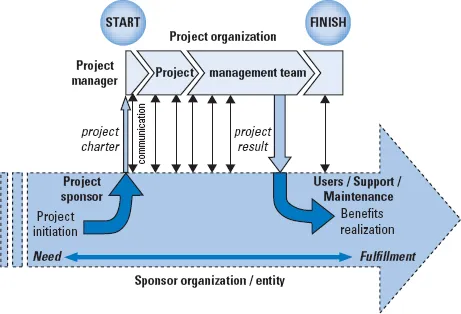
Figure 1.1 Common relationships between sponsor organization/entity and project organization
1.5 Frequently asked questions
We have identified some typical questions that one could ask when first confronted with project management or the ISO 21500 guideline.
What is a project?
Project – ISO 21500 definition:
A project is a unique set of processes consisting of coordinated and controlled activities with start and finish dates, undertaken to achieve an objective. Achievement of the project objective requires deliverables conforming to specific requirements, including multiple constraints such as time, cost and resources.
• This means: It has a defined start and finish, therefore a project is temporary;
• ‘Something’ is finished when the project is finished; it creates an end deliverable, the project objective;
• It is not business as usual, and a...
Table of contents
- Cover
- Title
- Colophon
- Tabel of contents
- Preface
- Acknowledgements
- 1 Introduction
- 2 ISO 21500 background and overview
- 3 ISO 21500 and roles and responsibilities
- 4 ISO 21500 and balancing the project constraints
- 5 ISO 21500 and competences of project personnel
- 6 ISO 21500 Subject groups
- 7 ISO 21500 compared to other methods, practices and models
- 8 ISO 21500 in practice
- Annex A ISO 21500 self-assessment
- Annex B Glossary
- Annex C References
- About the authors
Frequently asked questions
Yes, you can cancel anytime from the Subscription tab in your account settings on the Perlego website. Your subscription will stay active until the end of your current billing period. Learn how to cancel your subscription
No, books cannot be downloaded as external files, such as PDFs, for use outside of Perlego. However, you can download books within the Perlego app for offline reading on mobile or tablet. Learn how to download books offline
Perlego offers two plans: Essential and Complete
- Essential is ideal for learners and professionals who enjoy exploring a wide range of subjects. Access the Essential Library with 800,000+ trusted titles and best-sellers across business, personal growth, and the humanities. Includes unlimited reading time and Standard Read Aloud voice.
- Complete: Perfect for advanced learners and researchers needing full, unrestricted access. Unlock 1.5M+ books across hundreds of subjects, including academic and specialized titles. The Complete Plan also includes advanced features like Premium Read Aloud and Research Assistant.
We are an online textbook subscription service, where you can get access to an entire online library for less than the price of a single book per month. With over 1.5 million books across 990+ topics, we’ve got you covered! Learn about our mission
Look out for the read-aloud symbol on your next book to see if you can listen to it. The read-aloud tool reads text aloud for you, highlighting the text as it is being read. You can pause it, speed it up and slow it down. Learn more about Read Aloud
Yes! You can use the Perlego app on both iOS and Android devices to read anytime, anywhere — even offline. Perfect for commutes or when you’re on the go.
Please note we cannot support devices running on iOS 13 and Android 7 or earlier. Learn more about using the app
Please note we cannot support devices running on iOS 13 and Android 7 or earlier. Learn more about using the app
Yes, you can access ISO 21500 Guidance on project management - A Pocket Guide by Anton Zandhuis,Rommert Stellingwerf in PDF and/or ePUB format, as well as other popular books in Didattica & Sviluppo di business. We have over 1.5 million books available in our catalogue for you to explore.