
- 112 pages
- English
- ePUB (mobile friendly)
- Available on iOS & Android
eBook - ePub
Scrum - A Pocket Guide
About this book
This pocket guide is the one book to read for everyone who wants to learn about Scrum.
The book covers all roles, rules and the main principles underpinning Scrum, and is based on the Scrum Guide Edition 2013. A broader context to this fundamental description of Scrum is given by describing the past and the future of Scrum.
The author, Gunther Verheyen, has created a concise, yet complete and passionate reference about Scrum. The book demonstrates his core view that Scrum is about a journey, a journey of discovery and fun. He designed the book to be a helpful guide on that journey.
Ken Schwaber, Scrum co-creator says that this book currently is the best available description of Scrum around. The book combines some rare characteristics:
• It describes Scrum in its entirety, yet places it in a broader context (of past and future).
• The author focuses on the subject, Scrum, in a way that it truly supports the reader. The book has a language and style in line with the philosophy of Scrum.
• The book shows the playfulness of Scrum.
David Starr and Ralph Jocham, Professional Scrum trainers and early agile adopters, say that this is the ultimate book to be advised as follow-up book to the students they teach Scrum to and to teams and managers of organizations that they coach Scrum to.
Trusted by 375,005 students
Access to over 1 million titles for a fair monthly price.
Study more efficiently using our study tools.
Information
Topic
EducationSubtopic
Business Development
■ 1.1 TO SHIFT OR NOT TO SHIFT
The software industry was for a long time dominated by a paradigm of industrial views and beliefs (figure 1.1). This was in fact a copy-paste of old manufacturing routines and theories. An essential element in this landscape of knowledge, views and practices was the Taylorist1 conviction that ‘workers’ can’t be trusted to undertake intelligent and creative work. They are expected to only carry out executable tasks. Therefore their work must be prepared, designed and planned by more senior staff. Furthermore, hierarchical supervisors must still vigilantly oversee the execution of these carefully prepared tasks. Quality is assured by admitting the good and rejecting the bad batches of outputs. Monetary rewards are used to stimulate desired behavior. Unwanted behavior is punished. It’s like carrots and sticks.
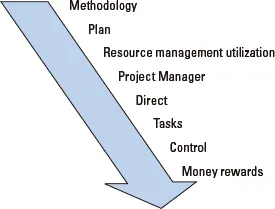
Figure 1.1 The industrial paradigm
The serious flaws of this paradigm in software development are known and well documented. In particular, the Chaos reports of the Standish Group have over and over again revealed the low success rates of traditional software development. The latest of these reports is dated 2011 (Standish, 2011). Many shortcomings and errors resulting from the application of the industrial paradigm in software development are well beyond reasonable levels of tolerance. The unfortunate response seems to have been to lower the expectations. It was accepted that only 10-20% of software projects would be successful. Success in the industrial paradigm is made up of the combination of on time, within budget and including all scope. Although these criteria for success can be disputed, it is the paradigm’s promise. It became accepted that quality is low, and that over 50% of features of traditionally delivered software applications are never used (Standish, 2002).
Although it is not widely and consciously admitted, the industrial paradigm did put the software industry in a serious crisis. Many tried to overcome this crisis by fortifying the industrial approach. More plans were created, more phases scheduled, more designs made, more work was done upfront, hoping for the actual work to be undertaken to be executed more effectively. The exhaustiveness of the upfront work was increased. The core idea remained that the ‘workers’ needed to be directed with even more detailed instructions. Supervision was increased and intensified.
And still, little improved. Many flaws, defects and low quality had to be tolerated.
It took some time, but inevitably new ideas and insights started forming following the observation of the significant anomalies of the industrial paradigm. The seeds of a new world view were already sown in the 1990’s. But it was in 2001 that these resulted in the formal naming of ‘Agile’, a turning-point in the history of software development. A new paradigm for the software industry was born (figure 1.2); a paradigm that thrives upon heuristics and creativity, and restoring the respect for the creative nature of the work and the intelligence of the ‘workers’ in software development.
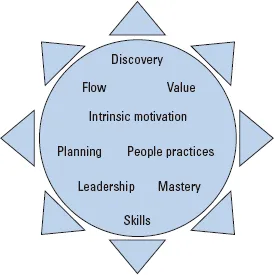
Figure 1.2 The Agile paradigm
The software industry has good reasons to move fast to the new paradigm; the existing flaws are significant, widely known and the presence of software in society grows exponentially, making it a critical aspect of our modern world. However, by definition, a shift to a new paradigm takes time. And the old paradigm seems to have deep roots. An industrial approach to software development even continues to be taught and promoted as the most appropriate one.
Many say that Agile is too radical and they, therefore, propagate a gradual introduction of Agile practices into the existing, traditional process. However, there is reason to be very skeptical about a gradual evolution, a slow progression from the old to the new paradigm, from waterfall to Agile.
The chances are quite high that a gradual evolution will never go beyond the surface, will not do more than just scratch that surface. New names will be installed, new terms and new practices will be imposed, but the fundamental thinking and behavior of people and organizations will remain the same. Essential flaws will remain untouched; especially the disrespect for people that will lead to the continued treatment of creative, intelligent people as mindless ‘workers’.
The preservation of the traditional foundation will keep existing data, metrics and standards in place, and the new paradigm will be measured against these old standards. Different paradigms by their nature consist of fundamentally different concepts and ideas, often even mutually exclusive. In general, no meaningful comparison between the industrial and the Agile paradigms is possible. It requires the honesty to accept the serious flaws of the old ways, and for leadership and entrepreneurship to embrace the new ways, thereby abandoning the old thinking.
A gradual shift is factually a status-quo situation that keeps the industrial paradigm intact.
There is overwhelming evidence that the old paradigm doesn’t work. But much of the evidence on Agile was anecdotal, personal or relatively minor. The Chaos report of 2011 by the Standish Group marks a turning point. Extensive research was done in comparing traditional projects with projects that used Agile methods. The report shows that an Agile approach to software development results in a much higher yield, even against the old expectations that software must be delivered on time, on budget and with all the promised scope. The report shows that the Agile projects were three times as successful, and there were three times fewer failed Agile projects compared with traditional projects. It is clear that against the right set of expectations, with a focus on active customer collaboration and frequent delivery of value, the new paradigm would be performing even better.
Yet, Agile is a choice, not a must. It is one way to improve the software industry. Research shows it is more successful.

The distinct rules of Scrum help in getting a grip on the new paradigm. The small set of prescriptions, as described in the following chapter, allows immediate action and results in a more fruitful absorption of the new paradigm. Scrum is a tangible way to adopt the Agile paradigm. Via Scrum, people do develop new ways of working; through discovery, experimentation-based learning and collaboration. They enter this new state of being, this state of agility; a state of constant change, evolution and improvement.
Nevertheless, despite its practicality, experience shows that adopting Scrum often represents a giant leap. This may be because of uncertainty, letting go of old certainties even if they prove not to be very reliable. It may be because of the time that it takes to make a substantial shift. It may be because of the determination and hard work that is required.
■ 1.2 THE ORIGINS OF AGILE
Despite the domination of the plan-driven, industrial views, an evolutionary approach to software development is not new. Craig Larman has extensively described the historical predecessors of Agile in his book ‘Agile & Iterative Development, A Manager’s Guide’ (Larman, 2004).
But the official label ‘Agile’ dates from early 2001, when 17 software development leaders gathered at the Snowbird ski resort in Utah. They discussed their views on software development in times when the failing waterfall approaches were replaced by heavy-weight RUP implementations, which did not in fact lead to better results than the traditional processes. These development leaders were following different paths and methods, each being a distinct implementation of the new paradigm; Scrum, eXtreme Programming, Adaptive Software Development, Crystal, Feature Driven Development, DSDM, etc.
The gathering resulted in assigning the label ‘Agile’ to the common principles, beliefs and thinking of these leaders and their methods. They were published as the ‘Manifesto for Agile Software Development’ (Beck, et.al., 2001). (See figure 1.3).
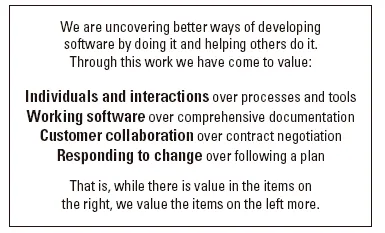
Figure 1.3 The text of the Manifesto for Agile Software Development
I often overhear the desire “to do Agile”. And all too often it is the desire for a magical solution, another silver bullet process that solves all problems. It makes me state that “Agile does not exist”. Agile is not one fixed process, method or practice. Agile is the collection of principles that the methods for Agile software development have in common. Agile refers to the mindset, the convictions and the preferences expressed in the Manifesto for Agile Software Development.
The manifesto does help to grasp the ideas underpinning Agile. If you use it as a source to gain a deeper understanding of Agile, then I strongly advise looking at the 12 principles, see: http://agilemanifesto.org/principles.html
■ 1.3 DEFINITION OF AGILE
I prefer to describe ‘Agile’ in terms of the following key characteristics that are common to the portfolio of Agile methods:
■ People driven;
■ Facilitation;
■ Iterative-incremental process;
■ Measuring success;
■ Change.
1.3.1 People driven
Agile software development is not driven by a predictive plan describing how to implement analyzed, designed and architected requirements. Agile acknowledges that requirements cannot be predicted in every possible detail in an upfront way.
Agile is not a process of handing over different types of intermediate deliverables to different specialist departments, where each department performs its specialized work in isolation.
Agile is driven by the continuous collaboration of people ranging over all required departments; whether they are called business, IT, marketing, sales, customer service, operations or management.
People are respected for their creativity, intelligence and self-organizing capabilities. People are respected for their ability to understand and resolve a problem without being overloaded with too much ceremony and bureaucracy. A ceremonial overload only replaces this col...
Table of contents
- Cover
- Title
- Colophon
- Foreword by Ken Schwaber
- Preface
- Reviews
- Contents
- 1 The Agile Paradigm
- 2 Scrum
- 3 Tactics for a Purpose
- 4 The Future State of Scrum
- Annex A: Scrum vocabulary
- Annex B: References
- About the author
Frequently asked questions
Yes, you can cancel anytime from the Subscription tab in your account settings on the Perlego website. Your subscription will stay active until the end of your current billing period. Learn how to cancel your subscription
No, books cannot be downloaded as external files, such as PDFs, for use outside of Perlego. However, you can download books within the Perlego app for offline reading on mobile or tablet. Learn how to download books offline
Perlego offers two plans: Essential and Complete
- Essential is ideal for learners and professionals who enjoy exploring a wide range of subjects. Access the Essential Library with 800,000+ trusted titles and best-sellers across business, personal growth, and the humanities. Includes unlimited reading time and Standard Read Aloud voice.
- Complete: Perfect for advanced learners and researchers needing full, unrestricted access. Unlock 1.4M+ books across hundreds of subjects, including academic and specialized titles. The Complete Plan also includes advanced features like Premium Read Aloud and Research Assistant.
We are an online textbook subscription service, where you can get access to an entire online library for less than the price of a single book per month. With over 1 million books across 990+ topics, we’ve got you covered! Learn about our mission
Look out for the read-aloud symbol on your next book to see if you can listen to it. The read-aloud tool reads text aloud for you, highlighting the text as it is being read. You can pause it, speed it up and slow it down. Learn more about Read Aloud
Yes! You can use the Perlego app on both iOS and Android devices to read anytime, anywhere — even offline. Perfect for commutes or when you’re on the go.
Please note we cannot support devices running on iOS 13 and Android 7 or earlier. Learn more about using the app
Please note we cannot support devices running on iOS 13 and Android 7 or earlier. Learn more about using the app
Yes, you can access Scrum - A Pocket Guide by Gunther Verheyen in PDF and/or ePUB format, as well as other popular books in Education & Business Development. We have over one million books available in our catalogue for you to explore.