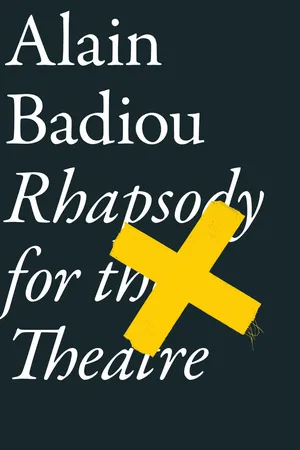
For Alain Badiou, theatre-unlike cinema-creates a space in which philosophy can be lived. It is, of all the arts, the most closely related to politics: both depend on a limited number of texts or statements, which are collectively enacted by a group of actors or militants who test the limits of the structure inn which they are confined, be it the medium of drama or the nation-state. For this reason, the history of theatre is inseparable from the history of state repression and censorship.
This definitive collection of Badiou's work on the theatre includes not only the title essay "Rhapsody for the Theatre," originally published as a pamphlet in France, but also essay on Jean-Paul Sartre, on the political destiny of contemporary drama, and on Badiou's own work as a playwright.
Trusted by 375,005 students
Access to over 1.5 million titles for a fair monthly price.
RHAPSODY FOR THE THEATRE: A SHORT PHILOSOPHICAL TREATISE
I
It is as good a division of the world as any other to observe that there are and have been societies with theatre and others without theatre. And that in societies that know this strange public place, where fiction is consumed as a repeatable event, this has always met with reticence, anathema, major or minor excommunications, as well as enthusiasm. More specifically, next to the spiritual suspicion that befalls theatre, there is always the vigilant concern of the State, to the point where all theatre has been one of the affairs of the State and remains so to this day!
Who fails to see that this territorial and mental division has the additional merit of cutting across that other, all-too-saturated divide of West and East or of North and South? Because at the far end of this East we find the brilliance of a theatre of exception, whereas it is generally elided from Islam. I say ‘generally’ because no consideration of universal theatricality can ignore the sacred dramas through which Iranian Shi’ism conferred Presence upon its founding martyr.
In this last case, the scandal is home to a heresy. But all true Theatre is a heresy in action. I have the habit of calling its orthodoxy ‘theatre’: an innocent and prosperous ritual, from which Theatre detaches itself as a rather implausible lightning bolt.
II
Another observation to set things in motion: if cinema is everywhere, it is no doubt because it requires no spectator, only the walls surrounding a viewing public. Let’s say that a spectator is real, whereas a viewing public is merely a reality, the lack of which is as full as a full house, since it is only a matter of counting. Cinema counts the viewers, whereas theatre counts on the spectator, and it is in the absence of either one or the other that critics, in a disastrous paradox, invent the spectator of a film and the viewer of a play. François Truffaut deciphers the spectator in the chandelier, but this chandelier is the opposite of the movie projector.
III
I once saw Guy Debord’s complete cinematographic oeuvre (which, significantly, had been published in book form) projected without pause, centred on the superb In girum imus nocte et consumimur igni (1978), indifferent to the emptiness as much as to the fullness (not of the chandelier but of the seat) in a movie theatre in Paris. This was made possible by the grace of the friendship of Gérard Lebovici, whom killers have since then found it in themselves to shoot down (the man behind such an idea of friendship in art, it must be said regardless of all other considerations, is at once a bit suspect for those who traffic in shadows). This pure temporal moment speaks to the glory of cinema, which may very well survive us humans. It is utterly foreign to theatre, which does not take place without spectators, since in this last case the representation (a word that we will put to the test at length) changes over into a supplementary rehearsal – the exact opposite of those ‘dress rehearsals’ and other ‘final run-throughs’ that, through a bit too much of the spectator’s real, turn into the premature event of the spectacle’s already having taken place.
IV
In the midst of the ‘red years’, around 1971–2, a group dedicated to cultural intervention, the Groupe Foudre, took it upon itself to cause a racket against the first outbursts of the ‘revisionist’ malady in the reassessment of the World War II. Movies such as Lacombe Lucien1 or Night Porter2 turned the equivocation between victim and executioner into a fiction, all the while making criminal choices seem innocent. Since then, we certainly have seen where all this would lead. The Groupe Foudre thus readily went to shout down and interrupt those disquieting tripes. Ah, to think of the charming lightness, the polemical health of that era! The watchword invented at the time was: ‘Down with the obscurantism of the obscure rooms!’ The mistake consisted in ignoring the fact that obscurantism can only be public and that cinema, unlike theatre, is by no means a public place, even if it appears to be one. What is wrapped in obscurity is the private individual, to whom after all we cannot deny the right to obscurity just like that. It is useless to intervene in cinema, because there is no spectator to be found, and, by logical consequence, no public. Being a private industry, cinema is also a private spectacle. The time of projection is that of an inconsistent gathering, a serial collection. Cinema, disconnected from the State, proposes no collective signification. The Groupe Foudre was justified in its polemic, full of joy in its action (ah! the ink squirts against the screen on which the colonial paratroopers were strutting, all worked up by the awful John Wayne, in that abomination titled The Green Berets!), but it was mistaken in the choice of its site: theatre alone is tied to the State, cinema belongs only to Capital. The former oversees the Crowd, the latter disperses individuals. Cultural–political intervention, which was what the Groupe Foudre dreamed of, has only one possible destination: the theatre. In any case, even here it risks becoming theatricalized rather than politicized.
V
So theatre is an affair of the State, which is morally suspicious, and requires a spectator. That much we know.
We would be better guided in all this, I will say it once and for all, if we relied on a systematic use of François Regnault’s The Spectator, which is a nearly complete treatise on modern theatre.3 His guide would give us a different outlook from mine: the outlook of the man of the theatre, which is what Regnault is and which I am not.
The Spectator: point of the real by which a spectacle comes into being and which, as Regnault tells us, corresponds to the taciturn and haphazard evening visitor.
VI
Unless we have recourse to Mallarmé, whose famous Book (as we know from the calculations with which he, like a dreamy apothecary, enumerated the necessary attendants) after all had the form of a Representation.
Mallarmé claims that in his time (but ours is worth as little as his) there is nothing historically real, for lack of a self-declared political collective, and, consequently, that it is theatre that gathers whatever is available to us in terms of action. Here are, in his own style, the two axioms which, for any contemporary thinking of theatre, it would suffice to clarify and meditate upon:
• There is no such thing as a present, for lack of a Crowd’s declaring itself.
• Action does not go beyond the Theatre.
Let me add the lesson from Regnault that within him, the Spectator, resides the self-declared Crowd and the untranscendable Action. To him everything is devoted.
VII
Theatre thus distinguishes itself according to the State, of which it is an affair (but why?), according to Morality, for which it is a suspect (but why?), and according to the Spectator, from whom it derives its point of the real, namely, that which interrupts the rehearsals. In this last regard, the essence of theatre lies in the existence of the opening night. The fact that there is a second night, so feared by the actors, touches upon the State. That there is a third presupposes that Morality did not prevent it from happening.…
But, at the same time, theatre is made up of nothing of the kind. For theatre is a material, corporeal, machinic assemblage. How do those majestic instances (the State, Morality, the Public) come to attach themselves to the scattered and nomadic matter of such an outrageously artisanal operation? What? Some scraps of paper, some rags, a small lamp, three chairs, and a sweet talker from the banlieues, and you are ready to claim that public power, morals, and the collective are put on hold, if not endangered?
You better begin by the strict enumeration of the ‘parts of the theatre’, in the same way that Aristotle spoke of the ‘parts of animals’. Show me the animal before concluding, like some abridged Mallarmé, as to its ‘superior essence’.4
VIII
Let’s posit that there is theatre as soon as we can enumerate: first, a public gathered with the intent of a spectacle; second, actors who are physically present, with their voices and bodies, in a space reserved for them with the express purpose of the gathered public’s consideration; and, third, a referent, textual or traditional, of which the spectacle can be said to be the representation.
The third condition excludes mime and dance from being considered theatre, at least when they make up the entire spectacle; it also excludes pure and unrepeatable improvisation. These are theatrical exercises or ingredients, but they are not theatre.
The second condition is incompatible with the idea of a theatre of objects, or with the purely mechanical production of words. A tape recorder can figure onstage, as we see in Jean-Paul Sartre’s The Condemned of Altona or, better yet, in Samuel Beckett’s Krapp’s Last Tape. However, it is the interlocution between actor and machine that makes for theatre. The machine in and of itself could hardly provide for that.
The first condition excludes that we pretend to be doing theatre by way of the simple theatricalization, out on the streets or indoors, of life as it is. We require a special convocation and a willingness to respond. That there is the need for a public prohibits the idea of theatre for nobody, but not of theatre for a single person, since the latter, as soon as she enters the place of theatre and takes her seat, constitutes a gathering unto herself.
IX
But now onto this elementary description another one superimposes itself, as if theatre were isomorphic with that singular activity we call ‘politics’ (I am not talking here about the monotonous administration of the State).
In fact, we could argue that there is politics when three things form a knot: the masses who all of a sudden are gathered in an unexpected consistency (events); the points of view incarnated in organic and enumerable actors (subject-effects); a reference in thought that authorizes the elaboration of discourse based upon the mode in which the specific actors in question are held together, even at a distance, by the popular consistency to which chance summons them.
The third point separates politics from everything that is merely blind fury or a nondiscursive impulse. The latter is only the material for politics, not its essence. The social as such is not politics, even if it may be required; nor is the institutional dimension, when taken separately, or the national as the instinct for a place or for an identity.
The second point refuses the existence of a politics that would be unanimous, undivided, monolithic. All existing politics organizes a scission. There is no nonpartisan politics.
The first point, inversely, excludes that a reasonable play of institutions alone would be political. For politics to happen, a haphazard point of the real is needed that is revealed by the dispersion abruptly introduced into that which, on the part of the State, ordinarily rules over the general passivity, the symbolic invisibility, of the real of History.
Public, actors, text-thought: would politics be that for which History is only the stage? Is this too romantic an idea? We must come to understand the effects of these axioms, all the while observing in passing that Mallarmé’s axioms already engaged both the (missing) Crowd and the (restricted) Action.
X
Of the three elementary conditions of theatre (public, actors, textual referent), which are transcendental or a priori conditions, we c...
Table of contents
Cover
Title Page
Copyright
Contents
Introduction by Bruno Bosteels
1. Rhapsody for the Theatre: A Short Philosophical Treatise
2. Theatre and Philosophy
3. The Political Destiny of Theatre Yesterday and Today
4. Notes on Jean-Paul Sartre’s The Condemned of Altona
5. The Ahmed Tetralogy
6. Three Questions to the Author
Sources
Frequently asked questions
Yes, you can cancel anytime from the Subscription tab in your account settings on the Perlego website. Your subscription will stay active until the end of your current billing period. Learn how to cancel your subscription
No, books cannot be downloaded as external files, such as PDFs, for use outside of Perlego. However, you can download books within the Perlego app for offline reading on mobile or tablet. Learn how to download books offline
Perlego offers two plans: Essential and Complete
Essential is ideal for learners and professionals who enjoy exploring a wide range of subjects. Access the Essential Library with 800,000+ trusted titles and best-sellers across business, personal growth, and the humanities. Includes unlimited reading time and Standard Read Aloud voice.
Complete: Perfect for advanced learners and researchers needing full, unrestricted access. Unlock 1.5M+ books across hundreds of subjects, including academic and specialized titles. The Complete Plan also includes advanced features like Premium Read Aloud and Research Assistant.
Both plans are available with monthly, semester, or annual billing cycles.
We are an online textbook subscription service, where you can get access to an entire online library for less than the price of a single book per month. With over 1.5 million books across 990+ topics, we’ve got you covered! Learn about our mission
Look out for the read-aloud symbol on your next book to see if you can listen to it. The read-aloud tool reads text aloud for you, highlighting the text as it is being read. You can pause it, speed it up and slow it down. Learn more about Read Aloud
Yes! You can use the Perlego app on both iOS and Android devices to read anytime, anywhere — even offline. Perfect for commutes or when you’re on the go. Please note we cannot support devices running on iOS 13 and Android 7 or earlier. Learn more about using the app
Yes, you can access Rhapsody for the Theatre by Alain Badiou, Bruno Bosteels in PDF and/or ePUB format, as well as other popular books in Philosophy & Theatre History & Criticism. We have over 1.5 million books available in our catalogue for you to explore.