- 304 pages
- English
- ePUB (mobile friendly)
- Available on iOS & Android
eBook - ePub
About this book
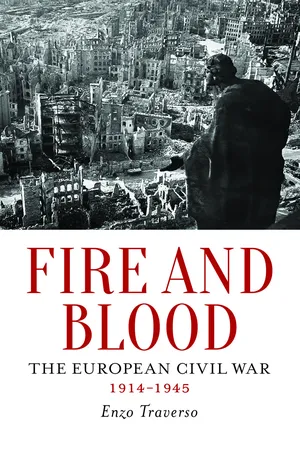
Fire and Blood looks at the European crisis of the two world wars as a single historical sequence: the age of the European Civil War (1914-1945). Its overture was played out in the trenches of the Great War; its coda on a ruined continent. It opened with conventional declarations of war and finished with "unconditional surrender." Proclamations of national unity led to eventual devastation, with entire countries torn to pieces. During these three decades of deepening conflicts, a classical interstate conflict morphed into a global civil war, abandoning rules of engagement and fought by irreducible enemies rather than legitimate adversaries, each seeking the annihilation of its opponents. It was a time of both unchained passions and industrial, rationalized massacre. Utilizing multiple sources, Enzo Traverso depicts the dialectic of this era of wars, revolutions and genocides. Rejecting commonplace notions of "totalitarian evil," he rediscovers the feelings and reinterprets the ideas of an age of intellectual and political commitment when Europe shaped world history with its own collapse.
Trusted by 375,005 students
Access to over 1 million titles for a fair monthly price.
Study more efficiently using our study tools.
Information
Topic
HistoriaSubtopic
Historia del siglo XXPART I
PATHS TO ACTION
Civil war, the culminating form of class struggle, violently abolishes all moral ties between enemy classes.
Leon Trotsky, Their Morals and Ours (1938)
Civil war is bellum with a justa causa on both sides, but also with in-justus hostis on both sides.
Carl Schmitt, Glossarium (1947)
ONE
Commencement
Interpretations
During the first half of the twentieth century, Europe experienced an extraordinary entanglement of conflicts: ‘classic’ wars between states; civil wars; wars of national liberation; genocides; violent confrontations arising from cleavages of class, nation, religion, politics and ideology. Many contemporary observers and, in their wake, several historians, have sought to sum up the meaning of this turbulent age by placing it under the sign of a ‘European civil war’. The comprehensive character and evocative power of this formula have assured it a certain success, but its status remains vague and uncertain. The term is quite frequently used, but it has rarely been subjected to any rigorous conceptualization or overall study.1 Its originator seems to have been the German painter Franz Marc, in a letter he wrote from the front shortly before his death at Verdun. As opposed to what propaganda claimed, he noted, the world war was neither a war against an eternal enemy nor a conflict of races, but ‘a European civil war, a war against the inner invisible enemy of the European spirit’.2
Similar formulae can be found in many postwar writers. In the opening pages of his essay on ‘total mobilization’ (1930), Ernst Jünger stressed the link between ‘the world war and the world revolution’, two phenomena between which there was ‘a deep imbrication’. Both things, he wrote, were simply ‘two sides of the same event of planetary scope, correlated in respect of both their origin and the manner in which they appeared’.3 Basically, the war of 1914–18 had simply been an apocalypse showing ‘Europe struggling against Europe’ in a climate of ‘civil war’.4 In November 1942, while Jünger was posted to the Wehrmacht headquarters in Paris, he similarly described this latest conflict in his journal as ‘a civil war on the world scale’ (Weltbürgerkrieg).5 This new war went far beyond the context of a traditional confrontation between powers, being now transformed into a global conflagration that was horrendously destructive. A few months later, having returned from a mission to the Caucasus at the moment of the German defeat at Stalingrad, Jünger reasserted this idea in still darker terms: ‘The war in the East is absolute, to a degree that Clausewitz could not have conceived, even after the experiences of 1812 – it is a war between states, between peoples, between citizens and between religions, with the object of zoological extinction.’6
Karl Löwith, exiled in Japan, examined in 1940 the dissolution of European unity, the true background of the war under way. The core of this broken unity was not material, but lay in a ‘shared spiritual disposition’.7 It was precisely because the issue at stake was the unity of the continent that the First World War, according to Löwith, had been ‘a civil war’.8 Its result was not unity but the advent of nihilism, a nihilism he interpreted as ‘the negation of existing civilization’,9 in other words the destruction of all values handed down by the European tradition.
There is a tendency today to associate the idea of ‘European civil war’ with the German historian Ernst Nolte, who used it for the title of one of his best-known books. For him, it defines the period that began with the October Revolution and ended with the defeat of Nazism. His interpretation is implicit in his book’s subtitle: ‘National Socialism and Bolshevism’, alluding to a conflict generated by the totalitarian germ of Communism, whose crimes the Nazis did no more than simply copy.10 On close examination, this thesis was already present in outline in his first book, Three Faces of Fascism, where he defined Nazism as a movement ‘radically opposed yet related’ to Marxism, which it combated by ‘the use of almost identical, and yet typically transformed methods’.11 In an isolated passage that is generally unnoticed, he even put forward the idea that would later form the focus of the Historikerstreit, attributing to Hitler a view of Bolshevism as ‘the most radical form of Jewish genocide ever known’.12 By way of conclusion to this first book of his, Nolte located the underlying core of fascism in resistance to the ‘transcendence’ of the modern world, a ‘transcendence’ embodied in its radical form by Marxism (on the philosophical level) and Bolshevism (on the political level). Fascism, accordingly, was an organized reaction against the advent of modernity, equally radical as its enemy in an age of wars and revolutions. As a rejection of this ‘practical transcendence’, fascism was naturally situated in a conservative or even reactionary tradition. But it also took the form of a ‘struggle against theoretical transcendence’, which denied the modern world while challenging it from within, ‘on the ground specific to it’.13 In order to combat modernity, when this took the form of revolution, a counter-revolution was needed – in other words a ‘conservative revolution’. Charles Maurras had been the first to understand that ‘radical reaction means revolution against the revolution’,14 indicating the direction that the fascist movements would take after the Great War. Maurras’s counter-revolution might still have aimed at a restoration of the Bourbons, but he opened the path subsequently taken by Mussolini and Hitler with other objectives. There was a clear continuity between counter-revolution and fascism. Which is why, against the prevailing trend in historiography (though Sternhell would later echo him), Nolte saw Action Française as a fascist movement.
In short, Nolte interpreted the twentieth century as an age dominated by a radical conflict between transcendence and resistance to transcendence, i.e. between revolution and counter-revolution, Communism and fascism.15 According to Nolte, the gigantic confrontation which tore the world apart after 1917 had been prefigured at the philosophical level by Marx and Nietzsche. In the nineteenth century, the author of The Birth of Tragedy had been the first representative of a radical revolt against the modern world. His view of modernity as a world with neither gods nor prophets inspired his critique of ‘theoretical transcendence’, while his rejection of democracy, mass society and socialism announced the coming battle against ‘practical transcendence’. Marx, who gave a philosophical and political form to the great ‘slave uprising’ of the modern age, was the antithesis of Nietzsche, the two respectively embodying revolution and counter-revolution. Nolte found in Nietzsche a ‘prediction of the great civil war’ that would break out in the twentieth century, as well as the ‘concept of unavoidable extermination’ that would accompany it.16 With Bolshevism, the ‘universal threat’ that Nietzsche had a presentiment of had taken a ‘concrete form’.17
Nolte never changed the broad lines of this interpretation. In a chapter of his Streitpunkte devoted to the Nazi view of Bolshevism as a ‘doctrine of humanity in Asiatic and barbarian guise’, he recalled Zinoviev’s 1920 speech in Baku to the Congress of Peoples of the East. This first attempt to organize the colonized peoples in an international movement had a strong impact on the fascist imagination. At Nazi meetings, Hitler, Himmler and Goebbels were in the habit of describing the Russian Revolution as a ‘revolution of Untermenschen’,18 a gigantic uprising aimed against Western civilization.
The historian Horst Möller, in the laudatio he delivered at the awarding of the Konrad Adenauer Foundation’s prize to Ernst Nolte in 2000, detected a Spenglerian accent throughout the work of his colleague.19 Nolte presented himself as a resigned and contemplative critic of modernity, almost Weberian, but there is an echo in his work of a warlike chaos bearing the traces of the ‘conservative revolution’. Nolte also received his demons from that tradition – from an anti-Semitic view of the ‘Jew’ as secret motor of the modern world: the heart of ‘transcendence’. His books, while helping us penetrate the mental dispositive and thought system of Nazism, at the same time reproduce certain essential features of this. In Streitpunkte, Nolte does indeed define the Jewish genocide as ‘the most terrible mass murder in world history’,20 but he interprets it as a derivative crime, a mere ‘imitation’ of the Bolshevik ‘genocide’. It is in Bolshevism that the real source of evil lies, and it found its natural representatives among the Jews: the people, Nolte writes citing Nietzsche, who ‘began the revolt of the slaves in morality’.21
The polemics that Nolte’s argument aroused are very well known. We should note, however, that it is far from exhausting the richness and plurality of meanings of the concept of European civil war found in the work of several authors. Many historians, rejecting Nolte’s apologetic approach, have dated the start of this civil war to 1914 rather than 1917.22 They agree in emphasizing that, far beyond the collapse of a system of alliances and a balance between the Great Powers, the First World War marked the end of a certain idea of Europe and the starting-point of a new epoch of crises, including social, political and military conflicts. This is an old idea, its premises found already in a book from the early 1950s: Hannah Arendt’s The Origins of Totalitarianism. Here the Great War is described as the ‘explosion’ of the Old World, its shattered pieces tearing and knocking against each other in a disorder that no longer corresponded either to the previous system of empires nor to a coherent grouping of national states. And the ‘twenty years of uneasy peace’ that followed the first world conflict are seen here as a chain reaction of ‘civil wars … bloodier and more cruel than all their predecessors’, finally leading only to a second general explosion still greater and more devastating than the first.23
More recently, the European crisis of the years 1914–45 has been called a ‘civil war’ by historians such as the Marxist Eric Hobsbawm and the liberal François Furet, who each emphasize from their different perspectives its essentially ‘ideological’ nature. The former contrasts the world that issued from the trenches of 1914 with that which preceded it, a ‘golden age’ of stability and security dominated by the idea of peace and progress. This was a world in which, in Europe at least, figures in millions were used to refer to the tons of coal and steel produced by the continent’s industries – not, as subsequently, to the number of victims of wars and genocides. In The Age of Extremes, Hobsbawm uses the concept of ‘ideological international civil war’24 to describe, well beyond the conflict between Communism and fascism, the rent in a continent ravaged by the moral confrontation between ‘two different ideological families’: on the one hand, the Enlightenment, a tradition that also includes, quite naturally, the Russian Revolution; and on the other hand, the anti-Enlightenment, i.e. fascism.25 The Great War was a watershed: its outbreak marked the end of the ‘long’ nineteenth century and the opening of an age of civil war. This latter thus coincides with the first part of a ‘short’ century, which Hobsbawm calls the ‘age of catastrophe’. ‘Ideological civil war’ and ‘age of catastrophe’: these two formulae are to some extent interchangeable.
For François Furet, too, the Second World War was a conflict that followed an ‘ideological logic’,26 situated in the context created by the turning-point of 1914. After the conflagration sparked by the Sarajevo assassination, the face of Europe was never again the same. The hiatus dividing these two epochs was so deep that the First World War appears to Furet as ‘one of the most enigmatic events of modern history’. Despite causing ‘an enormous break with what preceded it’, it ‘seems almost absurd: a civil war, but waged between sovereign states in the name of nationalistic passions’.27 This European crisis provides the matrix of two anti-liberal reactions, Communism and fascism, antinomic but in some ways parallel and twin, which Furet interprets as the actors in the totalitarian parenthesis that upset the ineluctable path of Western civilization towards democratic liberalism. For Hobsbawm, this civil war was worth wa...
Table of contents
- Cover Page
- Halftitle Page
- Title Page
- Copyright Page
- Dedication
- Contents
- Acknowledgements
- Introduction
- Part I: Paths to Action
- Part II: Cultures of War
- Illustration Credits
- Index
Frequently asked questions
Yes, you can cancel anytime from the Subscription tab in your account settings on the Perlego website. Your subscription will stay active until the end of your current billing period. Learn how to cancel your subscription
No, books cannot be downloaded as external files, such as PDFs, for use outside of Perlego. However, you can download books within the Perlego app for offline reading on mobile or tablet. Learn how to download books offline
Perlego offers two plans: Essential and Complete
- Essential is ideal for learners and professionals who enjoy exploring a wide range of subjects. Access the Essential Library with 800,000+ trusted titles and best-sellers across business, personal growth, and the humanities. Includes unlimited reading time and Standard Read Aloud voice.
- Complete: Perfect for advanced learners and researchers needing full, unrestricted access. Unlock 1.4M+ books across hundreds of subjects, including academic and specialized titles. The Complete Plan also includes advanced features like Premium Read Aloud and Research Assistant.
We are an online textbook subscription service, where you can get access to an entire online library for less than the price of a single book per month. With over 1 million books across 990+ topics, we’ve got you covered! Learn about our mission
Look out for the read-aloud symbol on your next book to see if you can listen to it. The read-aloud tool reads text aloud for you, highlighting the text as it is being read. You can pause it, speed it up and slow it down. Learn more about Read Aloud
Yes! You can use the Perlego app on both iOS and Android devices to read anytime, anywhere — even offline. Perfect for commutes or when you’re on the go.
Please note we cannot support devices running on iOS 13 and Android 7 or earlier. Learn more about using the app
Please note we cannot support devices running on iOS 13 and Android 7 or earlier. Learn more about using the app
Yes, you can access Fire and Blood by Enzo Traverso, David Fernbach in PDF and/or ePUB format, as well as other popular books in Historia & Historia del siglo XX. We have over one million books available in our catalogue for you to explore.