According to the dominant tradition of literary criticism, the novel is the form par excellence of the private individual. Empty Houses challenges this consensus by reexamining the genre's development from the mid-nineteenth to the mid-twentieth century and exploring what has until now seemed an anomaly--the frustrated theatrical ambitions of major novelists. Offering new interpretations of the careers of William Makepeace Thackeray, George Eliot, Henry James, James Joyce, and James Baldwin--writers known for mapping ever-narrower interior geographies--this book argues that the genre's inward-looking tendency has been misunderstood. Delving into the critical role of the theater in the origins of the novel of interiority, David Kurnick reinterprets the novel as a record of dissatisfaction with inwardness and an injunction to rethink human identity in radically collective and social terms.
Exploring neglected texts in order to reread canonical ones, Kurnick shows that the theatrical ambitions of major novelists had crucial formal and ideological effects on their masterworks. Investigating a key stretch of each of these novelistic careers, he establishes the theatrical genealogy of some of the signal techniques of narrative interiority. In the process he illustrates how the novel is marked by a hunger for palpable collectivity, and argues that the genre's discontents have been a shaping force in its evolution.
A groundbreaking rereading of the novel, Empty Houses provides new ways to consider the novelistic imagination.
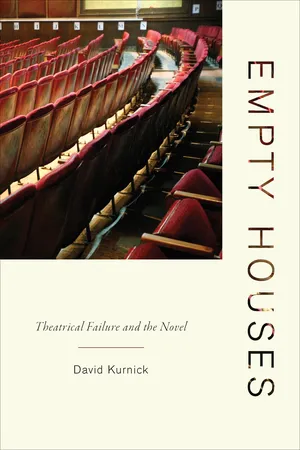
- 272 pages
- English
- ePUB (mobile friendly)
- Available on iOS & Android
eBook - ePub
About this book
Trusted by 375,005 students
Access to over 1.5 million titles for a fair monthly price.
Study more efficiently using our study tools.
Information
Publisher
Princeton University PressYear
2011Print ISBN
9780691153162
9780691151519
eBook ISBN
9781400840090
NOTES
INTRODUCTION Interiority and Its Discontents
1. On modernity's intensification of the analogy between domestic and psychic space, see Diana Fuss, The Sense of an Interior: Four Writers and the Rooms That Shaped Tem (New York: Rout-ledge, 2004).
2. Ian Watt, The Rise of the Novel (Berkeley: University of California Press, 1957), 206; Sylvie Thorel-Cailleteau, “The Poetry of Mediocrity,” in Franco Moretti, ed., The Novel, vol. 2 (Princeton, NJ: Princeton University Press, 2006), 77.
3. Georg Lukács, The Historical Novel, trans. Hannah and Stanley Mitchell (1962; reprint, Lincoln: Nebraska University Press, 1983), 201–206; Raymond Williams, Culture and Society: 1780–1950 (1958; reprint, New York: Columbia University Press, 1983), 102–109.
4. Fredric Jameson, The Political Unconscious: Narrative as a Socially Symbolic Act (Ithaca, NY: Cornell University Press, 1981), 221.
5. Franco Moretti, Modern Epic: The World System from Goethe to García Márquez, trans. Quintin Hoare (London: Verso, 1996), 143.
6. Nancy Armstrong, How Novels Think: The Limits of Individualism from 1719–1900 (New York: Columbia University Press, 2005), 25; Pierre Bourdieu, The Field of Cultural Production: Essays on Art and Literature (New York: Columbia University Press, 1993), 55. Armstrong's statement extends her argument in Desire and Domestic Fiction: A Political History of the Novel (New York: Oxford University Press, 1987) that the novel rewrites political conflicts as romantic entanglement.
7. The literature on “the public” and its relation to domesticity and psychological interiority is voluminous. Michael McKeon's The Secret History of Domesticity: Public, Private, and the Division of Knowledge (Baltimore: Johns Hopkins University Press, 2005) traces the emergence of modernity's public/private dichotomy, focusing on what he terms the “devolution of absolutism” in the seventeenth and eighteenth centuries: “a progressive detachment of the normatively absolute from its presumed locale in royal absolutism and its experimental relocation in ‘the people,' the family, women, the individual, personal identity, and the absolute subject” (xxii). Sexuality represents a final link in this devolutionary chain (see 269–319, 323). With its emphasis on the ways sexuality comes to contain the fantasy of access to an increasingly remote public, Empty Houses might be understood as following the literary historical line of McKeon's argument into a period beyond the scope of his study.
Influential accounts of the nineteenth-century fading of a robust public sphere include Richard Sennett, The Fall of Public Man (New York: Norton, 1974); Jürgen Habermas, The Structural Transformation of the Public Sphere: An Inquiry into a Category of Bourgeois Society, trans. Thomas Burger, with Frederick Lawrence (Cambridge, MA: MIT Press, 1989); and Hannah Arendt, The Human Condition (1958; reprint, Chicago: University of Chicago Press, 1998). Arendt's terminology is idiosyncratic: her category of “the social” designates the contamination of the properly public realm with properly private energies, and thus describes what Lauren Berlant has termed the “intimate public sphere” (see Berlant, The Queen of America Goes to Washington City: Essays on Sex and Citizenship [Durham, NC: Duke University Press, 1997], 1–24). But Arendt's account of the “modern discovery of intimacy” (69) coincides in its outlines with those of Sennett and Habermas. For an account supplementing Habermas's emphasis on institutions of publicness with a Foucauldian attention to discourses of sexual privatization, see Lauren Berlant and Michael Warner, “Sex in Public,” Critical Inquiry 24.2 (1998): 547–566. For a codification of the distinct but overlapping ways in which the public/private distinction signifies, see Jeff Weintraub, “The Theory and Politics of the Public/Private Distinction,” in idem and Krishan Kumar, eds., Public and Private in Thought and Practice: Perspectives on a Grand Dichotomy (Chicago: University of Chicago Press, 1997). I focus on the third of Weintraub's senses of “public,” that of “a fluid and polymorphous sociability”—a sense which Weintraub specifies “might almost be called dramaturgic, if that term were not so ambiguous” (7).
8. Susan Gal, “A Semiotics of the Public/Private Distinction,” differences 13.1 (2002): 77–95.
9. McKeon, The Secret History of Domesticity, 269. Gal's “recursive nesting” resembles McKeon's “dialectical recapitulation” (323), the process whereby the “internal” or “private” half of a given historical split between public and private is itself subject to division. Empty Houses hypothesizes that one function of the literary object is to retain the memory of those processes of subdivision as a formal and affective trace.
10. In an argument instructively sensitive to the ambiguities of the novel's supposed containment of politicized collectives in private subjects, John Plotz writes that “a potentially explosive singularity [thereby] comes to abide inside the deep subjects of the novel.” John Plotz, The Crowd: British Literature and Public Politics (Berkeley: University of California Press, 2000), 190.
11. Arendt, The Human Condition, 58.
12. Nancy Armstrong, “The Fiction of Bourgeois Morality and the Paradox of Individualism,” in Moretti, The Novel, 2:373.
13. Jameson, The Political Unconscious, 70.
14. Important critical accounts of the nineteenth-century novel's obsession with theatricality include Emily Allen, Theater Figures: The Production of the Nineteenth-Century British Novel (Columbus: Ohio State University Press, 2003); J. Jeffrey Franklin, Serious Play: The Cultural Form of the Nineteenth-Century Realist Novel (Philadelphia: University of Pennsylvania Press, 1999); and Joseph Litvak, Caught in the Act: Theatricality in the Nineteenth-Century English Novel (Berkeley: University of California Press, 1992). These books consider many of the authors treated here, and have been central to my thinking throughout, but none treats novelists' theatrical works; I seek to complicate these studies' consequent emphasis on the novel's antitheatricality. Alan L. Ackerman, Jr., The Portable Theater: American Literature and the Nineteenth-Century Stage (Baltimore: Johns Hopkins University Press, 1999), which discusses James's plays as well as his fiction, is an exception to this trend.
15. M. M. Bakhtin, The Dialogic Imagination: Four Essays, trans. Caryl Emerson and Michael Holquist (Austin: University of Texas Press, 1981), 4. Crucial recent departures from the tendency to understand the novel as antitheatrical include Lynn M. Voskuil's Acting Naturally: Victorian Theatricality and Authenticity (Charlottesville: University of Virginia Press, 2004) and Deborah Vlock's Dickens, Novel Reading, and the Victorian Popular Theatre (Cambridge: Cambridge University Press, 1998).
16. See Michael R. Booth, “Introduction,” in idem, ed., English Plays of the Nineteenth Century, vol. 1, Dramas 1800–1850 (Oxford: Oxford University Press, 1969); and Nina Auerbach, “Before the Curtain,” in Kerry Powell, ed., The Cambridge Companion to Victorian and Edwardian Theatre (Cambridge: Cambridge University Press, 2004): 3–14.
17. Influential accounts of this “novelization” include Raymond Williams, Drama from Ibsen to Brecht (1952; reprint, New York: Oxford University Press, 1969), 244–246; and Peter Szondi, Theory of the Modern Drama, trans. Michael Hays (Minneapolis: University of Minnesota Press, 1987).
18. Darko Suvin, To Brecht and Beyond: Soundings in Modern Dramaturgy (Brighton, England: Harvester, 1984), 58.
19. On nineteenth-century stage design, theater architecture, and audience behavior, see Simon Trussler, The Cambridge Illustrated History of British Theatre (Cambridge: Cambridge University Press, 1994), 191–266; and David Wiles, A Short History of Western Performance Space (Cambridge: Cambridge University Press, 2003). For a detailed account of mid-century changes in London's West End theater district, see Jim Davis and Victor Emeljanow, Reflecting the Audience: London Theatre going, 1840–1880 (Iowa City: University of Iowa Press, 2001). An invaluable source on naturalist stagecraft is Christopher Innes, A Sourcebook on Naturalist Theatre (London: Routledge, 2000). On Constantin Stanislavski's System and its American descendant, the Method—and their close relation to late-nineteenth-century theatrical naturalism—see Joseph R. Roach, The Player's Passion: Studies in the Science of Acting (Ann Arbor: University of Michigan Press, 1993), 197–217; and Steve Vineberg, Method Actors: Tree Generations of an American Acting Style (New York: Schirmer, 1994).
English director Declan Donnellan has dissented from the Method's dominance in terms resonating with the historical connections between stage design, acting style, and the domestic interior. His book The Actor and the Target casually conflates domestic and psychic space (the target of Donnellan's animus in the following passage, from which the epigraph to Empty Houses is taken, is the Method shibboleth of “concentration”): “It is important never to concentrate,” Donnellan tells his actor-reader. “Concentrating is like escaping the horror house of Uncle Silas: we always end up mysteriously back home. Imagine you are hungry and have no food in your fat. It doesn't matter how often you search the fridge: it will remain empty. The only place to get food is outside. If you stay in, you'll starve, no matter how often you rummage around the wire racks…It seems so safe at home, it seems so frightening on the streets, but this is a delusion. It is not safe at home; it is only safe on the streets. Don't go home.” Declan Donnellan, The Actor and the Target (St. Paul, MN: Theatre Communications Group, 2002), 28-29.
20. J. Jeffrey Franklin describes the Victorian supersession of “the subject of performance” by “the subject of reading,” while Elaine Hadley traces a replacement of “melodramatic” by “romantic” or novelistic subjectivity in the nineteenth century. See Franklin, Serious Play, 126; and Elaine Hadley, Melodramatic Tactics: Theatricalized Dissent in the English Marketplace, 1800–1885 (Stanford: Stanford University Press, 1995), 71. Friedrich Nietzsche's Birth of Tragedy (1872), which presents itself as an investigation into the origins of Greek drama, might more accurately be read as a report on this nineteenth-century process: Nietzsche tracks the transformation of Aeschylan tragedy (a ritual allowing “no opposition between public and chorus”) into Euripidian drama (in which this massed public is dissolved into individuated “spectators” scrutinizing “character representation and psychological refinement”). Nietzsche associates this new order with both “the novel” and the “death-leap into the bourgeois drama.” However fanciful as classical history, his essay constitutes a powerful allegory of the nineteenth-century theater, with the portrait of Euripides functioning as an anticipation of Ibsen's late-century psychologized dramas. Friedrich Nietzsche, The Birth of Tragedy and the Case of Wagner, trans. Walter Kaufmann (New York: Vintage, 1967), 62, 108, 91.
21. G. H. Lewes, On Actors and the Art of Acting (London: Smith, Elder, 1875), xi; Charles Dickens, The Life and Adventures of Nicholas Nickleby (1839; reprint, London: Penguin, 1982), 385.
22. See Carolyn Williams's reconstruction of these effects, and her excavation of their cognitive components, in “Moving Pictures: George Eliot and Melodrama,” in Lauren Berlant, ed.,...
Table of contents
- Cover Page
- Title Page
- Copyright Page
- Dedication Page
- Contents
- Acknowledgments
- Introduction: Interiority and Its Discontents
- One: Acoustics in the Tackeray Theater
- Two: George Eliot's Lot
- Three: Henry James's Awkward Stage
- Four: Joyce Unperformed
- Epilogue: In the Kingdom of Whomever: Baldwin's Method
- Notes
- Index
Frequently asked questions
Yes, you can cancel anytime from the Subscription tab in your account settings on the Perlego website. Your subscription will stay active until the end of your current billing period. Learn how to cancel your subscription
No, books cannot be downloaded as external files, such as PDFs, for use outside of Perlego. However, you can download books within the Perlego app for offline reading on mobile or tablet. Learn how to download books offline
Perlego offers two plans: Essential and Complete
- Essential is ideal for learners and professionals who enjoy exploring a wide range of subjects. Access the Essential Library with 800,000+ trusted titles and best-sellers across business, personal growth, and the humanities. Includes unlimited reading time and Standard Read Aloud voice.
- Complete: Perfect for advanced learners and researchers needing full, unrestricted access. Unlock 1.5M+ books across hundreds of subjects, including academic and specialized titles. The Complete Plan also includes advanced features like Premium Read Aloud and Research Assistant.
We are an online textbook subscription service, where you can get access to an entire online library for less than the price of a single book per month. With over 1.5 million books across 990+ topics, we’ve got you covered! Learn about our mission
Look out for the read-aloud symbol on your next book to see if you can listen to it. The read-aloud tool reads text aloud for you, highlighting the text as it is being read. You can pause it, speed it up and slow it down. Learn more about Read Aloud
Yes! You can use the Perlego app on both iOS and Android devices to read anytime, anywhere — even offline. Perfect for commutes or when you’re on the go.
Please note we cannot support devices running on iOS 13 and Android 7 or earlier. Learn more about using the app
Please note we cannot support devices running on iOS 13 and Android 7 or earlier. Learn more about using the app
Yes, you can access Empty Houses by David Kurnick in PDF and/or ePUB format, as well as other popular books in Literature & Literary Criticism. We have over 1.5 million books available in our catalogue for you to explore.