Agent-based computational modeling is changing the face of social science. In Generative Social Science, Joshua Epstein argues that this powerful, novel technique permits the social sciences to meet a fundamentally new standard of explanation, in which one "grows" the phenomenon of interest in an artificial society of interacting agents: heterogeneous, boundedly rational actors, represented as mathematical or software objects. After elaborating this notion of generative explanation in a pair of overarching foundational chapters, Epstein illustrates it with examples chosen from such far-flung fields as archaeology, civil conflict, the evolution of norms, epidemiology, retirement economics, spatial games, and organizational adaptation. In elegant chapter preludes, he explains how these widely diverse modeling studies support his sweeping case for generative explanation.
This book represents a powerful consolidation of Epstein's interdisciplinary research activities in the decade since the publication of his and Robert Axtell's landmark volume, Growing Artificial Societies. Beautifully illustrated, Generative Social Science includes a CD that contains animated movies of core model runs, and programs allowing users to easily change assumptions and explore models, making it an invaluable text for courses in modeling at all levels.
eBook - ePub
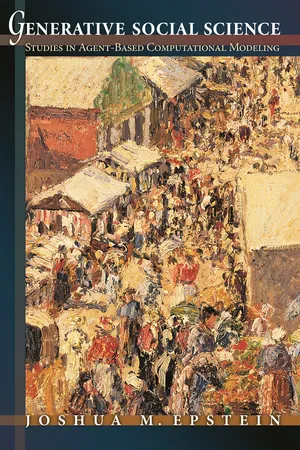
Generative Social Science
Studies in Agent-Based Computational Modeling
- 384 pages
- English
- ePUB (mobile friendly)
- Available on iOS & Android
eBook - ePub
About this book
Information
Publisher
Princeton University PressYear
2012Print ISBN
9780691208749
9780691125473
eBook ISBN
9781400842872
Topic
ÉconomieSubtopic
Théorie économiqueTable of contents
- Cover Page
- Title Page
- Copyright Page
- Dedication Page
- Contents
- Introduction
- Prelude to Chapter 1: The Generativist Manifesto
- Chapter 1 : Agent-Based Computational Models and Generative Social Science
- Prelude to Chapter 2: Confession of a Wandering Bark
- Chapter 2: Remarks on the Foundations of Agent-Based Generative Social Science
- Prelude to Chapter 3: Equilibrium, Explanation, and Gauss's Tombstone
- Chapter 3: Non-Explanatory Equilibria: An Extremely Simple Game with (Mostly) Unattainable Fixed Points
- Appendix to Chapter 3: Large Effect of a Subtle Rule Change
- Prelude to Chapters 4-6: Generating Civilizations: The 1050 Project and the Artificial Anasazi Model
- Chapter 4: Understanding Anasazi Culture Change through Agent-Based Modeling
- Chapter 5: Population Growth and Collapse in a Multiagent Model of the Kayenta Anasazi in Long House Valley
- Chapter 6: The Evolution of Social Behavior in the Prehistoric American Southwest
- Prelude to Chapter 7: Generating Patterns in the Timing of Retirement
- Chapter 7: Coordination in Transient Social Networks: An Agent-Based Computational Model of the Timing of Retirement
- Prelude to Chapter 8: Generating Classes without Conquest
- Chapter 8: The Emergence of Classes in a Multi-Agent Bargaining Model
- Prelude to Chapter 9: Generating Zones of Cooperation in the Prisoner's Dilemma Game
- Chapter 9: Zones of Cooperation in Demographic Prisoner's Dilemma
- Appendix to Chapter 9: Generating Norm Maps in the Demographic Coordination Game
- Prelude to Chapter 10: Generating Thoughtless Conformity to Norms
- Chapter 10: Learning to be Thoughtless: Social Norms and Individual Computation
- Prelude to Chapter 11: Generating Patterns of Spontaneous Civil Violence
- Chapter 11: Modeling Civil Violence: An Agent-Based Computational Approach
- Prelude to Chapter 12: Generating Epidemic Dynamics
- Chapter 12: Toward a Containment Strategy for Smallpox Bioterror: An Individual-Based Computational Approach
- Prelude to Chapter 13: Generating Optimal Organizations
- Chapter 13: Growing Adaptive Organizations: An Agent-Based Computational Approach
- Coda
- Index
Trusted by 375,005 students
Access to over 1.5 million titles for a fair monthly price.
Study more efficiently using our study tools.
Frequently asked questions
Yes, you can cancel anytime from the Subscription tab in your account settings on the Perlego website. Your subscription will stay active until the end of your current billing period. Learn how to cancel your subscription
No, books cannot be downloaded as external files, such as PDFs, for use outside of Perlego. However, you can download books within the Perlego app for offline reading on mobile or tablet. Learn how to download books offline
Perlego offers two plans: Essential and Complete
- Essential is ideal for learners and professionals who enjoy exploring a wide range of subjects. Access the Essential Library with 800,000+ trusted titles and best-sellers across business, personal growth, and the humanities. Includes unlimited reading time and Standard Read Aloud voice.
- Complete: Perfect for advanced learners and researchers needing full, unrestricted access. Unlock 1.5M+ books across hundreds of subjects, including academic and specialized titles. The Complete Plan also includes advanced features like Premium Read Aloud and Research Assistant.
We are an online textbook subscription service, where you can get access to an entire online library for less than the price of a single book per month. With over 1.5 million books across 990+ topics, we’ve got you covered! Learn about our mission
Look out for the read-aloud symbol on your next book to see if you can listen to it. The read-aloud tool reads text aloud for you, highlighting the text as it is being read. You can pause it, speed it up and slow it down. Learn more about Read Aloud
Yes! You can use the Perlego app on both iOS and Android devices to read anytime, anywhere — even offline. Perfect for commutes or when you’re on the go.
Please note we cannot support devices running on iOS 13 and Android 7 or earlier. Learn more about using the app
Please note we cannot support devices running on iOS 13 and Android 7 or earlier. Learn more about using the app
Yes, you can access Generative Social Science by Joshua M. Epstein in PDF and/or ePUB format, as well as other popular books in Économie & Théorie économique. We have over 1.5 million books available in our catalogue for you to explore.