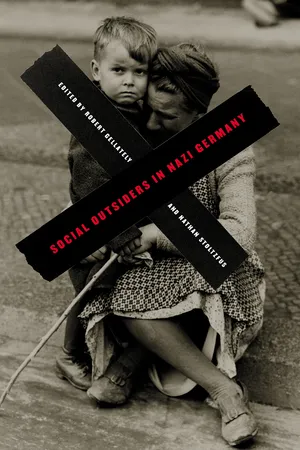
When Hitler assumed power in 1933, he and other Nazis had firm ideas on what they called a racially pure "community of the people." They quickly took steps against those whom they wanted to isolate, deport, or destroy. In these essays informed by the latest research, leading scholars offer rich histories of the people branded as "social outsiders" in Nazi Germany: Communists, Jews, "Gypsies," foreign workers, prostitutes, criminals, homosexuals, and the homeless, unemployed, and chronically ill. Although many works have concentrated exclusively on the relationship between Jews and the Third Reich, this collection also includes often-overlooked victims of Nazism while reintegrating the Holocaust into its wider social context.
The Nazis knew what attitudes and values they shared with many other Germans, and most of their targets were individuals and groups long regarded as outsiders, nuisances, or "problem cases." The identification, the treatment, and even the pace of their persecution of political opponents and social outsiders illustrated that the Nazis attuned their law-and-order policies to German society, history, and traditions. Hitler's personal convictions, Nazi ideology, and what he deemed to be the wishes and hopes of many people, came together in deciding where it would be politically most advantageous to begin.
The first essay explores the political strategies used by the Third Reich to gain support for its ideologies and programs, and each following essay concentrates on one group of outsiders. Together the contributions debate the motivations behind the purges. For example, was the persecution of Jews the direct result of intense, widespread anti-Semitism, or was it part of a more encompassing and arbitrary persecution of "unwanted populations" that intensified with the war? The collection overall offers a nuanced portrayal of German citizens, showing that many supported the Third Reich while some tried to resist, and that the war radicalized social thinking on nearly everyone's part.
In addition to the editors, the contributors are Frank Bajohr, Omer Bartov, Doris L. Bergen, Richard J. Evans, Henry Friedlander, Geoffrey J. Giles, Marion A. Kaplan, Sybil H. Milton, Alan E. Steinweis, Annette F. Timm, and Nikolaus Wachsmann.
eBook - PDF
Social Outsiders in Nazi Germany
- 339 pages
- English
- PDF
- Available on iOS & Android
eBook - PDF
Social Outsiders in Nazi Germany
About this book
Information
Publisher
Princeton University PressYear
2018Print ISBN
9780691086842
9780691007489
eBook ISBN
9780691188355
Table of contents
- Cover
- Title Page
- Copyright Page
- Contents
- CHAPTER 1 Social Outsiders and the Construction of the Community of the People
- CHAPTER 2 Social Outsiders in German History: From the Sixteenth Century to 1933
- CHAPTER 3 No “Volksgenossen”: Jewish Entrepreneurs in the Third Reich
- CHAPTER 4 When the Ordinary Became Extraordinary: German Jews Reacting to Nazi Persecution, 1933–1939
- CHAPTER 5 The Nazi Purge of German Artistic and Cultural Life
- CHAPTER 6 The Limits of Policy: Social Protection of Intermarried German Jews in Nazi Germany
- CHAPTER 7 The Exclusion and Murder of the Disabled
- CHAPTER 8 From Indefinite Confinement to Extermination: “Habitual Criminals” in the Third Reich
- CHAPTER 9 The Ambivalent Outsider: Prostitution, Promiscuity, and VD Control in Nazi Berlin
- CHAPTER 10 “Gypsies” as Social Outsiders in Nazi Germany
- CHAPTER 11 The Institutionalization of Homosexual Panic in the Third Reich
- CHAPTER 12 Police Justice, Popular Justice, and Social Outsiders in Nazi Germany: The Example of Polish Foreign Workers
- CHAPTER 13 Sex, Blood, and Vulnerability: Women Outsiders in German- Occupied Europe
- CHAPTER 14 Social Outcasts in War and Genocide: A Comparative Perspective
- List of Contributors
- Index
Trusted by 375,005 students
Access to over 1.5 million titles for a fair monthly price.
Study more efficiently using our study tools.
Frequently asked questions
Yes, you can cancel anytime from the Subscription tab in your account settings on the Perlego website. Your subscription will stay active until the end of your current billing period. Learn how to cancel your subscription
No, books cannot be downloaded as external files, such as PDFs, for use outside of Perlego. However, you can download books within the Perlego app for offline reading on mobile or tablet. Learn how to download books offline
Perlego offers two plans: Essential and Complete
- Essential is ideal for learners and professionals who enjoy exploring a wide range of subjects. Access the Essential Library with 800,000+ trusted titles and best-sellers across business, personal growth, and the humanities. Includes unlimited reading time and Standard Read Aloud voice.
- Complete: Perfect for advanced learners and researchers needing full, unrestricted access. Unlock 1.5M+ books across hundreds of subjects, including academic and specialized titles. The Complete Plan also includes advanced features like Premium Read Aloud and Research Assistant.
We are an online textbook subscription service, where you can get access to an entire online library for less than the price of a single book per month. With over 1.5 million books across 990+ topics, we’ve got you covered! Learn about our mission
Look out for the read-aloud symbol on your next book to see if you can listen to it. The read-aloud tool reads text aloud for you, highlighting the text as it is being read. You can pause it, speed it up and slow it down. Learn more about Read Aloud
Yes! You can use the Perlego app on both iOS and Android devices to read anytime, anywhere — even offline. Perfect for commutes or when you’re on the go.
Please note we cannot support devices running on iOS 13 and Android 7 or earlier. Learn more about using the app
Please note we cannot support devices running on iOS 13 and Android 7 or earlier. Learn more about using the app
Yes, you can access Social Outsiders in Nazi Germany by Robert Gellately, Nathan Stoltzfus, Robert Gellately,Nathan Stoltzfus in PDF and/or ePUB format, as well as other popular books in History & German History. We have over 1.5 million books available in our catalogue for you to explore.