The importance of the library, from ancient times to the digital era
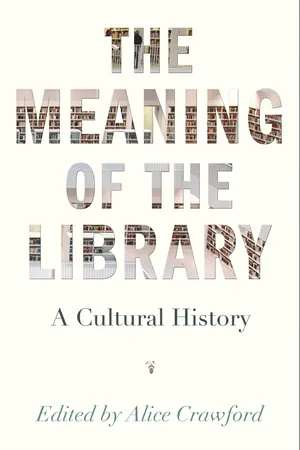
From Greek and Roman times to the digital era, the library has remained central to knowledge, scholarship, and the imagination. The Meaning of the Library is a generously illustrated examination of this key institution of Western culture. Tracing what the library has meant since its beginning, examining how its significance has shifted, and pondering its importance in the twenty-first century, notable contributors—including the Librarian of Congress and the former executive director of the HathiTrust—present a cultural history of the library. In an informative introduction, Alice Crawford sets out the book's purpose and scope, and an international array of scholars, librarians, writers, and critics offer vivid perspectives about the library through their chosen fields. The Meaning of the Library will appeal to all who are interested in this vital institution's heritage and ongoing legacy.
- 336 pages
- English
- ePUB (mobile friendly)
- Available on iOS & Android
eBook - ePub
About this book
Trusted by 375,005 students
Access to over 1.5 million titles for a fair monthly price.
Study more efficiently using our study tools.
Information
Publisher
Princeton University PressYear
2015Print ISBN
9780691175744
9780691166391
eBook ISBN
9781400865741
Topic
Lingue e linguisticaSubtopic
Storia mondialePART 1

THE LIBRARY THROUGH TIME
CHAPTER 1
Adventures in Ancient Greek and Roman Libraries
Edith Hall
Libraries are commonly regarded as serious, even austere environments, so it may come as a surprise that it is in a comedy, indeed our earliest surviving and rather raucous Aristophanic comedy, that the first certain literary response to a library occurs. The library belongs to Euripides, one of the three great tragedians of Athens, and the play is Aristophanes’s Acharnians, first performed in Athens in the late winter of 425 B.C. Athens and Sparta have been fighting the Peloponnesian War for six long years. The hero of the comedy, like many in his audience, is a peasant farmer who has suffered intensely as a result. His name is Dikaiopolis, which roughly translates as “the right way to run a city-state,” and he wants to put the case that the Athenians need to make immediate peace with Sparta. He has decided that the most rhetorically effective outfit in which to address his fellow citizens and appeal to their pity consists of a poor man’s rags. Since the famous dramatist Euripides was well known for writing tragedies in which royal heroes suffered from straitened circumstances and appeared in rags, Dikaiopolis’s first port of call is the house of this tragic poet.
He knocks on the door and asks Euripides’s slave—who turns out to be phenomenally intellectual—where his master is. The poet is apparently upstairs, hard at work writing a play. With the aid of some kind of stage machinery, Euripides, sitting elevated in his study, is “rolled out” into view and appears seated in the upper storey of his house. It is time for Dikaipolis to make his request. But what he actually asks for is not a stage costume as such, but “the tatters of some old drama” (μοι ῥάκιόν τι τοῦ παλαιοῦ δράματος); as he says to Euripides, “I have to treat the chorus to a long oration (ῥῆσιν μακράν), and if I do it badly it will mean death for me” (415–17).
The comic action that ensues plays on the double meaning of the word for “tatters” here, rhakion, which alludes both to scraps of papyrus and to ragged old theatrical costumes.1 Euripides seems to be sitting in a paper jungle constituted by papyri containing his own plays and tells his slave to get the “strips” (spargana, 431) of the play featuring the most ragged hero of them all, his famous (and alas, lost) Telephus: they are to be found, he says, close to the scraps of two other plays, “on top of the tatters of Thyestes, mixed up with those of Ino” (432–4). While Dikaipolis does collect a hat and other theatrical props from Euripides, the scene only makes sense if he also departs with a papyrus roll containing a famous speech from the tragedy Telephus. It is a comic and topicalized subversion of this oration that he shortly performs before the Athenian people.
In this wonderful theatrical episode we can see the invention of the type of Western comedy that creates laughter at the expense of tragedy. We can also see the very birth of the comic image of the library as a place inhabited by cerebral individuals who seem inherently funny to ordinary people of common sense. But the scene also demonstrates how the very idea of book assemblage could stimulate artistic inventiveness: the notoriously bookish Euripides’s papyrus collection inspires a dazzling scene of comic metatheater. This scene may actually be the ultimate source of the ancient tradition, recorded in Euripides’s Hellenistic biography, that he was the first recorded owner of a large personal library, and that this informed the very nature of his plots and poetry (see also Aristophanes’s Frogs 943, 1049). In this tradition, we can see that the ancient Greeks were aware that the invention of book collections inevitably affected the contents of books, at least where dramatic poetry was concerned.
Since I am a scholar who has specialized in literature, my discussion in this essay will mainly address the relationship between the ancient library and ancient poetry rather than ancient geography, science, or philosophy. Unlike many accounts of ancient libraries, it will not be addressing the nuts and bolts—although they are inherently fascinating—of the cataloguing systems that the poet and librarian Callimachus pioneered more than two millennia before Melvil Dewey created decimal classification. I will not be discussing explicitly the parallels between the ancient library and modern digital projects such as Google Books and Europeana, although excellent examples of such discussions, by classical scholars, are available.2 It is the idea of the library, which we inherit more or less directly from the ancient Mediterranean and near Eastern worlds, that constitutes my primary concern. I would have liked to write about the depiction of libraries in ancient Greek and Roman drama, poetry and fiction, along the lines of Debra Castillo’s The Translated World: A Postmodern Tour of Libraries in Literature (1984), but there are, sadly, few enough libraries actually evoked or even described in surviving ancient literature.3 But the dearth of literary representations of ancient book collections is out of all proportion to the vast amount of factual information we possess about them. The finds at Qumran alone have revealed far too much about the physical, material realities of the painstaking ancient process of book reproduction to discuss in a single essay—not just in the Dead Sea Scrolls themselves, but in the ink wells and even the plaster coverings of the desks at which the scribes labored.4 The subject matter is enormous, even if we focus exclusively on the libraries of the pagan Greeks and Romans, to the exclusion of the Babylonians and Assyrians from whose library organization systems they learned, or of the Phoenicians, Egyptians, and Jews, let alone the early Christians, who inherited their basic library building plan from their pagan precursors.5
One man in antiquity was brave enough to attempt to write a comprehensive three-volume treatise on libraries. This was the erudite Varro, an Italian from the venerable Sabine settlement at Reate in central Italy, who in the mid-first century B.C. compiled his study de Bibliothecis. Varro’s book must have been very substantial, at least to judge from his surviving three-volume work on agriculture. Varro was an encyclopedist, whom Julius Caesar appointed public librarian in Rome in 47 B.C. He was the only known ancient author to be granted the privilege of having a bust in his likeness installed in one of the main Roman libraries while he was still alive (Pliny, HN 7.30.115). His treatise may have been commissioned as an ideological accompaniment to Caesar’s quest to expand the incipient Roman realm, “to connect world-literature with the world-empire.”6 The uneasy relationship between libraries and imperialism, indeed, will be a recurring theme in this essay, closely tied up with the relationship between libraries and cultural creativity. But first it is important to underline the sheer scale of the topic of the library in the ancient Greek and Roman worlds. Even as early as the first century B.C., before the great surge in library-building that was to occur under the high Empire, notably under the Emperor Trajan in the early second century A.D., Varro’s project in compiling a universal historical treatise on libraries would have daunted anyone but him. And the history of great pagan libraries was to continue for several centuries thereafter, until 543 A.D., when the Emperor Justinian finally closed down the temple of Isis at Philae in Egypt, built under the same Ptolemies who built the library at Alexandria. Behind the massive colonnade of the Philae temple at least one massive room had functioned as a library.
The papyrus on which most ancient Greek and Latin books were recorded, as an organic material, was extremely vulnerable to rotting and wear and tear. Aristotle bequeathed his personal library to his student Theophrastus, but two generations later the collection of rolls ended up in the hands of some “ordinary people” of Scepsis in Asia Minor, who did not know how to store its precious contents (Strabo 13.1.54). When they realized that the books were actually extremely valuable, they hid them from the book collectors sent out by the rich Attalid dynasty at nearby Pergamum, who wanted to build up the collection in their library. Unfortunately, the uneducated owners of the books decided to conceal them as if they were gold or coins, in a dug-out trench. They were damaged dreadfully by both moisture and moths. When they were finally purchased, it was by a man who loved to collect books rather than by a philosopher, and he “restored” the texts in such an amateurish way that, when they were eventually published, they were found to be full of mistakes.
On the other hand, forgers sometimes stained brand new papyri to make them look like authentic ancient texts, perhaps those actually written by one of the famous canonical writers, in order to increase their monetary value. The ancients were very clear that there was a difference between the materialistic bibliophile who collected books as commodities, and the cultured person who actually understood their contents. The nouveau riche Trimalchio whose banquet is described by Petronius boasts that his libraries rivalled those of the emperor.7 Some rich men did indeed use banquets as opportunities to display books that they had never studied (Seneca, Dial. 9.9.4). Lucian wrote a diatribe attacking a Syrian, Against the Ignorant Book-Collector. This rich man buys shiploads of books, is never seen without one in his hand, and endlessly glues and trims them, applying cedar oil and saffron, and keeping them in purple silk and leather cases. But he is deluding himself because “he thinks that by the multitude of books” he can rectify his “deficient education.”
Libraries held many different kinds of collections. Some of the most important to advances in ancient intellectual life were the specialist libraries that mainly or exclusively collected the writings of members of a particular philosophical school, such as the Stoics, whose center of learning was on the island of Rhodes. There the great Stoic polymath scholar Posidonius, usually called “the Rhodian” but actually a native of Apamea in Syria, practiced during the first half of the first century B.C. Pompey, Caesar, Cicero, and Brutus all studied there. Rhodes was also renowned as a center of astronomical studies, a particular interest of the bookworm Emperor Tiberius, who spent several years on the island.8 Other archives might house a special collection of, for example, theater scripts. The most famous of these was the depository in Athens, organized by the theater-loving orator and statesman Lycurgus, ruler of Athens from 336 until 324 B.C. It was probably housed in the old Athenian Metröon in the marketplace (originally a council house rather than a collection of papers), along with other documents related to the history and activities of the state. Lycurgus probably began the collection of plays because there were so many emendations being made by contemporary actors to the authentic texts of the plays of the great three tragedians of the previous century—Aeschylus and Sophocles as well as Euripides. Some of these plays were very popular in the performance repertoire, and thus vulnerable to creative adaptation.9
Libraries varied massively in scale as well as contents. On the one hand there were small book collections that could be carried around in handy containers, like the portable scrinium or cista on a Roman mosaic in Tunis shown in figure 1.1. It is probably to be imagined as holding the “parts” or whole plays in which the actor portrayed here specialized, or that had been written or enjoyed by the seated man, depending on whether he represents an author who has collaborated with the actor or, more likely, his patron.10 At the other end of the scale, there were vast libraries containing hundreds of thousands of papyrus rolls, housed in magnificent, purpose-built architectural edifices. In between these extremes there were private libraries in which solitary misanthropes hid from the world, like that of the tragedian Euripides; Xenophon remarks on the unparalleled size of the book collection amassed by the philosopher Euthydemus (Mem. 4.2.8). Other private libraries were large enough to accommodate the leading lights of a whole philosophical school comfortably, such as the “Villa of the Papyri” found in 1752 at Herculaneum. This was the vacation villa of no less a figure than Julius Caesar’s father-in-law, Calpurnius Piso, where the famous philosopher Philodemos of Gadara supervised his patron’s magnificent collection of Epicurean texts.11 The modern technology of multispectral imaging has allowed the remains of some of them, burnt by the same volcanic eruption that destroyed Pompeii in 79 A.D., to be deciphered and published by modern scholars.

Fig. 1.1. Portable scrinium or cista on a Roman mosaic in Tunis. Reproduced by kind permission of the Musée archéologique de Sousse, Tunisia.
The first public library of all may have been established by Clearchus, tyrant of Heraclea on the south coast of the Black Sea, who died in 353 B.C.12 This Pontic despot had been educated at Athens by the two leading intellectuals of the time, Plato and Isocrates, and the tradition that he built a library is connected with the ancient perception that the Greeks of the Black Sea were anxious to avoid the accusation that they lived in a cultural backwater. But it was the people of the first two generati...
Table of contents
- Cover Page
- Title Page
- Copyright Page
- Dedication Page
- Contents
- List of Illustrations
- Acknowledgments
- Introduction
- Part 1. The Library Through Time
- Part 2. The Library in Imagination
- Part 3. The Library Now and in the Future
- Selected Bibliography
- Contributors
- Index
Frequently asked questions
Yes, you can cancel anytime from the Subscription tab in your account settings on the Perlego website. Your subscription will stay active until the end of your current billing period. Learn how to cancel your subscription
No, books cannot be downloaded as external files, such as PDFs, for use outside of Perlego. However, you can download books within the Perlego app for offline reading on mobile or tablet. Learn how to download books offline
Perlego offers two plans: Essential and Complete
- Essential is ideal for learners and professionals who enjoy exploring a wide range of subjects. Access the Essential Library with 800,000+ trusted titles and best-sellers across business, personal growth, and the humanities. Includes unlimited reading time and Standard Read Aloud voice.
- Complete: Perfect for advanced learners and researchers needing full, unrestricted access. Unlock 1.5M+ books across hundreds of subjects, including academic and specialized titles. The Complete Plan also includes advanced features like Premium Read Aloud and Research Assistant.
We are an online textbook subscription service, where you can get access to an entire online library for less than the price of a single book per month. With over 1.5 million books across 990+ topics, we’ve got you covered! Learn about our mission
Look out for the read-aloud symbol on your next book to see if you can listen to it. The read-aloud tool reads text aloud for you, highlighting the text as it is being read. You can pause it, speed it up and slow it down. Learn more about Read Aloud
Yes! You can use the Perlego app on both iOS and Android devices to read anytime, anywhere — even offline. Perfect for commutes or when you’re on the go.
Please note we cannot support devices running on iOS 13 and Android 7 or earlier. Learn more about using the app
Please note we cannot support devices running on iOS 13 and Android 7 or earlier. Learn more about using the app
Yes, you can access The Meaning of the Library by Alice Crawford in PDF and/or ePUB format, as well as other popular books in Lingue e linguistica & Storia mondiale. We have over 1.5 million books available in our catalogue for you to explore.