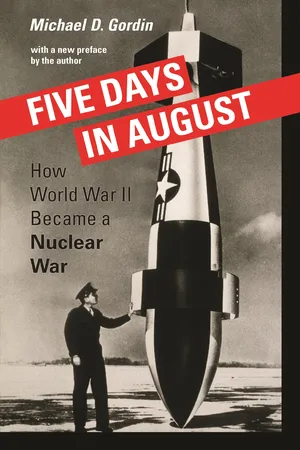
Most Americans believe that the Second World War ended because the two atomic bombs dropped on Japan forced it to surrender. Five Days in August boldly presents a different interpretation: that the military did not clearly understand the atomic bomb's revolutionary strategic potential, that the Allies were almost as stunned by the surrender as the Japanese were by the attack, and that not only had experts planned and fully anticipated the need for a third bomb, they were skeptical about whether the atomic bomb would work at all. With these ideas, Michael Gordin reorients the historical and contemporary conversation about the A-bomb and World War II.
Five Days in August explores these and countless other legacies of the atomic bomb in a glaring new light. Daring and iconoclastic, it will result in far-reaching discussions about the significance of the A-bomb, about World War II, and about the moral issues they have spawned.
- 232 pages
- English
- ePUB (mobile friendly)
- Available on iOS & Android
eBook - ePub
About this book
Trusted by 375,005 students
Access to over 1.5 million titles for a fair monthly price.
Study more efficiently using our study tools.
Information
Publisher
Princeton University PressYear
2015Print ISBN
9780691168432
9780691128184
eBook ISBN
9781400874439

FIGURE 1.1 Western Pacific theater, summer 1945. Source: Modified from Carl W. Hoffman, The Seizure of Tinian (Washington, DC: Government Printing Office, 1951), rear flap.

FIGURE 1.2 (opposite page) Map of major B-29 target cities in the Japanese Home Islands (with the exception of Kokura, not depicted, which lies on the northern tip of the southern island of Kyushu). Reproduced from Wesley Frank Craven and James Lea Cate, The Army Air Forces in World War II, Volume 5: The Pacific: Matterhorn to Nagasaki, June 1944 to August 1945 (Chicago: University of Chicago Press, 1953), frontispiece.
Chapter 1
Endings
THE SECOND WORLD WAR ENDED SUDDENLY. On 6 August 1945, an atomic bomb exploded over Hiroshima, Japan; on 8 August, the Soviet Union declared war on the Japanese Empire and began early the following morning a staggeringly successful steamroller advance across Manchuria; and on 9 August, a second atomic bomb destroyed much of the Japanese city of Nagasaki. As the story is usually (and frequently) told, this triumvirate of shocks so stunned the Japanese imperial inner circle, and especially Emperor Hirohito, that he unprecedentedly intervened in war-planning deliberations and moved for conditional surrender on 10 August. (The momentous meeting took place on 9 August; the Nagasaki blast occurred in the middle of it.) Back in Washington, U.S. President Harry S. Truman and his cabinet considered the offer, and Secretary of State James Byrnes penned a response insisting that the Japanese surrender be “unconditional”—Allied war terms since the late President Franklin Roosevelt had enunciated them at the Casablanca Conference in 1943. On 14 August, the Japanese acceded, and the emperor broke his traditional silence and announced the surrender over the radio the following day. The first (and to date only) nuclear war was over.1 Sudden indeed.
The end of the war clearly came suddenly for Japan. This is a book about how it was equally sudden for the Allies as well, and in particular for the Americans. Coming to grips with the suddenness of the war’s end forces a complete reassessment of how, when, and why the atomic bomb was dropped—the very issues that have engaged so many Americans for the last sixty years. For the generations who have grown up with the truism that “the bomb ended the war,” thinking in terms of suddenness may seem hard to swallow.2 Millions of Americans have been taught the history of the atomic bomb as if it were self-evident, from the beginning, that nuclear weapons would by their very nature compel the Japanese to surrender. Echoing this common perception, Manhattan Project veteran Edward Teller wrote that “Hiroshima changed the course of history.”3 We are so familiar with such announcements of the transformation of the world through the nuclear blasts at Hiroshima and (although far less often invoked) Nagasaki that the claim seems to us natural, beyond question. We think of nuclear weapons as transformative because, quite simply, they are such, and always were. It was, supposedly, obvious to all concerned in summer 1945 that these weapons were “special,” “epoch-making,” and “revolutionary,” not just to the Japanese who suffered the consequences of atomic bombing, but also to the Americans involved in the decision to conduct it.4
Yet there is something glaringly amiss with this standard picture. No one in 1945 possessed the ability to foretell the future (not surprisingly). The principal American politicians, military figures, and scientists expressed much skepticism at the time over whether the bomb would in fact “work.” Even the definition of what it meant for the bomb to “work” changed dramatically over the course of a few days. At first, “work” meant to explode. After Hiroshima, “work” meant shortening the war by a few months (say, before the scheduled November invasion of the southern Japanese island of Kyushu). Only after 14 August did “work” mean “end the war.” The war was not over until the Japanese government decided that it was; the Allies could engage in various gambits to achieve this goal, but only the Japanese possessed the power to make any of those gambits “work.” It is by looking backward into World War II, and not forward into the Cold War, that we can really begin to evaluate what was unique to these weapons, and what belonged to a longer process of gradual escalation.
Almost nobody before 14 August thought that two bombs would be sufficient: if the first bomb did not cause surrender, the American decision makers reasoned, then many would be required, at the very least a third bomb before the end of August, and likely several others before the scheduled invasion.5 In examining attitudes toward the bomb before the detonation over Hiroshima, and then after Nagasaki but before surrender—five days in August—the historical evidence shows that a sizable group of decision makers did not believe the bomb would have the power to end the war immediately. On the contrary, the sudden surrender of the Japanese caught Washington rather off-guard, unprepared for demobilization or the economic shocks of peace. A dramatic consequence such as surrender demands an extraordinary cause, and American scientists, politicians, and journalists found that cause in the first postwar days by retrospectively emphasizing the atomic bomb to the exclusion of all other factors. Only the nuclear was “special” enough.6
The use of the atomic bombs against Japanese cities in the final days of World War II still generates enormous interest and controversy, primarily because of concerns over the moral justification of these actions.7 As usually presented, the debate about whether the atomic bombings were justified conflates two separate issues: military justification and moral justification. As the story here unfolds, it will become very clear that the issue of military justification is moot. Because so many military planners and influential politicians considered the atomic bomb to be, at least in some degree, an “ordinary” weapon—certainly special, even unique, in some senses, but decidedly not in the senses we appreciate today—dropping one or several of them merited no more justification than the inception of firebombing campaigns, napalm, or other local decisions made largely in the field: that is, little to no justification. The issue of military justification of the atomic bombings simply did not appear as a live question for Truman or his advisers.
Of course, the reason this topic generates vehemence from both critics and defenders of the atomic bombings stems directly from the other question: moral justification. Any assessment of morality in wartime, in terms of both the goals of the war and the means (strategies or weapons) used to achieve it, depends on political values, religious beliefs, moral judgments, and—crucially—context. World War II was the most brutal conflict the world has ever seen, swallowing in its maw approximately fifty-five million lives. The litany of clear-cut crimes against humanity even only in the Pacific theater, thus excluding the Holocaust and setting aside for the moment the status of the atomic bombings, is staggering: the rape of Nanjing, the torture and slaughter of prisoners of war, the Bataan death march, the forced prostitution of Korean “comfort women,” the aggressive firebombing of civilian populations, and so on. By the time the Americans began to consider the potential utility of the atomic bomb, they had already for years experienced increasing brutality, bloodshed, mayhem, and dehumanization, and experienced them routinely. This context should be central in any attempt to frame the question of the morality of atomic bombing, let alone in any answer.
Without context, the Little Boy and Fat Man bombs that destroyed Hiroshima and Nagasaki, respectively, were only combinations of fissionable material, electrical components, conventional explosives, and metal. All the social and physical infrastructure of political decisions, military calculations, long-distance bombers, and the late stages of a seemingly eternal war provided the tools for contemporaries to think about the atomic bombs. The bombs might be considered special or unique for a variety of intellectually valid reasons: the introduction of the mechanism of nuclear fission into warfare; the scale of the design of the bomb; radioactivity; American monopoly on the weapon; the fact that an equivalent destruction to an atomic bombing created through conventional raids, and the number of planes needed to cause it, was so much greater; and so on. In each instance, the line between a quantitatively different bomb (a bigger blast) and a qualitatively different bomb (a revolution in warfare) is a matter of judgment; it is a claim about when a change in degree turns into a change in kind. The American scientists, politicians, and soldiers who participated in the atomic bombings made assessments of the atomic bombs as unique and special weapons, but they did not make the same kinds of assessments we make today. To understand the differences, the history needs to be recast from an entirely different angle.
To accomplish this, I reorient the story of the atomic bomb drops in time, in place, and in emphasis. A brief inspection of the chronology of relevant events demonstrates how skewed the common American understanding of the timeline has become. The story of the atomic bomb is usually told in three parts. The first part ranges from the discovery of uranium fission in December 1938 to the detonation of a plutonium implosion device at the Trinity test in the New Mexico desert on 16 July 1945. This is the story of the Manhattan Project, usually the preserve of historians of science, and it highlights the work of scientists and engineers in developing a functional atomic bomb.8 These scientists—and their epicenter of bomb-design operations, Los Alamos—typically vanish from view after Trinity, as if their work was now accomplished (it was not: they continued to make more bombs), and the story shifts to President Truman and the Potsdam Conference of the Big Three (Truman, Churchill/Atlee, and Stalin) that took place in late July 1945, immediately after the nuclear test. We are now in the province of diplomatic historians, and the story stresses Truman’s decision making about the atomic bomb and how the bomb fit or failed to fit into both the Allied end-of-war strategy for Japan and the emergent Cold War in Europe. After the issuance of the Potsdam Declaration calling for the unconditional surrender of Japan’s armed forces, this story stops. This timeline compresses months of deliberations dating from before Truman assumed office in April 1945 and extending after the American delegation returned from Potsdam into a small period of time and a single “decision.”
Immediately after Potsdam, the traditional story of the atomic bomb flashes to the Pacific theater of World War II for four days: 6–9 August 1945. In these days, atomic bombs were dropped on Hiroshima and Nagasaki, and the Soviet Union entered the Pacific War. As soon as those three events happen, the story almost immediately moves to Tokyo and the Japanese cabinet’s deliberations about surrender. Four years of fighting and the months-long punishing firebombing campaign are eclipsed in a story that is largely about diplomacy before the bombs explode, and Japanese government deliberations afterwards. Almost without exception, the story ends on 15 August 1945, with the emperor’s announcement of surrender. This typical history not only enhances certain features of the historical record at the expense of others—minimizing both the brutality of warfighting in the Pacific and the attempts of the Japanese government to seek a negotiated surrender—but also sharply reduces the amount of already-scarce evidence useful for understanding the dramatic speed in which World War II ended. By placing the bulk of the account after most histories of the “Hiroshima decision” conclude, this book shifts the focus in time in unfamiliar ways.
The reorientation in place is similarly broad. The story of the atomic bombs’ use reprises a canonical list of places: Los Alamos, Alamogordo, Washington, Potsdam, Tokyo, Hiroshima, and Nagasaki. None of these places ever knowingly confronted a combat-ready atomic bomb. The only site where the atomic bomb was evident as a military weapon was the island of Tinian, nestled in the Marianas. The 509th Composite Group, which was assigned the task of delivering the atomic bombs, and the Los Alamos assembly team named Project Alberta were stationed here. Since Tinian was the only site where the military, scientific, and diplomatic strands of the story of the atomic bomb converged, it demands very close attention. By focusing on how the soldiers and scientists there perceived the weapon they were charged with delivering, we can see the military features of the atomic bomb in relief, with its geopolitical implications, its moral valences, and its scientific aspects in the background. In particular, since Tinian was the home base for most of the B-29s involved in the extensive firebombing campaign against Japan that began in earnest in March 1945, the atomic bomb in situ partakes of the history of conventional firebombing on every level. Finally, nowhere more than on Tinian was the potential third atomic bombing a reality, since Project Alberta and the 509th remained in a state of readiness for assembling that additional bomb until the instruments of surrender were signed on 2 September—that is, over two weeks after surrender had supposedly already catapulted the bombs into the category of “unusable” weapons.
The change of emphasis presented in the pages that follow may appear the most dramatic. The history as usually presented focuses on both what Truman intended to accomplish by authorizing the atomic bombings and what role those bombings played in ending the war. Consider, for a moment, what would have happened if Japan had not surrendered on 14 August. Would the atomic bomb’s role in the conflict seem the same to us today?9 It is impossible to answer such questions directly, since the war did in fact end on 14 August; yet, we can now, for the first time—by concentrating on the events and the almost ignored archival documents of the presurrender, postatomic period lasting from 6 to 14 August—tell the story of how the atomic bomb was thought about and treated before anyone could claim that the bomb had ended the war, simply because the war was not yet over. These changes of time, place, and emphasis reveal an utterly surprising history of the atomic bomb’s role in World War II.
That history usually appears either as a breathless story peaking at Hiroshima or surrender, or as a romanticized tale of Great Men Making Epochal Decisions. Here the narrative is framed instead as military history: an account based on archival documents that looks at how the bomb was conceived of as a tactical weapon, not as a geopolitical strategic gambit. From this point of view, many in the field perceived the atomic bomb as a quantitatively different firebomb (it was much more explosive, more efficient, and required fewer B-29 bombers to deliver), but not as a qualitative change in warfare, however epochal Truman and his advisers at times considered it to be. Military men in particular considered the decision to drop the bomb as a given from the moment development shaded into a deliverable weapon. By December 1944—months before Roosevelt’s death in his fourth term of office—crews had already been assigned to deliver the bombs. The history of the atomic bomb is studded with special procedures of use, special committees, and special moral deliberations by the commander-in-chief. For some of the participants, particularly those close to the scientists, the bomb was indeed intrinsically “special” because the source of its explosive power—the fission of uranium or plutonium—was unprecedented. The bomb was, to these individuals, atomic. For those who emphasized the atomic bomb as a bomb, however, what mattered was whether it would destroy enemy personnel and infrastructure, period. Debates over other “special” aspects of the bomb—such as radiological aftereffects—were rather muted until after surrender had “demonstrated” that the bomb was Special, even Unique.
A remarkable fact about this post-Hiroshima, presurrender period is how distant surrender seemed to those directly concerned with the actual dropping of these weapons. One can observe this most clearly in the preparations for a combat drop of a third bomb. Discussion of target and timing for the Third Shot—most likely Tokyo on 19 August—proceeded actively both before and after Nagasaki. Such preparations continued even between surrender and the beginning of the American Occupation of Japan on 2 September, a transitional period when Allied forces feared that a militarist coup might restart hostilities. The Third Shot was a reality in progress until unconditional surrender—seen as the two bombs’ success—began the rapid and mostly unconscious process of expunging it from historical memory. This military option of more atomic strikes, mentioned in numerous cables, briefings, shipping manifests, and diplomatic and scientific correspondence, dropped out of sight by the end of August 1945, and today most Americans believe the reason the United States dropped two bombs on Japan is that the government knew in advance that two would suffice. The days up to surrender prove this supposed military omniscience to be nonexistent.
The world we live in today is, in many crucial respects relating to nuclear weapons, still best thought of as a “postsurrender” world. As the title of a monumental recent work on the history of modern Europe since 1945 elegantly puts it, the most important fact to understand about Europe today is that it is still “postwar”: World War II generated such a colossal transformation of the conditions of European existence that removing that fact from view even for a...
Table of contents
- Cover Page
- Title Page
- Copyright Page
- Dedication Page
- Contents
- List of Illustrations
- Preface to the Paperback Edition
- Acknowledgments
- Chronology
- Chapter 1: Endings
- Chapter 2: Shock
- Chapter 3: Special
- Chapter 4: Miracle
- Chapter 5: Papacy
- Chapter 6: Revolution
- Chapter 7: Beginnings
- Coda: On the Scholarly Literature
- Abbreviations Used in Notes
- Notes
- Index
Frequently asked questions
Yes, you can cancel anytime from the Subscription tab in your account settings on the Perlego website. Your subscription will stay active until the end of your current billing period. Learn how to cancel your subscription
No, books cannot be downloaded as external files, such as PDFs, for use outside of Perlego. However, you can download books within the Perlego app for offline reading on mobile or tablet. Learn how to download books offline
Perlego offers two plans: Essential and Complete
- Essential is ideal for learners and professionals who enjoy exploring a wide range of subjects. Access the Essential Library with 800,000+ trusted titles and best-sellers across business, personal growth, and the humanities. Includes unlimited reading time and Standard Read Aloud voice.
- Complete: Perfect for advanced learners and researchers needing full, unrestricted access. Unlock 1.5M+ books across hundreds of subjects, including academic and specialized titles. The Complete Plan also includes advanced features like Premium Read Aloud and Research Assistant.
We are an online textbook subscription service, where you can get access to an entire online library for less than the price of a single book per month. With over 1.5 million books across 990+ topics, we’ve got you covered! Learn about our mission
Look out for the read-aloud symbol on your next book to see if you can listen to it. The read-aloud tool reads text aloud for you, highlighting the text as it is being read. You can pause it, speed it up and slow it down. Learn more about Read Aloud
Yes! You can use the Perlego app on both iOS and Android devices to read anytime, anywhere — even offline. Perfect for commutes or when you’re on the go.
Please note we cannot support devices running on iOS 13 and Android 7 or earlier. Learn more about using the app
Please note we cannot support devices running on iOS 13 and Android 7 or earlier. Learn more about using the app
Yes, you can access Five Days in August by Michael D. Gordin in PDF and/or ePUB format, as well as other popular books in History & World War II. We have over 1.5 million books available in our catalogue for you to explore.