The remarkable story of how our solar system came to be
The birth and evolution of our solar system is a tantalizing mystery that may one day provide answers to the question of human origins. From Dust to Life tells the remarkable story of how the celestial objects that make up the solar system arose from common beginnings billions of years ago, and how scientists and philosophers have sought to unravel this mystery down through the centuries, piecing together the clues that enabled them to deduce the solar system's layout, its age, and the most likely way it formed.
Drawing on the history of astronomy and the latest findings in astrophysics and the planetary sciences, John Chambers and Jacqueline Mitton offer the most up-to-date and authoritative treatment of the subject available. They examine how the evolving universe set the stage for the appearance of our Sun, and how the nebulous cloud of gas and dust that accompanied the young Sun eventually became the planets, comets, moons, and asteroids that exist today. They explore how each of the planets acquired its unique characteristics, why some are rocky and others gaseous, and why one planet in particular—our Earth—provided an almost perfect haven for the emergence of life.
From Dust to Life is a must-read for anyone who desires to know more about how the solar system came to be. This enticing book takes readers to the very frontiers of modern research, engaging with the latest controversies and debates. It reveals how ongoing discoveries of far-distant extrasolar planets and planetary systems are transforming our understanding of our own solar system's astonishing history and its possible fate.
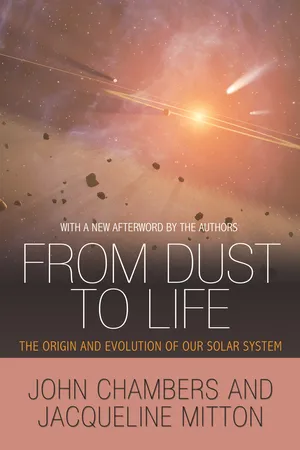
eBook - ePub
From Dust to Life
The Origin and Evolution of Our Solar System
- 320 pages
- English
- ePUB (mobile friendly)
- Available on iOS & Android
eBook - ePub
About this book
Information
Publisher
Princeton University PressYear
2017Print ISBN
9780691175706
9780691145228
eBook ISBN
9781400885565
Topic
Physical SciencesSubtopic
Science History
1992 QB1, 248, 250
1999 RQ36, 271
2008 TC3, 84
51 Pegasi, 15
achondrites, 82–83
Adams, John Couch, 38, 39
Airy, George Biddell, 38
Alfvén, Hannes, 54
alpha elements, 95
alpha particles, 95, 97–98
alpha radiation, 62
Andromeda galaxy, 52
angular momentum, 49; angular momentum problem, 50, 51, 55; of Earth-Moon system, 172; of solar system, 3, 48, 54
Apollo missions, 86, 169, 177, 183
archaea, 192
Archean era, 191, 197, 199
Aristarchus of Samos, 23
Aristotle, 23, 24, 28, 29
asteroid belt, 7, 36, 123, 225–26, 228–31, 234–36, 266, 273
asteroid families, 231–33
asteroids, 7, 8, 35, 36, 42; collisions between, 77, 79, 90, 226–29, 265, 273–74; C-type, 85, 229, 237; D-type, 229, 261; as meteorite parent bodies, 76, 77, 83–85, 150, 241; near-Earth, 79; orbits of, 229, 232; P-type, 229; satellites of, 236; shapes of, 236; space missions to, 236–41; S-type, 85, 229, 239; Trojan, 7, 42, 259, 260, 261. See also asteroid belt; asteroid families
Astraea, 36
astronomical unit, 5, 19, 20
atomic mass, 65, 92, 93
atomic number, 65, 93
atomic weight, 92, 93, 94
atoms: first, 98; structure of, 64
Babinet, Jacques, 49
Babylonian astronomy, 22
bacteria, 192
Baptistina family of asteroids, 233
Becquerel, Henri, 61
Beta Pictoris, 125, 126, 127
beta radiation, ...
Table of contents
- Cover Page
- Title Page
- Copyright Page
- Dedication Page
- Contents
- List of Illustrations
- Preface
- One: Cosmic Archaeology
- Two: Discovering the Solar System
- Three: An Evolving Solar System
- Four: The Question of Timing
- Five: Meteorites
- Six: Cosmic Chemistry
- Seven: A Star Is Born
- Eight: Nursery for Planets
- Nine: Worlds of Rock and Metal
- Ten: The Making of the Moon
- Eleven: Earth, Cradle of Life
- Twelve: Worlds of Gas and Ice
- Thirteen: What Happened to the Asteroid Belt?
- Fourteen: The Outermost Solar System
- Fifteen: Epilogue: Paradigms, Problems, and Predictions
- Afterword to the 2017 Edition
- Glossary
- Sources and Further Reading
- Index
Trusted by 375,005 students
Access to over 1.5 million titles for a fair monthly price.
Study more efficiently using our study tools.
Frequently asked questions
Yes, you can cancel anytime from the Subscription tab in your account settings on the Perlego website. Your subscription will stay active until the end of your current billing period. Learn how to cancel your subscription
No, books cannot be downloaded as external files, such as PDFs, for use outside of Perlego. However, you can download books within the Perlego app for offline reading on mobile or tablet. Learn how to download books offline
Perlego offers two plans: Essential and Complete
- Essential is ideal for learners and professionals who enjoy exploring a wide range of subjects. Access the Essential Library with 800,000+ trusted titles and best-sellers across business, personal growth, and the humanities. Includes unlimited reading time and Standard Read Aloud voice.
- Complete: Perfect for advanced learners and researchers needing full, unrestricted access. Unlock 1.5M+ books across hundreds of subjects, including academic and specialized titles. The Complete Plan also includes advanced features like Premium Read Aloud and Research Assistant.
We are an online textbook subscription service, where you can get access to an entire online library for less than the price of a single book per month. With over 1.5 million books across 990+ topics, we’ve got you covered! Learn about our mission
Look out for the read-aloud symbol on your next book to see if you can listen to it. The read-aloud tool reads text aloud for you, highlighting the text as it is being read. You can pause it, speed it up and slow it down. Learn more about Read Aloud
Yes! You can use the Perlego app on both iOS and Android devices to read anytime, anywhere — even offline. Perfect for commutes or when you’re on the go.
Please note we cannot support devices running on iOS 13 and Android 7 or earlier. Learn more about using the app
Please note we cannot support devices running on iOS 13 and Android 7 or earlier. Learn more about using the app
Yes, you can access From Dust to Life by John Chambers,Jacqueline Mitton in PDF and/or ePUB format, as well as other popular books in Physical Sciences & Science History. We have over 1.5 million books available in our catalogue for you to explore.