A groundbreaking book by one of the world's leading historians of Chinese architecture
Translated by Alexandra Harrer.
Fu Xinian is considered by many to be the world's leading historian of Chinese architecture. He is an expert on every type of Chinese architecture from every period through the nineteenth century, and his work is at the cutting edge of the field. Traditional Chinese Architecture gathers together, for the first time in English, twelve seminal essays by Fu Xinian. This wide-ranging book pays special attention to the technical aspects of the building tradition since the first millennium BC, and Fu Xinian's signature drawings abundantly illustrate its nuances.
The essays delve into the modular basis for individual structures, complexes, and cities; lateral and longitudinal building frames; the unity of sculpture and building to create viewing angles; the influence of Chinese construction on Japanese architecture; and the reliability of images to inform us about architecture. Organized chronologically, the book also examines such topics as the representation of architecture on vessels in the Warring States period, early Buddhist architecture, and the evolution of imperial architecture from the Tang to Ming dynasty. A biography of Fu Xinian and a detailed Chinese-English glossary are included.
Bringing together some of the most groundbreaking scholarship in Chinese architectural history, Traditional Chinese Architecture showcases an uncontested master of the discipline.
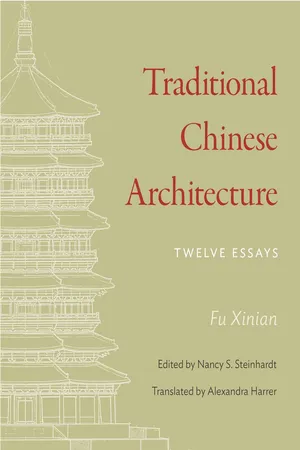
eBook - ePub
Traditional Chinese Architecture
Twelve Essays
- 448 pages
- English
- ePUB (mobile friendly)
- Available on iOS & Android
eBook - ePub
About this book
Information
Topic
ArchitectureSubtopic
Architecture GeneralTable of contents
- Cover Page
- The Princeton-China Series
- Title Page
- Copyright Page
- Contents
- List of Illustrations
- Preface
- Editor’s Note
- Chronology of Chinese Dynasties
- Map of China
- Biography of Fu Xinian 傅熹年
- One - Representations of Architecture on Vessels of the Warring States Period
- Two - Reconstruction of Northern Dynasties Buildings Based on Relief Sculpture and Murals in Cave-Temples at Maijishan
- Three - Early Buddhist Architecture in China
- Four - The Development of Timber-Frame Architecture during the Two Jins and the Northern and Southern Dynasties
- Five - Architectural Features of the Northern and Southern Dynasties and the Sui and Tang Periods in China as Reflected in Japanese Architecture of the Asuka and Nara Periods
- Six - Hanyuan Hall at Daminggong in Tang Chang’an
- Seven - The Module in Tang Architecture
- Eight - Imperial Architecture of Tang through Ming and Its Relation to Other Architecture
- Nine - The Problem of Pillar Displacement with Respect to the Characteristics of Song Construction
- Ten - Song Architecture in South China and Its Relation to Japanese Great Buddha–Style Architecture of the Kamakura Period
- Eleven - Northern Song Architecture in the Painting A Thousand Li of Rivers and Mountains by Wang Ximeng
- Twelve - Typical Design Features of Ming Palaces and Altars in Beijing
- Glossary
- Index
Trusted by 375,005 students
Access to over 1.5 million titles for a fair monthly price.
Study more efficiently using our study tools.
Frequently asked questions
Yes, you can cancel anytime from the Subscription tab in your account settings on the Perlego website. Your subscription will stay active until the end of your current billing period. Learn how to cancel your subscription
No, books cannot be downloaded as external files, such as PDFs, for use outside of Perlego. However, you can download books within the Perlego app for offline reading on mobile or tablet. Learn how to download books offline
Perlego offers two plans: Essential and Complete
- Essential is ideal for learners and professionals who enjoy exploring a wide range of subjects. Access the Essential Library with 800,000+ trusted titles and best-sellers across business, personal growth, and the humanities. Includes unlimited reading time and Standard Read Aloud voice.
- Complete: Perfect for advanced learners and researchers needing full, unrestricted access. Unlock 1.5M+ books across hundreds of subjects, including academic and specialized titles. The Complete Plan also includes advanced features like Premium Read Aloud and Research Assistant.
We are an online textbook subscription service, where you can get access to an entire online library for less than the price of a single book per month. With over 1.5 million books across 990+ topics, we’ve got you covered! Learn about our mission
Look out for the read-aloud symbol on your next book to see if you can listen to it. The read-aloud tool reads text aloud for you, highlighting the text as it is being read. You can pause it, speed it up and slow it down. Learn more about Read Aloud
Yes! You can use the Perlego app on both iOS and Android devices to read anytime, anywhere — even offline. Perfect for commutes or when you’re on the go.
Please note we cannot support devices running on iOS 13 and Android 7 or earlier. Learn more about using the app
Please note we cannot support devices running on iOS 13 and Android 7 or earlier. Learn more about using the app
Yes, you can access Traditional Chinese Architecture by Xinian Fu, Nancy Shatzman Steinhardt, Alexandra Harrer in PDF and/or ePUB format, as well as other popular books in Architecture & Architecture General. We have over 1.5 million books available in our catalogue for you to explore.