A powerful new understanding of global currency trends, including the rise of the Chinese yuan
At first glance, the modern history of the global economic system seems to support the long-held view that the leading world power's currency—the British pound, the U.S. dollar, and perhaps someday the Chinese yuan—invariably dominates international trade and finance. In How Global Currencies Work, three noted economists provide a reassessment of this history and the theories behind the conventional wisdom.
Offering a new history of global finance over the past two centuries, and marshaling extensive new data to test established theories of how global currencies work, Barry Eichengreen, Arnaud Mehl, and Livia Chi?u argue for a new view, in which several national monies can share international currency status, and their importance can change rapidly. They demonstrate how changes in technology and in the structure of international trade and finance have reshaped the landscape of international currencies so that several international financial standards can coexist. They show that multiple international and reserve currencies have in fact coexisted in the pastupending the traditional view of the British pound's dominance prior to 1945 and the U.S. dollar's dominance more recently.
Looking forward, the book tackles the implications of this new framework for major questions facing the future of the international monetary system, from whether the euro and the Chinese yuan might address their respective challenges and perhaps rival the dollar, to how increased currency competition might affect global financial stability.
eBook - ePub
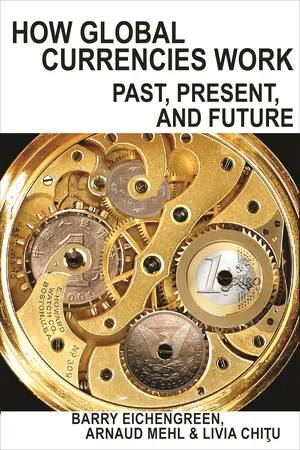
How Global Currencies Work
Past, Present, and Future
- 272 pages
- English
- ePUB (mobile friendly)
- Available on iOS & Android
eBook - ePub
About this book
Information
Publisher
Princeton University PressYear
2017Print ISBN
9780691191867
9780691177007
eBook ISBN
9781400888573
Subtopic
FinanzwesenTable of contents
- Cover Page
- Half Title Page
- Title Page
- Copyright Page
- Contents
- List of Tables
- List of Figures
- Acknowledgments
- 1: Introduction
- 2: The Origins of Foreign Balances
- 3: From Jekyll Island to Genoa
- 4: Reserve Currencies in the 1920s and 1930s
- 5: The Role of Currencies in Financing International Trade
- 6: Evidence from International Bond Markets
- 7: Reserve Currency Competition in the Second Half of the Twentieth Century
- 8: The Retreat of Sterling
- 9: The Rise and Fall of the Yen
- 10: The Euro as Second in Command
- 11: Prospects for the Renminbi
- 12: Conclusion
- Notes
- References
- Index
Trusted by 375,005 students
Access to over 1.5 million titles for a fair monthly price.
Study more efficiently using our study tools.
Frequently asked questions
Yes, you can cancel anytime from the Subscription tab in your account settings on the Perlego website. Your subscription will stay active until the end of your current billing period. Learn how to cancel your subscription
No, books cannot be downloaded as external files, such as PDFs, for use outside of Perlego. However, you can download books within the Perlego app for offline reading on mobile or tablet. Learn how to download books offline
Perlego offers two plans: Essential and Complete
- Essential is ideal for learners and professionals who enjoy exploring a wide range of subjects. Access the Essential Library with 800,000+ trusted titles and best-sellers across business, personal growth, and the humanities. Includes unlimited reading time and Standard Read Aloud voice.
- Complete: Perfect for advanced learners and researchers needing full, unrestricted access. Unlock 1.5M+ books across hundreds of subjects, including academic and specialized titles. The Complete Plan also includes advanced features like Premium Read Aloud and Research Assistant.
We are an online textbook subscription service, where you can get access to an entire online library for less than the price of a single book per month. With over 1.5 million books across 990+ topics, we’ve got you covered! Learn about our mission
Look out for the read-aloud symbol on your next book to see if you can listen to it. The read-aloud tool reads text aloud for you, highlighting the text as it is being read. You can pause it, speed it up and slow it down. Learn more about Read Aloud
Yes! You can use the Perlego app on both iOS and Android devices to read anytime, anywhere — even offline. Perfect for commutes or when you’re on the go.
Please note we cannot support devices running on iOS 13 and Android 7 or earlier. Learn more about using the app
Please note we cannot support devices running on iOS 13 and Android 7 or earlier. Learn more about using the app
Yes, you can access How Global Currencies Work by Barry Eichengreen,Arnaud Mehl,Livia Chitu in PDF and/or ePUB format, as well as other popular books in Volkswirtschaftslehre & Finanzwesen. We have over 1.5 million books available in our catalogue for you to explore.