Why we need to think more like economists to successfully combat terrorism
If we are to correctly assess the root causes of terrorism and successfully address the threat, we must think more like economists do. Alan Krueger's What Makes a Terrorist, explains why our tactics in the fight against terrorism must be based on more than anecdote, intuition, and speculation.
Many popular ideas about terrorists are fueled by falsehoods, misinformation, and fearmongering. Many believe that poverty and lack of education breed terrorism, despite a wealth of evidence showing that most terrorists come from middle-class and often college-educated backgrounds. Krueger closely examines the factors that motivate individuals to participate in terrorism, drawing inferences from terrorists' own backgrounds and the economic, social, religious, and political environments in the societies from which they come. He describes which countries are the most likely breeding grounds for terrorists, and which ones are most likely to be their targets. Krueger addresses the economic and psychological consequences of terrorism and puts the threat squarely into perspective, revealing how our nation's sizable economy is diverse and resilient enough to withstand the comparatively limited effects of most terrorist strikes. He also calls on the media to be more responsible in reporting on terrorism.
Bringing needed clarity to one of the greatest challenges of our generation, this 10th anniversary edition of What Makes a Terrorist features a new introduction by the author that discusses the lessons learned in the past decade from the rise of ISIS and events like the 2016 Pulse nightclub attack in Orlando, Florida.
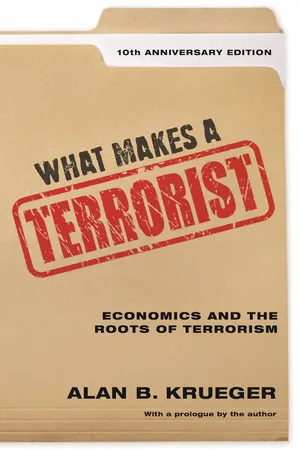
eBook - ePub
What Makes a Terrorist
Economics and the Roots of Terrorism - 10th Anniversary Edition
- 232 pages
- English
- ePUB (mobile friendly)
- Available on iOS & Android
eBook - ePub
What Makes a Terrorist
Economics and the Roots of Terrorism - 10th Anniversary Edition
About this book
Trusted by 375,005 students
Access to over 1.5 million titles for a fair monthly price.
Study more efficiently using our study tools.
Information
Publisher
Princeton University PressYear
2018Print ISBN
9780691138756
9780691177823
eBook ISBN
9781400888979
1
Who Becomes a Terrorist? Characteristics of Individual Participants in Terrorism
FOR THE PAST six years or so I have been studying various aspects of the economics of terrorism. This lecture asks why individuals participate in terrorism: What are their characteristics? Can we infer something about their motivation, the causes behind their participation, from their characteristics and family backgrounds?
I am often asked, “What does this have to do with economics? Why would an economist choose to work on this topic?”
I have two answers, one somewhat flip and the other more serious—although I believe that both are valid. The flip answer is that participation in terrorism is just a special application of the economics of occupational choice. Labor economists are, after all, experts on occupational choice. Some people choose to become doctors or lawyers or economists, and others pursue careers in terrorism. If economics can add something to our understanding of occupational choice in general, perhaps it can be applied to understand participation in terrorism.
The second answer is that, together with Jörn-Steffen Pischke, now at the London School of Economics, I studied the outbreak of hate crimes against foreigners in Germany in the early 1990s. Through this work (Krueger and Pischke, 1997), I became interested in whether economic factors play a role in people’s participation in hate crimes and terrorism. The bottom line from the work on hate crimes, which carries over to my research on the economics of terrorism, is that poor economic conditions do not seem to motivate people to participate in terrorist activities. This appears to hold true at both the individual level and the societal level.
Here I address the individual level. In the following lecture I describe research conducted at the country level, and I discuss the characteristics of countries that are either havens for terrorists or targets of terrorists. In the final lecture I consider the economic consequences of terrorism, and you will see that I have a fairly broad definition of economics that reaches into psychology as well as other measures of well-being.
A number of world leaders and prominent thinkers have drawn a connection running from poor economic conditions and lack of education to the outbreak of terrorism. President George W. Bush was initially quite reluctant to make this association after September 11, but eventually—prompted I think by his desire to appear compassionate and by the widespread popular support for the idea—he decided to draw a connection, too. In a major speech he gave in Monterrey, Mexico, on March 22, 2002, for example, President Bush said, “We fight against poverty because hope is an answer to terror” (G. W. Bush, 2002). His wife Laura Bush went further, claiming, “A lasting victory in the war against terror depends on educating the world’s children because educated children are much more likely to embrace the values that defeat terror” (L. Bush, 2002). Other world leaders and people responsible for important international institutions made similar comments. For example, James Wolfensohn, when he was president of the World Bank, said, “The war on terrorism will not be won until we have come to grips with the problem of poverty and thus the sources of discontent.”
Former British Prime Minister Tony Blair has, on multiple occasions, made a connection between economic conditions and terrorism. On November 12, 2001, he said, “The dragon’s teeth of terrorism are planted in the fertile soil of wrongs unrighted, of disputes left to fester for years or even decades, of failed states, of poverty and deprivation” (Blair, 2001). In July 2005, after the bombings of the London transit system, he reiterated this point: “Ultimately what we now know, if we did not before, is that where there is extremism, fanaticism or acute and appalling forms of poverty in one continent, the consequences no longer stay fixed in that continent” (King, 2005). Elie Wiesel observed that “The fanatic has no questions, only answers. Education is the way to eliminate terrorism” (Jai, 2001). Bill Clinton and Al Gore both made comments along these lines, in addition to President Bush, demonstrating that this is a bipartisan issue in the United States (Gore, 2002). Turkish Prime Minister Recep Tayyip Erdogan, King Abdullah of Jordan, terrorism experts like Jessica Stern of the Kennedy School, and many others have claimed that poverty is a cause of terrorism (Stern, 2000; Fendel, 2005).
Yet I hope to persuade you in this lecture and the next one that there is very little support for a connection between poverty and terrorism. In fact, it is remarkable to me that so many prominent, well-intentioned world leaders and scholars would draw this connection without having an empirical basis for it. A wealth of evidence now shows that any effect of education and poverty on terrorism is indirect, complicated, and probably quite weak.
In my collected articles on education, titled Education Matters (Krueger 2003b), I emphasize the many benefits of education for individuals and for society in general. My work certainly supports the view that education confers many benefits. I do not, however, think that a reduction in terrorism is one of those benefits. In fact, I believe that merely increasing educational spending and years of schooling without focusing on the content of education may even be counterproductive when it comes to terrorism.
The literature on hate crimes is older and better developed than the literature on terrorism. Therefore I begin by discussing hate crimes and defining terrorism. Next I address how public opinion relates to terrorism. Then I turn to a profile of terrorists and suggest how one should theoretically model participation in terrorism at a conceptual level.
Defining Terrorism
Terrorism is a notoriously difficult concept to define. In fact, if I were to start in this field from scratch, I would avoid the word terrorism altogether and use a more neutral term such as politically motivated violence. Terrorism is a tactic. Richard Clarke (2004), who served on the U.S. National Security Council, argued that declaring war on terrorism would be like Franklin Roosevelt or Winston Churchill declaring war on U-boats at the beginning of World War II. It is unusual to declare war on a tactic. Moreover, the tactic of terrorism is difficult to define. There are more than a hundred different scholarly definitions of terrorism. At a conference in 2002, foreign ministers from over fifty Islamic states agreed to condemn terrorism but could not agree on a definition of what it was that they had condemned (“Muslim Nations Fail to Define Terrorism,” 2002).
When I talk about terror...
Table of contents
- Cover Page
- Title Page
- Copyright Page
- Dedication Page
- Contents
- Prologue to the Tenth Anniversary Edition
- Preface to the First Edition
- Introduction
- 1. Who Becomes a Terrorist? Characteristics of Individual Participants in Terrorism
- 2. Where Does Terror Emerge? Economic and Political Conditions and Terrorism
- 3. What Does Terrorism Accomplish? Economic, Psychological, and Political Consequences of Terrorism
- Questions and Answers Following the Lectures
- Afterword
- References
- Index
Frequently asked questions
Yes, you can cancel anytime from the Subscription tab in your account settings on the Perlego website. Your subscription will stay active until the end of your current billing period. Learn how to cancel your subscription
No, books cannot be downloaded as external files, such as PDFs, for use outside of Perlego. However, you can download books within the Perlego app for offline reading on mobile or tablet. Learn how to download books offline
Perlego offers two plans: Essential and Complete
- Essential is ideal for learners and professionals who enjoy exploring a wide range of subjects. Access the Essential Library with 800,000+ trusted titles and best-sellers across business, personal growth, and the humanities. Includes unlimited reading time and Standard Read Aloud voice.
- Complete: Perfect for advanced learners and researchers needing full, unrestricted access. Unlock 1.5M+ books across hundreds of subjects, including academic and specialized titles. The Complete Plan also includes advanced features like Premium Read Aloud and Research Assistant.
We are an online textbook subscription service, where you can get access to an entire online library for less than the price of a single book per month. With over 1.5 million books across 990+ topics, we’ve got you covered! Learn about our mission
Look out for the read-aloud symbol on your next book to see if you can listen to it. The read-aloud tool reads text aloud for you, highlighting the text as it is being read. You can pause it, speed it up and slow it down. Learn more about Read Aloud
Yes! You can use the Perlego app on both iOS and Android devices to read anytime, anywhere — even offline. Perfect for commutes or when you’re on the go.
Please note we cannot support devices running on iOS 13 and Android 7 or earlier. Learn more about using the app
Please note we cannot support devices running on iOS 13 and Android 7 or earlier. Learn more about using the app
Yes, you can access What Makes a Terrorist by Alan B. Krueger in PDF and/or ePUB format, as well as other popular books in Politics & International Relations & International Economics. We have over 1.5 million books available in our catalogue for you to explore.