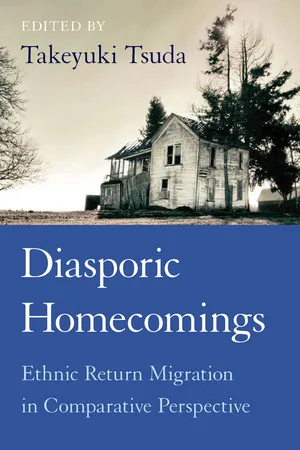
In recent decades, increasing numbers of diasporic peoples have returned to their ethnic homelands, whether because of economic pressures, a desire to rediscover ancestral roots, or the homeland government's preferential immigration and nationality policies. Although the returnees may initially be welcomed back, their homecomings often prove to be ambivalent or negative experiences. Despite their ethnic affinity to the host populace, they are frequently excluded as cultural foreigners and relegated to low-status jobs shunned by the host society's populace. Diasporic Homecomings, the first book to provide a comparative overview of the major ethnic return groups in Europe and East Asia, reveals how the sociocultural characteristics and national origins of the migrants influence their levels of marginalization in their ethnic homelands, forcing many of them to redefine the meanings of home and homeland.
- 368 pages
- English
- ePUB (mobile friendly)
- Available on iOS & Android
eBook - ePub
About this book
Trusted by 375,005 students
Access to over 1.5 million titles for a fair monthly price.
Study more efficiently using our study tools.
Information
Publisher
Stanford University PressYear
2009Print ISBN
9780804762762
9780804762748
Edition
1eBook ISBN
9780804772068
II
Ethnic Return Migration to Europe
4
From Germans to Migrants
Aussiedler Migration to Germany
The German government is aware of its historical responsibility toward the German minorities in Eastern Europe and, in particular, toward those in the former Soviet Union. In light of this background, the government respects the decision of each individual to either make his future in his current home or to come to Germany within the framework of the legally defined conditions of admittance. The government will make sure that this migration is socially acceptable. This presupposes integration. Integration is therefore the central focus of Aussiedler policy.
Federal Republic of Germany, Federal Ministry of the Interior (n.d. (b)) (emphasis added)
NOT QUITE 20 YEARS AGO, the Aussiedler—ethnic Germans living in the former Soviet Union and Eastern and Central Europe and eligible to be accepted as citizens in Germany—were presented by the German government as “our own countrymen” (unsere eigene Landsleute) (Waffenschmidt 1988: 1). Today, they have become immigrants accepted for historical reasons whose integration, the German government assures its citizens, will be made as “socially acceptable” as possible. Once, “the German Aussiedler [were] welcome here” and they were touted as “a large and varied net gain for our country and for us all,” which could be “verif[ied]” with “quantifiable data” (Pressemitteilung 440/89, 1989). Today, the Immigration Law (2005) has a provision for integration courses—“a fundamental building block for integration in Germany”—which is intended for Aussiedler and their spouses and children as well as for noncitizen migrants, clearly indicating that Aussiedler are seen to be facing the same integration challenges that any new migrant faces (Federal Republic of Germany 2004; Federal Republic of Germany, Federal Ministry of the Interior, n.d. (a)).
In the post–cold war era momentous changes surrounding Aussiedler migration have occurred. One of the most fundamental changes is the makeup of the Aussiedler migration flow itself, which shifted from a pre–cold war makeup of Germans from Poland and Romania to one made up largely of migrants from mixed German-Russian marriages in the former Soviet Union. The reasons for migration have also arguably shifted, from co-ethnic return migration on the basis of discrimination to economically motivated migration. Aussiedler policy has largely been reactive, as has much of overall German migration policy and legislation, rather than being a proactive and coherent strategy.
Significantly, the context of Aussiedler migration has also shifted, as has the political context of migration to Germany in toto. Although the change in policy rhetoric indicates a substantive shift both in the political context of Aussiedler migration and in the status of Aussiedler themselves, other changes in German legislation, policy, and rhetoric demonstrate a parallel liberalization of broader naturalization and immigration policy. Aussiedler are now increasingly seen as immigrants like any others; and, indeed, conversely, other immigrants are increasingly welcome as citizens in the German polity, whereas Aussiedler—or immigrant citizens—suffer from increasingly negative public opinion. This shift has, in turn, had a negative effect on the integration and self-identity of Aussiedler, who increasingly view themselves as neither Germans nor Russians but as a distinctly separate group.
What has been behind this shift? I argue here that, paradoxically, two related aspects of Aussiedler migration itself were the driving force behind the dramatic change in German immigration and citizenship policy in the 1990s: Aussiedler’s surprisingly poor—compared to the level expected—sociocultural and economic integration and their own self-understanding and German public perception of their poor integration against the background of what had been expected (compare Chapter 1).1 Finally, but no less significantly, are the numbers involved. Aussiedler migration, which averaged 40,000 per year from 1950 to the mid-1980s, peaked at nearly 400,000 in 1990 as the cold war drew to an end. As a result of these three developments, Aussiedler migration was severely restricted. At the same time, a more open policy toward non-German residents in Germany was developing—the result, I argue, of an increasing conviction among German policymakers that noncitizen denizens were a more fundamental part of German society than immigrant citizens; again, this was a reactive shift, but one whose significance should not be underestimated. Ultimately, by the turn of the twenty-first century, Aussiedler were disadvantaged compared to non-German residents in Germany, in terms both of migration and their lack of social integration, and Germany’s migration policy had shifted from one of ethnic privilege to a more open one (see Chapter 3) in response to the deteriorating Aussiedler situation and changes in geopolitics.
The Development and Changing Political-Ideological Interpretation of Aussiedler Policy
Ethnic German migrants from Eastern and Central Europe and the former Soviet Union who enjoy a special legal status, Aussiedler, become German citizens and receive assistance (now cut back substantially) in integrating into German society and economy (for more information see von Koppenfels 2002). The post–World War II Aussiedler policy arose from a primarily ideological basis. Rather than being open to all those of German origin, as is often believed, the Aussiedler program was open only to ethnic Germans from Communist countries (and, since 1993, only to those from the former Soviet Union).2 The policy was based on the supposition of ethnically based discrimination or persecution of Germans in Eastern and Central Europe and not on German ethnic belonging as such. It was based on two legal texts: Article 116 of the Basic Law and the Federal Expellee and Refugee Law (FERL) of 1953.3 These two laws were developed in reaction to two crucial policy decisions made during and after World War II. These decisions—made by the Allies and by the Soviet Union—did draw on German ethnicity: When Hitler invaded Russia in 1941, Stalin feared that ethnic Germans, living in Russia since the eighteenth century, might place their loyalty to Germany above their loyalty to Russia. Solely on the basis of their German ethnicity, Stalin therefore ordered 500,000 ethnic Germans deported eastward to Kazakhstan and Siberia, where they remained in internment camps until 1956.4 Similarly, the Allies’ decision to expel 8 million Germans from former German territories ceded to Poland and Czechoslovakia, westward this time, also played a role.5 In both cases, German ethnicity (determined by such factors as family name, native language, or religion) was the decisive factor in the expulsion or deportation decision.
The citizenship status of the 8 million expellees in postwar West Germany was legally unclear, with some holding Polish or Czech passports and others holding German ones; likewise, there was also ideologically based concern for the 3 to 4 million Germans in Eastern and Central Europe and the Soviet Union6 as well as the 16 million in East Germany. Responding to the use of ethnicity in the decisions made at Potsdam and made by Stalin, ethnicity was correspondingly introduced into these two German laws to ensure the inclusion of these Germans. Article 116 removed any uncertainty, including expellees as full members in the German polity and making no legal differentiation between expellees and native Germans.7 Article 116 included the phrase deutsche Volkszugehörigkeit , roughly translated as “German ethnicity,” but literally meaning “belonging to the German people,” to assure this legal equality (Parlamentarischer Rat 1949: 596). It should be noted that at the same time, the right to asylum for political and other refugees was equally enshrined in Article 16 of the Basic Law.

Figure 4.1 Aussiedlermigration to Germany, 1950-2006. Data from “Zuzug 1950-1996” (1996) and Statistisches Bundesamt (2008).
The FERL, passed in 1953 after heavy lobbying by expellees, established a legal basis for the integration and equality of the expellees as well as for the continued acceptance of Aussiedler from Central and Eastern Europe and refugees from East Germany. The provisions for the continued acceptance of Aussiedler and refugees from East Germany reflected West Germany’s political positioning during the cold war and were justified as such. In February 1953 Minister for Expellees Lukaschek said in the German Parliament that the refugees from East Germany who would benefit under this law “are victims of the Cold War. The flight from the Soviet Zone of Occupation is a clear political vote of the German people for the free West” (Deutscher Bundestag, 250th Session, February 25, 1953: 11,972B). Or, from a different angle, drawing an explicit comparison to the liberal German asylum policy that accepted nearly all those fleeing the Communist bloc,8 one member of Parliament noted that it should likewise be “a matter of course that our . . . German brothers and sisters [from Communist countries] may come here unhindered” (Parlamentarischer Rat 1950: 1756).
As argued later, however, the post–cold war migration was qualitatively different, which had significant results for German migration policy. Broadly, the door to Germany from the Soviet bloc was wide open during the cold war. However, during that time, the door out of the Soviet bloc was, for the most part, closed. As that door began to open with Mikhail Gorbachev’s liberalization at the end of the 1980s, the raison d’être of the German policy lost its validity, and the Germans began to close their doors to their German countrymen (see Figure 4.1). This restriction was hastened by the poor integration and social marginalization of Aussiedler, which in turn led to increasing negative public opinion (see opening quote of this chapter). These domestic political factors undoubtedly played a role in the changes in Aussiedler policy.
Political-Ideological Interpretation of Aussiedler Policy
Because Aussiedler are accepted in Germany on the basis of presumed ethnic discrimination9 rather than ethnicity per se, potential Aussiedler must therefore see themselves as German in the former Soviet Union and represent themselves as German to others (FERL, §6). The legal assumption of this representation is then that they have suffered discrimination on the basis of being members of the German minority and are, on the basis of that presumed discrimination, eligible for Aussiedler status. Logically, then, it follows that the relevant laws require potential Aussiedler to show that they have maintained German linguistic,10 cultural, and/or social characteristics in order to qualify for Aussiedler status. In other words, to have suffered ethnic discrimination, they must have been identifiable as members of the German ethnic minority. If they were not identifiable as such, they cannot have been singled out for ethnically based persecution or discrimination.
This requirement was initially—in the 1950s, 1960s, and early 1970s—interpreted rather loosely both by officials and by courts deciding disputed cases. However, as the political landscape changed in the Eastern bloc, this situation did not continue to hold true. In 1975, with the signature of the Helsinki Final Act and the establishment of the Commission on Security and Cooperation in Europe (CSCE), human and minority rights were protected in signatory states, which included Romania, Poland, and the Soviet Union—the states with the bulk of ethnic Germans in Central and Eastern Europe. Thus the purpose of the Aussiedler policy, that of protecting the minority and human rights of one particular ethnic minority, was to some extent rendered superfluous.11 This development was reflected in court decisions that tightened requirements for ethnic German return migration.
Cold War Versus Post–Cold War Aussiedler
When Aussiedler migration and integration is analyzed, the cold war–era Aussiedler are, for the most part, widely seen as unproblematic and successful, whereas the integration of those who migrated in the post–cold war era increasingly deteriorated. Aussiedler who migrated during the cold war were, it is nearly universally agreed, unproblematic in terms of integration. They worked hard, learned hard, were willing to integrate, and were accepted as Germans. They largely came from Poland and Romania, with just under 5 percent coming from the Soviet Union in the 1950–1987 period. They had maintained ties with German culture, including strong German language skills, and had education and professional training that were relatively close to German standards. Furthermore, those Aussiedler who migrated during the cold war appear to have been those who had both closer ties to Germany and a stronger will to emigrate—when emigration was quite difficult—and to integrate.
With the coming of the post–cold war Aussiedler, the situation in Germany changed as well. The origin of the Aussiedler was radically different, with about 75 percent (1988–2005) coming from the former Soviet Union—with different language and professional skills—a situation that was exacerbated by German legislation passed in 1992 limiting migration to the former Soviet Union.
At the same time, public opinion began to turn against Aussiedler. This negative public opinion was one of the key factors in the severe reduction of integration benefits—which in the early 1990s included job training, language courses, loans, pension benefits (now reduced to well below native German levels), and lump sum “compensatory” payments (FERL, §§9, 13; “Hilfen für Spätaussiedler,” 1998: 38–53; “Sonderprogramm zur Eingliederung der Aussiedler,” 1988: 5–18). Not only was the increasing scale of Aussiedler ...
Table of contents
- Title Page
- Copyright Page
- Table of Contents
- Introduction - Diasporic Return and Migration Studies
- I - The Causes of Diasporic Return
- II - Ethnic Return Migration to Europe
- III - Ethnic Return Migration to East Asia
- Conclusion
- Contributors
- Index
Frequently asked questions
Yes, you can cancel anytime from the Subscription tab in your account settings on the Perlego website. Your subscription will stay active until the end of your current billing period. Learn how to cancel your subscription
No, books cannot be downloaded as external files, such as PDFs, for use outside of Perlego. However, you can download books within the Perlego app for offline reading on mobile or tablet. Learn how to download books offline
Perlego offers two plans: Essential and Complete
- Essential is ideal for learners and professionals who enjoy exploring a wide range of subjects. Access the Essential Library with 800,000+ trusted titles and best-sellers across business, personal growth, and the humanities. Includes unlimited reading time and Standard Read Aloud voice.
- Complete: Perfect for advanced learners and researchers needing full, unrestricted access. Unlock 1.5M+ books across hundreds of subjects, including academic and specialized titles. The Complete Plan also includes advanced features like Premium Read Aloud and Research Assistant.
We are an online textbook subscription service, where you can get access to an entire online library for less than the price of a single book per month. With over 1.5 million books across 990+ topics, we’ve got you covered! Learn about our mission
Look out for the read-aloud symbol on your next book to see if you can listen to it. The read-aloud tool reads text aloud for you, highlighting the text as it is being read. You can pause it, speed it up and slow it down. Learn more about Read Aloud
Yes! You can use the Perlego app on both iOS and Android devices to read anytime, anywhere — even offline. Perfect for commutes or when you’re on the go.
Please note we cannot support devices running on iOS 13 and Android 7 or earlier. Learn more about using the app
Please note we cannot support devices running on iOS 13 and Android 7 or earlier. Learn more about using the app
Yes, you can access Diasporic Homecomings by Takeyuki Tsuda in PDF and/or ePUB format, as well as other popular books in Social Sciences & Emigration & Immigration. We have over 1.5 million books available in our catalogue for you to explore.