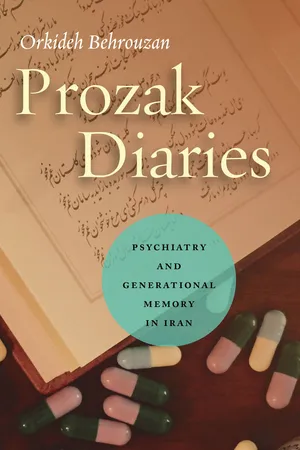
Prozak Diaries
eBook - ePub

Prozak Diaries

Psychiatry and Generational Memory in Iran

  1. 328 pages
  2. English
  3. ePUB (mobile friendly)
  4. Available on iOS & Android
eBook - ePub

Prozak Diaries

Psychiatry and Generational Memory in Iran

About this book

Prozak Diaries is an analysis of emerging psychiatric discourses in post-1980s Iran. It examines a cultural shift in how people interpret and express their feeling states, by adopting the language of psychiatry, and shows how experiences that were once articulated in the richly layered poetics of the Persian language became, by the 1990s, part of a clinical discourse on mood and affect. In asking how psychiatric dialect becomes a language of everyday, the book analyzes cultural forms created by this clinical discourse, exploring individual, professional, and generational cultures of medicalization in various sites from clinical encounters and psychiatric training, to intimate interviews, works of art and media, and Persian blogs. Through the lens of psychiatry, the book reveals how historical experiences are negotiated and how generations are formed.

Orkideh Behrouzan traces the historical circumstances that prompted the development of psychiatric discourses in Iran and reveals the ways in which they both reflect and actively shape Iranians' cultural sensibilities. A physician and an anthropologist, she combines clinical and anthropological perspectives in order to investigate the gray areas between memory and everyday life, between individual symptoms and generational remembering. Prozak Diaries offers an exploration of language as experience. In interpreting clinical and generational narratives, Behrouzan writes not only a history of psychiatry in contemporary Iran, but a story of how stories are told.

Frequently asked questions

Yes, you can cancel anytime from the Subscription tab in your account settings on the Perlego website. Your subscription will stay active until the end of your current billing period. Learn how to cancel your subscription.
No, books cannot be downloaded as external files, such as PDFs, for use outside of Perlego. However, you can download books within the Perlego app for offline reading on mobile or tablet. Learn more here.
Perlego offers two plans: Essential and Complete
  • Essential is ideal for learners and professionals who enjoy exploring a wide range of subjects. Access the Essential Library with 800,000+ trusted titles and best-sellers across business, personal growth, and the humanities. Includes unlimited reading time and Standard Read Aloud voice.
  • Complete: Perfect for advanced learners and researchers needing full, unrestricted access. Unlock 1.4M+ books across hundreds of subjects, including academic and specialized titles. The Complete Plan also includes advanced features like Premium Read Aloud and Research Assistant.
Both plans are available with monthly, semester, or annual billing cycles.
We are an online textbook subscription service, where you can get access to an entire online library for less than the price of a single book per month. With over 1 million books across 1000+ topics, we’ve got you covered! Learn more here.
Look out for the read-aloud symbol on your next book to see if you can listen to it. The read-aloud tool reads text aloud for you, highlighting the text as it is being read. You can pause it, speed it up and slow it down. Learn more here.
Yes! You can use the Perlego app on both iOS or Android devices to read anytime, anywhere β€” even offline. Perfect for commutes or when you’re on the go.
Please note we cannot support devices running on iOS 13 and Android 7 or earlier. Learn more about using the app.
Yes, you can access Prozak Diaries by Orkideh Behrouzan in PDF and/or ePUB format, as well as other popular books in Social Sciences & Global Development Studies. We have over one million books available in our catalogue for you to explore.
Index
Page numbers in italics refer to illustrations.
1979 Revolution. See Iranian Revolution
Academy of Culture, 49
ADHD (Attention Deficit Hyperactivity Disorder), 2, 6, 16, 193, 195; biomedicine and, 185–88, 199–201, 213, 253n51, 267nn4,5; changes in diagnoses, 24, 29, 32, 56, 88, 164, 165–67, 229n2, 266n1, 267n6, 268n8; child psychiatry and, 54, 58–59, 69, 87, 161, 198, 266n2, 267n3; generational relationships and, 33, 167–74; parenting and, 159–61, 163–65, 167–73, 185, 219, 268nn10,12, 271n35; public media and, 11, 73, 163
addiction, 47, 49, 73, 78, 205, 245n63, 249n20, 251n38
Adorno, Theodor, 150, 264n38
aesthetics: childhood, 104, 115, 140; cultural, 13, 31–32, 99, 126, 269n23; generational, 16, 78, 99, 120, 175, 212; of memory, 30–31, 120; of war, 260n10
affect, 8, 26, 184, 193, 203, 213–14, 230n6; affectedness, 8, 31, 56, 104, 111, 202, 230n6; affective memory, 119–20, 184, 212; affective space, 6, 9–10, 32, 40, 93, 98, 126, 134–37, 158, 183–84, 231n10, 255n8, 264n34, 271n32; blogs and, 9, 129, 133–37; depreshen and, 26, 29, 34, 92–93, 98, 107, 116, 119–20, 182; discourses of, 1, 3, 16, 28, 39–40, 89, 239n13; generational identities and, 29, 31, 104, 107, 118, 126, 130, 141–43...

Table of contents

  1. Cover
  2. Copyright
  3. Title Page
  4. Contents
  5. Note on Transliteration
  6. Abbreviations
  7. The Anthropologist
  8. The Poet-Satirist
  9. Freud
  10. The Counselor
  11. The Student
  12. The Blogger
  13. The Mother
  14. The Medical Intern
  15. Conclusion: Reflections on Mental Health and Interdisciplinary Conversations across Cultures
  16. Reference Matter
  17. Acknowledgments
  18. Notes
  19. References
  20. Index