In the United States, egg donation for reproduction and egg donation for research involve the same procedures, the same risks, and the same population of donors—disadvantaged women at the intersections of race and class. Yet cultural attitudes and state-level policies regarding egg donation are dramatically different depending on whether the donation is for reproduction or for research. Erin Heidt-Forsythe explores the ways that framing egg donation itself creates diverse politics in the United States, which, unlike other Western democracies, has no centralized method of regulating donations, relying instead on market forces and state legislatures to regulate egg donation and reproductive technologies.
Beginning with a history of scientific research around the human egg, the book connects historical debates about the “natural” (reproduction) and “unnatural” (research) uses of women’s eggs to contemporary political regulation of egg donation. Examining egg donation in California, New York, Arizona, and Louisiana and coupled with original data on how egg donation has been regulated over the last twenty years, this book is the first comprehensive overview and analysis of the politics of egg donation across the United States.
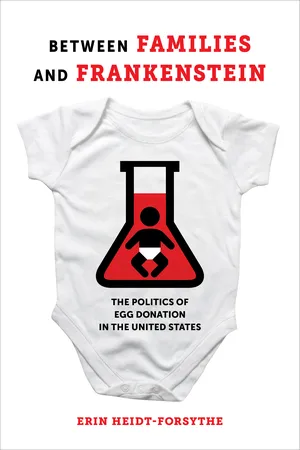
eBook - ePub
Between Families and Frankenstein
The Politics of Egg Donation in the United States
- 296 pages
- English
- ePUB (mobile friendly)
- Available on iOS & Android
eBook - ePub
Between Families and Frankenstein
The Politics of Egg Donation in the United States
About this book
Trusted by 375,005 students
Access to over 1.5 million titles for a fair monthly price.
Study more efficiently using our study tools.
Information
Publisher
University of California PressYear
2018Print ISBN
9780520298187
Edition
1eBook ISBN
9780520970434
CHAPTER ONE
Dream or Nightmare?
Theories and Histories of Egg Donation in the United States
Traveling through New Brunswick, New Jersey, drivers find that tedious stretches of highway are dotted with billboards; not terribly unusual, except that these billboards advertise egg donation. Festooned with brightly colored chicken eggs, warmly smiling doctors, and chubby babies accompanied by storks, these advertisements reveal the large, lucrative fertility industry in New Jersey. Young women at nearby Rutgers and Princeton Universities can earn eight thousand to ten thousand dollars for signing up, passing a battery of tests, and having their eggs procured through outpatient surgery. However, New Brunswick is also home to the Stem Cell Institute of New Jersey. In contrast to the fertility industry, which put up those cheerful billboards soliciting egg donation for reproduction, the institute has faced major political attention and turmoil. In 2008, only eight months after breaking ground for the Christopher Reeves Pavilion in the future eighteen-story research tower in the center of the city, voters rejected a ballot measure allocating almost half a billion dollars in funding for the institute (Jackson 2008). While young women can easily apply to become egg donors at the seventeen clinics across New Jersey, moral and ethical debates about using state money for research—some of which involves human eggs—plague stem cell science in the state. The dream and potential of egg donation to create life on one hand, and to create cures on the other, can easily slide into a political nightmare.
THE POLITICS OF EGG DONATION: REPRODUCTION VERSUS RESEARCH
One of the key questions I explain is why, given the robust regulation of egg donation in comparative industrialized countries, the US is so different in its approach to the politics of egg donation. In a system of federalism like that of the US, states have an important role in crafting and implementing policy, even when the policy has been created at the national level. States have been vested in issues surrounding egg donation since the 1980s, and interest in human eggs for research has burgeoned since the development of stem cell research in the late 1990s (Bonnicksen 1989, Bonnicksen 2002, Markens 2007, Thompson 2013). Egg donation also developed and changed in the public imagination: while early depictions of egg donation for reproduction portrayed the technology as morally suspect, it has transitioned into a highly conventional practice for those privileged to access infertility care in the US. However, the belief that egg donation is a conventional choice for family formation has not always prevailed; moral and body politics have informed the histories and policies of egg donation. I argue that existing explanations for the US regulatory system—that privacy, the controversial nature of abortion, and the lack of bioethical discourse explain regulation of egg donation in the US—are incomplete. These arguments fail to account for two important patterns in the politics of egg donation in the US: first, why egg donation for reproduction has summoned diverse framing and policy responses; and second, why state political actors have engaged with issues related to egg donation. In this chapter I argue that two explanatory frameworks work together to illuminate the unique regulatory approach of the US to egg donation, as described in table 1.
TABLE 1
The Politics of Egg Donation
Body Politics and Morality Politics

As discussed in the introduction, the US is viewed in the public imagination (as well as in scholarly observation) as the Wild West of reproductive technology, where egg donation practices and regulations are determined and policed by multibillion-dollar commercial markets. On one hand, the US has been perceived as too passive on bioethical issues, refusing to regulate private reproductive decisions, scientific research, and commercial markets; on the other hand, the US has been described as being mired in debates over abortion, precluding any reasonable discussion of egg donation (Jasanoff 2005). This characterization is rooted in comparison: while other nations have centralized regulatory regimes restricting egg donation practices, a cursory examination of the US shows no such regulatory framework. For example, some nations (such as Germany, Austria, Italy, and Norway) have banned egg donation outright. Other nations (such as the UK and Canada) allow egg donation, but donation cannot be compensated. Some nations (Israel and Switzerland) restrict the use of donor eggs to those who are legally married, a privilege often reserved for heterosexual couples. The US stands out among these examples of centralized regulation, with its seemingly unfettered system attracting domestic and international consumers looking to purchase third-party eggs for reproduction.
In order to solve this puzzle, in this chapter I examine two major frameworks—body politics and morality politics—that explain the diverse politics of egg donation. At different moments in the history and regulation of egg donation, these frameworks have gained and lost traction in defining egg donation in the US context. Body politics, as an area of inquiry in gender, women’s, and sexuality studies, has traditionally examined gender, sexuality, and reproductive issues in the context of state power. Overarching questions about how the state intervenes in reproduction have long underpinned body politics; since the 1990s, feminist scholars have used the lens of body politics to consider the relationships between state power and reproductive technologies (Franklin 1995). Egg donation fits into body politics: the state uses its powers of regulation to advance political ideologies about gender and the family, particularly as they interact with other social structures like race, class, and sexuality (e.g., Roberts 2009, Daniels and Heidt-Forsythe 2012, Thompson 2005). However, missing from these conversations within body politics is how this framework informs egg donation politics and policies.
Egg donation in the US is not only shaped by considerations of body politics and interventions by the state into reproduction; it is also structured by discussions of ethical and moral values. Morality politics—a field of study within political science and policy studies—considers how certain issues are defined in the public sphere through the lens of fundamental moral principles. This lens shapes how political actors define an issue, what the terms of debate are, and how distinct partisan, contentious politics are provoked by the issue. For example, those who study abortion politics and policy have noted the ways that the issue is defined through the lens of morality related to life and bodily autonomy, how discourse occurs between opposing actors who represent different fundamental principles, and how distinct politics and policy are created in relation to abortion (e.g., Mooney and Lee 1995, Norrander and Wilcox 1999). In the scholarship on morality politics, there is increasing attention to the ways that the politics of stem cell research and cloning are defined through morality politics (e.g., Ryan 2014, Bonnicksen 2002). However, this research lacks attention to the intersection of reproduction and controversial research—the place where egg donation exists. In egg donation for reproduction and egg donation for research, morality politics potentially has important explanatory power in conjunction with body politics.
Part of the overarching premise of this book—that norms of gender create divisions between the “natural” and abject and shape the politics of egg donation—is that body politics and morality politics have played roles in this process in the past and still do so today, and in this chapter I break down these roles. Discussing the broader existing debates in body and morality politics, this chapter traces how body and morality politics have shaped the US system of egg donation and how they have gained and lost relevance in this system. After laying out the ways that these frameworks help explain egg donation for reproduction and research, this chapter connects body and morality politics to the practical, scholarly, and political histories of this reproductive technology in the US context. I argue that rather than being a strange, Wild West system of regulation that makes little sense in light of nearly universal regulation of egg donation in Europe, North America, and Oceania, egg donation reflects the simultaneous logics of body politics and morality politics. Contemporary politics surrounding egg donation in the US have taken two different trajectories, where egg donation for reproduction is defined according to body politics, and egg donation for stem cell and cloning research is defined through morality politics as an abject, strange, and unnatural use of women’s bodies. However, these patterns have not always existed—and the histories of egg donation illustrate how stakeholders employ body politics and morality politics to frame the reproductive technology in the US.
BODY POLITICS OF EGG DONATION: THINKING CRITICALLY ABOUT STRATIFIED REPRODUCTION
While conflicts over egg donation for reproduction and research seem new and discomfiting, they are an echo of much older debates about inequality, reproduction, and the state. For nearly fifty years, scholars have carefully observed and analyzed how the combination of reproduction and technology provides “a terrain for imagining . . . contested claims of powerful religious and political ideologies” (Ginsburg and Rapp 1995). State power is exercised over the body and its processes—particularly practices that literally reproduce the population of the nation—and this power communicates and enforces hierarchies of identity (among these are gender, race, and class), citizenship, and representation in political spaces (Roberts 1998, 2012, Ginsburg and Rapp 1995, Franklin and Ragoné 1998, Luker 1984, Dickenson 2007, Browner and Sargent 2011, Ehrenreich and English 1978, Gordon 2004). Reproduction and motherhood are sites of contestation in political institutions and policymaking, particularly at the state level (Skocpol 1992, Petchesky [1984] 1990, Daniels 1993, Roberts 1998, Jelen and Wilcox 2003, Kreitzer 2015). As is the case in other reproductive issues, egg donation is a site of debates and confrontations about the role of the state in commodification and exploitation, procreation, kinship and the biological family, and bodily autonomy (Mamo 2008, Farquhar 1996, Franklin 2013). More broadly, politics surrounding egg donation (and indeed, the body in general) serve the aims of the state to not only define civil society and citizenship but also define the meanings of the state’s economic and political powers (Waylen et al. 2013). Egg donation’s role in stem cell and cloning research has also opened up broader debates on inequalities within scientific research and innovation, particularly on issues of access to the benefits of such research (Thompson 2005, 2013, Benjamin 2013).
Stratified reproduction is a process by which “physical and social reproductive tasks are accomplished according to inequalities that are based on hierarchies [of social categories], of class, race, ethnicity, gender” (Colen 1995, 78, Rapp 1999). Reproductive stratification is based in—and further aggravates—inequalities in lived experiences inside and outside of reproduction. In experiences ranging from sexual activity to access to contraceptive technologies, from access to abortion to access to pregnancy care, from childbirth to socializing children, individuals encounter the work of forming families in different and often unequal ways. This “reproductive labor” of physically reproducing and sustaining children, families, and domestic tasks is not only strongly associated with femininity and the lived experience of women but is also often devalued and discredited as valid and important paid or unpaid work (Colen 1995, Rapp 1999). Reproductive labor is not, however, equally disregarded or rewarded across the population; according to hierarchies of class, race, gender, sexuality, and ability, some individuals are highly incentivized and rewarded for reproductive labor, while others are shamed, punished, and prevented from reproducing and raising families (e.g., Roberts 1998). State authority and control over technologies in reproduction and research are used to promote hierarchies of gender, race, class, and sexuality within and across national borders, and inequalities are anchored in complex webs of laws and policies that enforce ideologies of reproductive value (Farquhar 1996, Petchesky [1984] 1990, Mamo 2007, Markens 2007, Thompson 2005, Colen 1995, Rapp 1999, Roberts 2009, 1998).
Although the use of egg donation has skyrocketed over the past twenty years, not all people have experienced increased access to infertility treatment or sophisticated reproductive technologies (Roberts 1998). Stratification has arguably become more intense with egg donation (among other reproductive technologies): in the US context, the high costs of procedures and pharmaceutical drugs come out of patients’ pockets for those without comprehensive health insurance. Intense reproductive stratification in reproductive technologies is not simply a product of economic resources: as Roberts (1998, 2009) notes, historically the entire fertility market in the US has been built upon white, middle- and upper-class consumers, while women of color face high levels of scrutiny, surveillance, and legal restrictions regarding fertility and childbirth (see also Smith 2007). Historically, infertility clinics aimed their services at white, economically privileged, urban couples, as evidenced by commercial practices that heavily advertised to and served these populations (Roberts 1998, Markens 2007, Thompson 2005, Almeling 2011).1 With the increasing sophistication and application of genetic testing, pharmaceutical drugs, and obstetric technologies, there has been a shift to individual responsibility in reproduction across the entire population, where individuals are increasingly being asked not only to accept personal risk during reproduction but also to access all possible technologies in order to have a “successful” reproductive experience (Roberts 2009, Thompson 2005, 2013, Harwood 2007).2 From the Centers for Disease Control advising “pre-pregnant” women against alcohol consumption to seemingly mandatory amniocentesis, from genetic testing during the first trimester of pregnancy to increasingly sophisticated technologies for visualizing fetuses in the womb, women face intense pressure in a stratified system of technology access: one’s ability to access the best medical care, reproductive technologies, and pharmaceuticals determines one’s fitness as a mother (Roberts 2009). Despite the prevalence of these technologies, not all people have equal access to even a minimum level of health care, much less sophisticated reproductive technologies like donated eggs. Additionally, the benefits of research using donor eggs—such as regenerative medicine—have not been spread equally across the population, particularly failing to reach socioeconomically disadvantaged groups (Benjamin 2013). The values, beliefs, and assumptions about inequality, reproduction, and research shape the politics and policy outcomes related to egg donation—while the state must intervene in some cases to alleviate inequality in access to reproductive technologies, in other cases the inequality may be reinforced by state inaction (Roberts 2009).
MOTHERHOOD AND EGG DONATION IN STRATIFIED REPRODUCTION
Although stratified reproduction and access to technologies have changed through biomedicalization and the use of egg donation, these patterns are rooted in the US’s history of using race, gender, class, and other identities to determine what makes a good mother versus a bad one. Popular culture, media representations, legal cases, and public policy demonstrate prevailing ideologies about who is a good or a bad mother: for example, President Theodore Roosevelt warned of “race suicide” during the Progressive Era, a historical moment when increasing numbers of single women agitated for increased liberties in sexuality and reproduction, the workplace, and education, while delaying marriage, pregnancy, and childbirth (Traister 2016). During this same era, other women were deemed innately unfit to be mothers owing to their sexuality, race, ethnicity, immigration status, gender identity, or disability. Whereas the state made an explicit call for white, single women to settle down and form families, it enforced punitive and oppressive reproductive policies (such as state-mandated sterilization) on marginalized women (Solinger 2005, Roberts 1998). However, there is no “good” mother without a corresponding “bad” mother in popular culture and political life, and this binary has hinged on race, class, and sexuality. African American, Latina, Asian American, and Native American women, particularly economically disadvantaged women, have been historically defined as unfit mothers in a stratified system of reproduction. Among these groups, nonwhite, young, and unmarried women have been subject to a litany of negative sociopolitical representations that define their motherhood as criminal and damaging. Reflecting these representations, punitive policies and social practices prevented women from fulfilling their goals of motherhood (Solinger 2005, Roberts 1998, 2009).
This division between good and bad mothers is reinforced through commercial and political practices related to egg donation in the US—particularly the ways that certain women’s bodies are deemed appropriate and natural for reproduction and motherhood, while other women’s bodies are defined as deviant or unfit, disqualifying them for reproduction and motherhood. Importantly, there are multiple roles women’s bodies can play in egg donation markets and politics: the bod...
Table of contents
- Title
- Copyright
- Dedication
- Contents
- List of Illustrations
- Acknowledgments
- Introduction
- 1. Dream or Nightmare? Theories and Histories of Egg Donation in the United States
- 2. Framing Egg Donation at the State Level
- 3. Statecraft Is Always Soul Craft: Egg Donation Politics in Four States
- 4. Toward a New Gendered Partisanship: Egg Donation Politics in the States
- Conclusion
- Appendix 1
- Appendix 2
- Appendix 3
- Notes
- Works Cited
- Index
Frequently asked questions
Yes, you can cancel anytime from the Subscription tab in your account settings on the Perlego website. Your subscription will stay active until the end of your current billing period. Learn how to cancel your subscription
No, books cannot be downloaded as external files, such as PDFs, for use outside of Perlego. However, you can download books within the Perlego app for offline reading on mobile or tablet. Learn how to download books offline
Perlego offers two plans: Essential and Complete
- Essential is ideal for learners and professionals who enjoy exploring a wide range of subjects. Access the Essential Library with 800,000+ trusted titles and best-sellers across business, personal growth, and the humanities. Includes unlimited reading time and Standard Read Aloud voice.
- Complete: Perfect for advanced learners and researchers needing full, unrestricted access. Unlock 1.5M+ books across hundreds of subjects, including academic and specialized titles. The Complete Plan also includes advanced features like Premium Read Aloud and Research Assistant.
We are an online textbook subscription service, where you can get access to an entire online library for less than the price of a single book per month. With over 1.5 million books across 990+ topics, we’ve got you covered! Learn about our mission
Look out for the read-aloud symbol on your next book to see if you can listen to it. The read-aloud tool reads text aloud for you, highlighting the text as it is being read. You can pause it, speed it up and slow it down. Learn more about Read Aloud
Yes! You can use the Perlego app on both iOS and Android devices to read anytime, anywhere — even offline. Perfect for commutes or when you’re on the go.
Please note we cannot support devices running on iOS 13 and Android 7 or earlier. Learn more about using the app
Please note we cannot support devices running on iOS 13 and Android 7 or earlier. Learn more about using the app
Yes, you can access Between Families and Frankenstein by Erin Heidt-Forsythe in PDF and/or ePUB format, as well as other popular books in Social Sciences & Gynecology, Obstetrics & Midwifery. We have over 1.5 million books available in our catalogue for you to explore.