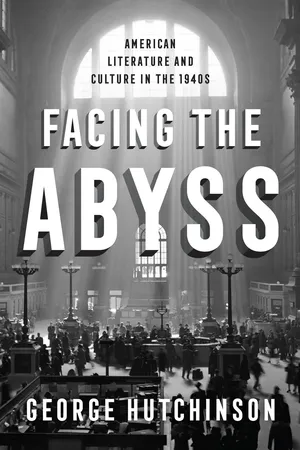
Mythologized as the era of the "good war" and the "Greatest Generation," the 1940s are frequently understood as a more heroic, uncomplicated time in American history. Yet just below the surface, a sense of dread, alienation, and the haunting specter of radical evil permeated American art and literature. Writers returned home from World War II and gave form to their disorienting experiences of violence and cruelty. They probed the darkness that the war opened up and confronted bigotry, existential guilt, ecological concerns, and fear about the nature and survival of the human race. In Facing the Abyss, George Hutchinson offers readings of individual works and the larger intellectual and cultural scene to reveal the 1940s as a period of profound and influential accomplishment.
Facing the Abyss examines the relation of aesthetics to politics, the idea of universalism, and the connections among authors across racial, ethnic, and gender divisions. Modernist and avant-garde styles were absorbed into popular culture as writers and artists turned away from social realism to emphasize the process of artistic creation. Hutchinson explores a range of important writers, from Saul Bellow and Mary McCarthy to Richard Wright and James Baldwin. African American and Jewish novelists critiqued racism and anti-Semitism, women writers pushed back on the misogyny unleashed during the war, and authors such as Gore Vidal and Tennessee Williams reflected a new openness in the depiction of homosexuality. The decade also witnessed an awakening of American environmental and ecological consciousness. Hutchinson argues that despite the individualized experiences depicted in these works, a common belief in art's ability to communicate the universal in particulars united the most important works of literature and art during the 1940s. Hutchinson's capacious view of American literary and cultural history masterfully weaves together a wide range of creative and intellectual expression into a sweeping new narrative of this pivotal decade.
- English
- ePUB (mobile friendly)
- Available on iOS & Android
eBook - ePub
About this book
Trusted by 375,005 students
Access to over 1.5 million titles for a fair monthly price.
Study more efficiently using our study tools.
Information
Subtopic
Literary Criticism in DramaIndex
Literature1
WHEN LITERATURE MATTERED
One of the first writers to emerge from World War II was Gore Vidal, whose debut novel, Williwaw (1946), drew on his experience as a naval officer in the Aleutian Islands. It was a surprise bestseller, and after his second novel, In a Yellow Wood, came out the next year he found himself “very much on view with the other young lions of the second postwar generation. Journalists were eager to know if we would be ‘lost,’ too.” The magazine Life featured several of these “young lions,” including a sultry full-page photo of Truman Capote. “Thus began his career as a celebrity,” in Vidal’s words. He was twenty-one; Vidal, twenty. “In those days works of literature were often popular,” he reminisced in his 1995 memoir, “something no longer possible.” Vidal moved to Paris in the late 1940s and stayed in the hotel where Sartre and de Beauvoir held court after they’d been driven from the Café Flore by hordes of tourists who came to look at them. “Now,” Vidal continued, “I find it hard to believe that I once lived in a time when writers were world figures because of what they wrote, and that their ideas were known even to the vast perennial majority that never reads.… [W]riting was still central to the culture if not the culture.”1 In the 1940s, literature mattered.
Popular radio shows featured literary critics talking about recent poetry and fiction. The New Yorker’s book-review editor hosted one of the most popular radio shows in America, and his anthology, Reading I’ve Liked, ranked seventh on the bestseller list for nonfiction in 1941.2 At the Democratic Primary Convention in 1948, F. O. Matthiessen, a professor of American literature, delivered a nominating speech for Henry Wallace, the late FDR’s vice president. Writers were celebrities. Literature was popular. The 1940s was the most intensely literary decade in American history, perhaps in world history.
Books symbolized freedom. Posters of 1942 quoted the president: “Books cannot be killed by fire. People die, but books never die. No man and no force can put thought in a concentration camp forever. No man and no force can take from the world the books that embody man’s eternal fight against tyranny. In this war, we know, books are weapons.”3 During the Blitz, Muriel Rukeyser recalled, “newspapers in America carried full-page advertisements for The Oxford Book of English Verse, announced as ‘all that is imperishable of England.’ ”4 For the first and only time in history, protecting books in war zones became an official aim of armed forces.5
The Writers’ War Board, founded two weeks after Pearl Harbor as an independent propaganda agency, spotlighted modernist books as the targets of Nazism. American publishers gladly joined the crusade. To buy a book, particularly a “modern” book, was to defend liberty. “This book, like all books,” read the back of the dust jacket to Muriel Rukeyser’s volume of antifascist poetry Beast in View (1944), “is a symbol of the liberty and the freedom for which we fight. You, as a reader of books, can do your share in the desperate battle to protect those liberties—Buy War Bonds.”6 The front of the dust jacket featured an abstract rendering of the inside of a rifle barrel (fig. 1.1).
This was the golden age of the public library. From the 1910s through the 1940s, libraries sprang up in rural towns across the states, neighborhood branches sprouted in the great cities, and librarianship multiplied. During the Depression and “the War,” the libraries offered free shelter, entertainment, and education, harboring readers rich and poor. Writers’ memoirs of the 1930s and 1940s often feature tributes to the public library, whether neighborhood branch or metropolitan temple.

FIGURE 1.1 Dustjacket for the first edition of Muriel Rukeyser’s Beast in View (Doubleday, 1944). Source: Reproduced by permission of Random House LLC.
Richard Wright got his education through the public libraries, beginning with the whites-only Memphis library, where he borrowed books on a white friend’s card, posing as an errand boy. Jo Sinclair, from a desperately poor Jewish family in Cleveland, used the neighborhood branch of her public library as her first writing school.7 Then, as a WPA employee digesting foreign-language newspapers, she worked at the main branch downtown and stayed long hours after work to explore its treasures. The “New York intellectuals” grew up in the public libraries even if their formal education came from City College, NYU, or Columbia. Alfred Kazin is just one of many who spent his days in the New York Public Library’s palatial reading room:
There it was, as soon as you walked up the great marble steps off Fifth Avenue. “ON THE DIFFUSION OF EDUCATION AMONG THE PEOPLE REST THE PRESERVATION AND PERPETUATION OF OUR FREE INSTITUTIONS.” It said that to you as you entered the great hall, in gold letters on the pylons facing the Fifth Avenue entrance. The entrance also read: “THE LIBRARY IS OPEN EVERY DAY OF THE YEAR 9 A.M.–10 P.M., MONDAY–SATURDAY. 1–10 SUNDAY.
Year after year I seemed to have nothing more delightful to do than to sit much of the day and many an evening at one of those great golden tables acquainting myself with every side of my subject. Whenever I was free to read, the great Library seemed free to receive me.8
Karl Shapiro’s “Public Library,” in V-Letter and Other Poems (1944) extols: “What is it, easier than a church to enter, / Politer than a department store, this center / That like Grand Central leads to everywhere?” Shapiro was planning to become a librarian before the draft intervened. For both Kazin and Shapiro, the library is the central institution of democracy: “Is it more civic than City Hall? … / Its one demand is freedom, its one motto / Deep in the door, Read, Know, and Tolerate.”9 The diversity of patrons and incongruous temporal juxtapositions in the library struck the refugee Claude Lévi-Strauss in the early 1940s: “I went to work every morning in the American room of the New York Public Library. There, under its neo-classical arcades and between walls paneled with old oak, I sat near an Indian in a feather headdress and a beaded buckskin jacket—who was taking notes with a Parker pen.”10
The 1930s and 1940s also saw a profound expansion of book distribution across the United States as increasing numbers of Americans took up reading in their spare time. The market for books expanded dramatically, despite constraints. Books from the first half of the 1940s are not pretty. With rationing, they had to be printed on cheap paper, in small type within tight margins. Trade books had to be cut back, deterring risk and forcing shorter print runs. Yet the hunger for books grew. William Jovanovich later recalled that “publishers were able to sell practically everything to war workers, who had plenty of money and not much to spend it on.”11 James T. Farrell partly attributed the expansion to the scarcity of consumer goods; gas rationing, which cut down on pleasure trips; and restrictions on new film production. Gertrude Stein, recounting her first encounter with American GIs during the liberation of France, contrasted them with the soldiers of World War I, who “did not read much not those we knew.” They told her they thought it was because they didn’t have much to do in the 1930s, and the radio quizzes and crossword puzzles “kind of made them feel that it was no use just being ignorant.”12 The anecdote matches publishers’ suspicions. Book publishing developed into a mass industry with new distribution techniques, eventually making the business attractive even to financial markets.13 The expansion of demand inspired experiments. When the war ended, literary publishing boomed.
Priming the pump for demand for “modern” literature was a publishing enterprise that dated back to 1917, the Modern Library. Horace Liveright, the chief of Boni and Liveright, had started it as a self-consciously modernist venture—a reprint operation focusing on international modernism and attempting to make the best of recent literature available in an affordable and matching format to a growing intellectual class through the 1920s. With careful editorial selection, it quickly established a reputation for quality as well as affordability. Liveright’s risky publishing and other ventures simultaneously made him famous and put him in hock by the early 1920s, however, and in 1925 he sold the imprint to two of his junior associates, Bennett Cerf and Donald Klopfer.
Cerf and Klopfer cannily moved to modern marketing and distribution techniques while building further the editorial distinction of the series, and within five years sales quadrupled. In the course of the 1930s the Modern Library solidified a revered status among intellectuals even as it used mass-production and -distribution techniques to sell its wares, foreshadowing the paperback revolution of the late 1940s.14 They promoted the notion that they provided a reading list of the best contemporary writing, so that one couldn’t go wrong buying one of their books and that reading them on a regular basis would constitute an education. They imitated Alfred A. Knopf’s Borzoi colophon concept with a torchbearer motif designed initially by Rockwell Kent. But Modern Library, as mainly a reprint publisher, had a different mission.
Cerf and Klopfer tested the limits of respectability with mail-order schemes, a Book-a-Month plan, and other ideas usually disdained among the “high-class” publishers like Knopf—and their audiences. They risked being taken for “pushy Jews,” something no one would say of the lordly Knopf (who was also Jewish). To maintain their reputation with critics and readers they kept titles that sold as few as two thousand copies a year, yet to maintain their reputation with the booksellers they cut any titles expected to sell less than that. Sales went through the roof in the course of the Great Depression as Cerf and Klopfer hit the roads to win over bookstores, college campuses, and department stores, implanting in retailers’ minds the assurance that their books would not waste shelf space. You can sell a one-dollar book over three times easier than a three-dollar-book, they told the retailers, and it turned out they were right.
Worried about their image, however, they avoided newsstands and drugstores (which sold pulp fiction and comic books), and they never looked beyond the cities. By the end of the 1930s Modern Library supplied a large share of the books for college literature courses while also appealing to nonacademics and maintaining their all-important reputation for “class.” But in addition to making their own fortunes and reputations, Cerf and Klopfer had helped expand the market for modern literature across the urban United States.
In the early 1930s, Cerf and Klopfer founded Random House as a limited edition “fine press,” separate from the Modern Library, reinforcing their literary prestige. But in the mid-1930s they began to open up the list and turn it into a trade house, which became a behemoth in the course of the 1940s. Cerf, the gregarious one of the two (later a regular on the popular TV show What’s My Line?), rubbed elbows with movie stars and directors and wrote a column, “Trade Winds,” for the Saturday Review of Literature. Meanwhile, Klopfer enlisted in the army in 1942, serving until Germany’s surrender and earning a chestful of medals, including the French Croix de Guerre.
Their correspondence during the war reveals plenty of back-and-forth with the movie studios. One evening, Cerf found himself sitting beside a beautiful German woman at a friend’s dinner party and introduced himself. She was Greta Garbo.15 When studios bought the rights to a novel, both publisher and author got a cut, and so movies became another cherished source of income in the literary world. Sinclair Lewis got a whopping $150,000 for the movie rights to Cass Timberlane in 1945.16 Marketing machines brought attention to the books on which movies were based, not infrequently featuring a blow-up of the dust jacket on marquees and posters. Bookstores, in turn, exploited the glamour of the movies in their displays, linking books to the stars who played the characters.17 Not only did Hollywood rewrite novels into scripts that could pass muster with the Hays Office Production Code and draw huge audiences, but publishers began “novelizing” popular films, often using ghostwriters. The Metro-Goldwyn Mayer prize for the “Novel of the Year” paid $100,000 to the winning author, assuring financial independence for life.18
The democratization of taste had its counterpart in the class backgrounds of authors. James T. Farrell, after noting that “far more people of the lower-middle class and even workers are reading seriously,” added that “with ever greater frequency the more vigorous American writers are of plebeian origin, and … writers of the upper classes try to imitate them.”19
Time called 1943 “the most remarkable [year] in the 150-year-old history of U.S. publishing.” It added that “the whole vast literate population of the United States” was “for the first time buying and reading books”—surely an exaggeration but indicative of a major shift in consumption. Orders from bookshops and department stores, their shelves free of overstock, poured into publishers’ offices.20 With consumption of other goods curtailed by rationing, people were staying home and reading. And into the midst of this boom came what was arguably the most imaginative and transformative initiative in th...
Table of contents
- Cover
- Title Page
- Copyright
- Dedication
- Epigraphs
- Contents
- List of Illustrations
- Acknowledgments
- Introduction
- 1. When Literature Mattered
- 2. Popular Culture and the Avant-Garde
- 3. Labor, Politics, and the Arts
- 4. The War
- 5. America! America! A Jewish Renaissance?
- 6. A Rising Wind: “Literature of the Negro” and Civil Rights
- 7. Queer Horizons
- 8. Women and Power
- 9. Ecology and Culture
- Epilogue: One World
- Notes
- Index
Frequently asked questions
Yes, you can cancel anytime from the Subscription tab in your account settings on the Perlego website. Your subscription will stay active until the end of your current billing period. Learn how to cancel your subscription
No, books cannot be downloaded as external files, such as PDFs, for use outside of Perlego. However, you can download books within the Perlego app for offline reading on mobile or tablet. Learn how to download books offline
We are an online textbook subscription service, where you can get access to an entire online library for less than the price of a single book per month. With over 1.5 million books across 990+ topics, we’ve got you covered! Learn about our mission
Look out for the read-aloud symbol on your next book to see if you can listen to it. The read-aloud tool reads text aloud for you, highlighting the text as it is being read. You can pause it, speed it up and slow it down. Learn more about Read Aloud
Yes! You can use the Perlego app on both iOS and Android devices to read anytime, anywhere — even offline. Perfect for commutes or when you’re on the go.
Please note we cannot support devices running on iOS 13 and Android 7 or earlier. Learn more about using the app
Please note we cannot support devices running on iOS 13 and Android 7 or earlier. Learn more about using the app
Yes, you can access Facing the Abyss by George Hutchinson in PDF and/or ePUB format, as well as other popular books in Literature & Literary Criticism in Drama. We have over 1.5 million books available in our catalogue for you to explore.