What happens when a critique of modernity—a "revolt against the traditions of the Western world"—is situated within a non-European context, where the concept of the modern has been inevitably tied to the image of the West?
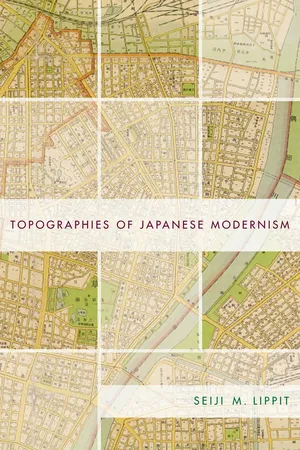
Seiji M. Lippit offers the first comprehensive study in English of Japanese modernist fiction of the 1920s and 1930s. Through close readings of four leading figures of this movement— Akutagawa, Yokomitsu, Kawabata, and Hayashi—Lippit aims to establish a theoretical and historical framework for the analysis of Japanese modernism.
The 1920s and 1930s witnessed a general sense of crisis surrounding the institution of literature, marked by both the radical politicization of literary practice and the explosion of new forms of cultural production represented by mass culture. Against this backdrop, this study traces the heterogeneous literary topographies of modernist writings. Through an engagement with questions of representation, subjectivity, and ideology, it situates the disintegration of literary form in these texts within the writers' exploration of the fluid borderlines of Japanese modernity.
- English
- ePUB (mobile friendly)
- Available on iOS & Android
eBook - ePub
Topographies of Japanese Modernism
About this book
Information
Subtopic
20th Century HistoryIndex
LiteratureTable of contents
- Cover
- Half title
- Title
- Copyright
- Dedication
- Contents
- Acknowledgments
- Introduction: Fissures of Japanese Modernity
- Chapter 1. Disintegrating Mechanisms of Subjectivity: Akutagawa Ryunosuke’s Last Writings
- Chapter 2. Topographies of Empire: Yokomitsu Riichi’s Shanghai
- Chapter 3. Mapping the Space of Mass Culture: Kawabata Yasunari’s Scarlet Gang of Asakusa
- Chapter 4. Negations of Genre: Hayashi Fumiko’s Nomadic Writing
- Chapter 5. A Phantasmatic Return: Yokomitsu Riichi’s Melancholic Nationalism
- Notes
- Bibliography
- Index
Trusted by 375,005 students
Access to over 1.5 million titles for a fair monthly price.
Study more efficiently using our study tools.
Frequently asked questions
Yes, you can cancel anytime from the Subscription tab in your account settings on the Perlego website. Your subscription will stay active until the end of your current billing period. Learn how to cancel your subscription
No, books cannot be downloaded as external files, such as PDFs, for use outside of Perlego. However, you can download books within the Perlego app for offline reading on mobile or tablet. Learn how to download books offline
Perlego offers two plans: Essential and Complete
- Essential is ideal for learners and professionals who enjoy exploring a wide range of subjects. Access the Essential Library with 800,000+ trusted titles and best-sellers across business, personal growth, and the humanities. Includes unlimited reading time and Standard Read Aloud voice.
- Complete: Perfect for advanced learners and researchers needing full, unrestricted access. Unlock 1.5M+ books across hundreds of subjects, including academic and specialized titles. The Complete Plan also includes advanced features like Premium Read Aloud and Research Assistant.
We are an online textbook subscription service, where you can get access to an entire online library for less than the price of a single book per month. With over 1.5 million books across 990+ topics, we’ve got you covered! Learn about our mission
Look out for the read-aloud symbol on your next book to see if you can listen to it. The read-aloud tool reads text aloud for you, highlighting the text as it is being read. You can pause it, speed it up and slow it down. Learn more about Read Aloud
Yes! You can use the Perlego app on both iOS and Android devices to read anytime, anywhere — even offline. Perfect for commutes or when you’re on the go.
Please note we cannot support devices running on iOS 13 and Android 7 or earlier. Learn more about using the app
Please note we cannot support devices running on iOS 13 and Android 7 or earlier. Learn more about using the app
Yes, you can access Topographies of Japanese Modernism by Seiji M. Lippit in PDF and/or ePUB format, as well as other popular books in Literature & 20th Century History. We have over 1.5 million books available in our catalogue for you to explore.