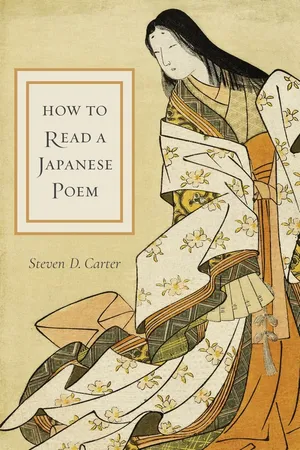
How to Read a Japanese Poem offers a comprehensive approach to making sense of traditional Japanese poetry of all genres and periods. Steven D. Carter explains to Anglophone students the methods of composition and literary interpretation used by Japanese poets, scholars, and critics from ancient times to the present, and adds commentary that will assist the modern reader.
How to Read a Japanese Poem presents readings of poems by major figures such as Saigy? and Bash? as well as lesser known poets, with nearly two hundred examples that encompass all genres of Japanese poetry. The book gives attention to well-known forms such as haikai or haiku, as well as ancient songs, comic poems, and linked verse. Each chapter provides examples of a genre in chronological order, followed by notes about authorship and other contextual details, including the time of composition, physical setting, and social occasion. The commentaries focus on a central feature of Japanese poetic discourse: that poems are often occasional, written in specific situations, and are best read in light of their milieu. Carter elucidates key concepts useful in examining Japanese poetics as well as the technical vocabulary of Japanese poetic discourse, familiarizing students with critical terms and concepts. An appendix offers succinct definitions of technical terms and essays on aesthetic ideals and devices.
- English
- ePUB (mobile friendly)
- Available on iOS & Android
eBook - ePub
How to Read a Japanese Poem
About this book
Trusted by 375,005 students
Access to over 1.5 million titles for a fair monthly price.
Study more efficiently using our study tools.
Information
Subtopic
Asian Literary CollectionsIndex
Literature
Portrait of Man’yō-era poet Kakinomoto no Hitomaro, from Nishiki hyakunin isshu azuma ori, an illustrated text of Hyakunin isshu by the eighteenth-century artist Katsukawa Shunshō.
Courtesy L. Tom Perry Special Collection, HBLL, Brigham Young University.
Chapter 1
ANCIENT SONG AND POETRY
ANONYMOUS, Kojiki 10: “A song that was a signal for the men of Kume to strike down the men of the Earth Spider clan”

| Ah, the great pit | osaka no |
| at Osaka: | ōmuroya ni |
| so many the men | hito sawa ni |
| who have come here, | kiiriori |
| so many the men | hito sawa ni |
| who here band together! | iriori to mo |
| Yet the Kume men | mitsumitsushi |
| so famed for valor— | kume no ko ga |
| clubs they will take up | kubutsutsu i |
| and swords with pommels of stone, | ishitsutsu i mochi |
| to strike all a fatal blow. | uchite shi yamamu |
Envoy
| You Kume men | mitsumitsushi |
| so famed for valor: | kume no kora ga |
| clubs you must take up | kubutsutsu i |
| and swords with pommels of stone— | ishitsutsu i mochi |
| for now is the time to strike! | ima utaba yorashi |
CONTEXT: This song comes from one of the earliest Japanese writings, Kojiki (Record of Ancient Matters, 712). In Nihon shoki (Chronicles of Japan, 720) it is introduced with the following preface (pp. 203–4) concerning the mythical first emperor, Jinmu (whose reign began, according to tradition, in 660 BCE): “When he arrived at the great pit at Osaka, eighty men of the Earth Spider clan, men with tails, waited there in an unruly manner, so the child of the heavenly deity ordered a banquet to be served to them, with eighty stalwarts assigned as servers, each wearing his sword. The stalwarts were told, ‘When you hear the song, cut them all down.’ This was the song that signaled for them to attack.”
The Kume “stalwarts” took their name from a place (near Kashiwara) on the southern edge of the Nara plain, close to Osaka.
COMMENT: Whether the first stanza is addressed to the attackers or describes their action objectively is not clear, but taken in dramatic context the final phrase utaba yorashi (If [you] strike now, it will be best!) suggests a second-person voice. The irregular prosody of the first stanza (5-6-5-5-5-6-5-5-5-7-7) reflects an era before standardization. A symbiotic relationship between chōka and song is suggested by the presence of a makurakotoba, mitsumitsushi—“robust” or “valorous”—a “pillow word” that was formulaically applied to the clan name Kume. And we also see other common syntactic structures, parallelism (lines 3–6) and repetition (9–10 repeated in 3–4 of the envoy). Martial subjects appear often in early records but thereafter virtually disappear from poetry, unless one takes into account the song sections of military tales such as Tales...
Table of contents
- Cover
- Title Page
- Copyright
- Dedication
- Epigraph
- Contents
- Acknowledgments
- Introduction
- Chapter 1. Ancient Song and Poetry
- Chapter 2. Long Poems and Short Poems
- Chapter 3. Popular Songs
- Chapter 4. Linked Verse
- Chapter 5. Unorthodox Poems
- Chapter 6. Comic Poems
- Chapter 7. Poems in Chinese
- Appendix 1: Technical Terms
- Appendix 2: Aesthetic Ideals and Devices
- Notes
- Sources of Japanese Texts
- Selected Bibliography
- Index of Japanese Names, Titles, and Terms
- Illustrations
Frequently asked questions
Yes, you can cancel anytime from the Subscription tab in your account settings on the Perlego website. Your subscription will stay active until the end of your current billing period. Learn how to cancel your subscription
No, books cannot be downloaded as external files, such as PDFs, for use outside of Perlego. However, you can download books within the Perlego app for offline reading on mobile or tablet. Learn how to download books offline
Perlego offers two plans: Essential and Complete
- Essential is ideal for learners and professionals who enjoy exploring a wide range of subjects. Access the Essential Library with 800,000+ trusted titles and best-sellers across business, personal growth, and the humanities. Includes unlimited reading time and Standard Read Aloud voice.
- Complete: Perfect for advanced learners and researchers needing full, unrestricted access. Unlock 1.5M+ books across hundreds of subjects, including academic and specialized titles. The Complete Plan also includes advanced features like Premium Read Aloud and Research Assistant.
We are an online textbook subscription service, where you can get access to an entire online library for less than the price of a single book per month. With over 1.5 million books across 990+ topics, we’ve got you covered! Learn about our mission
Look out for the read-aloud symbol on your next book to see if you can listen to it. The read-aloud tool reads text aloud for you, highlighting the text as it is being read. You can pause it, speed it up and slow it down. Learn more about Read Aloud
Yes! You can use the Perlego app on both iOS and Android devices to read anytime, anywhere — even offline. Perfect for commutes or when you’re on the go.
Please note we cannot support devices running on iOS 13 and Android 7 or earlier. Learn more about using the app
Please note we cannot support devices running on iOS 13 and Android 7 or earlier. Learn more about using the app
Yes, you can access How to Read a Japanese Poem by Steven D. Carter in PDF and/or ePUB format, as well as other popular books in Literature & Asian Literary Collections. We have over 1.5 million books available in our catalogue for you to explore.