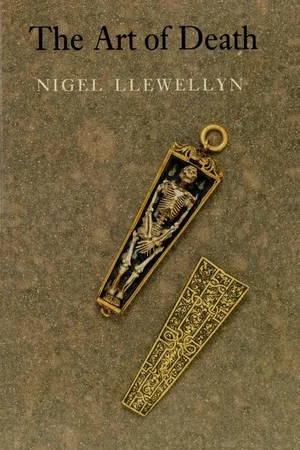
How did our ancestors die? Whereas in our own day the subject of death is usually avoided, in pre-Industrial England the rituals and processes of death were present and immediate. People not only surrounded themselves with memento mori, they also sought to keep alive memories of those who had gone before. This continual confrontation with death was enhanced by a rich culture of visual artefacts. In The Art of Death, Nigel Llewellyn explores the meanings behind an astonishing range of these artefacts, and describes the attitudes and practices which lay behind their production and use.
Illustrated and explained in this book are an array of little-known objects and images such as death’s head spoons, jewels and swords, mourning-rings and fans, wax effigies, church monuments, Dance of Death prints, funeral invitations and ephemera, as well as works by well-known artists, including Holbein, Hogarth and Blake.
- English
- ePUB (mobile friendly)
- Available on iOS & Android
eBook - ePub
About this book
Trusted by 375,005 students
Access to over 1.5 million titles for a fair monthly price.
Study more efficiently using our study tools.
Information
Topic
ArtSubtopic
Art GeneralREFERENCES
INTRODUCTION
1 From ‘Death’, The Complete Poems, ed. A. Rudrum (Harmondsworth, 1976), p. 302. See also George Strode, The Anatomie of Mortalitie (London, 1628), p. 55.
I · THE OBJECT OF COMMEMORATION
1 D.J. Enright, ed., The Oxford Book of Death (Oxford, 1983), p. 293. On samplers see D. King, Samplers, Victoria & Albert Museum (London, 1960).
2 As a challenge to the Italianate interpretation of Northern art see Svetlana Alpers, The Art of Describing: Dutch Art in the Seventeenth Century (Chicago, 1983). For England see Maurice Howard and Nigel Llewellyn, ‘Painting and Imagery’, Renaissance and Reformation, ed. Boris Ford; volume III of the Cambridge Guide to the Arts in Great Britain (Cambridge, 1989), especially pp. 223–5.
3 Peter Murray, The Dulwich Picture Gallery: A Catalogue (London, 1980). The version of the inscription given here has been modernized.
4 Elizabeth Honig, ‘Lady Dacre and Pairing by Hans Eworth’, Renaissance Bodies: The Human Figure in English Culture, c. 1540–1660, ed. Lucy Gent and Nigel Llewellyn (London, 1990), pp. 71–5.
5 Enright, op.cit., p. 4.
6 See N. Pevsner and E. Williamson, The Buildings of England: Derbyshire (2nd edn, Harmondsworth, 1978), p. 350 and plate 45.
7 John Hayes, Thomas Rowlandson: Watercolours and Drawings (London, 1972), pp. 184–5, 201; for the second of these subjects, see also Ronald Paulson, Rowlandson: A New Interpretation (New York, 1972), pp. 13–14.
8 O. Millar: The Age of Charles I: Painting in England, 1620–1649, Tate Gallery exhibition catalogue (London, 1972), p. 102 and plate 161.
II · RITES OF PASSAGE
1 The key text here is Robert Hertz’s essay ‘Death’, first published in 1907. The literature on the anthropology of death is extensive, but for this analysis see Arnold Van Gennep, The Rites of Passage, trans. M. B. Vizedom and G. L. Caffee (London, 1960); Maurice Bloch and J. Parry, eds, Death and the Regeneration of Life (Cambridge, 1982); Phillippe Ariès, The Hour of Our Death, trans. H. Weaver (London, 1981).
2 Richard Hooker, Of the Laws of Ecclesiastical Polity, V, xlvi, ed. C. Morris (London, 1907), II, pp. 179–81. For Donne’s will see Public Record Office, London, P.C.C. 46 St John, proved 5 April 1631.
3 Roy Strong, ‘Sir Henry Unton and his Portrait: An Elizabethan Memorial Picture and its History’, Archaeologia, xcix (1965), pp. 53–76 and Strong, National Portrait Gallery: Tudor and Jacobean Portraits (London, 1969), I, pp. 315–9, and II, plates 627–34.
4 Robert Wright, ed., Funebria nobilissima ad praestantissimi equjitis D. Henrici Untoni (Oxford, 1596).
5 Dudley Carleton to John Chamberlain, cited by Diana Poulton in John Dowland (2nd edn, London, 1982), pp. 423–4 (English modernized).
6 See Poulton, op.cit., chapter V and passim.
III · DYING, A PROCESS
1 What remains of this monument is now in storage in the Old Muniment Room at Hereford Cathedral. Its original form, as seen from the north transept, is just visible in James Storrer, The History and Antiquities of the Cathedral Churches of Great Britain (London, 1816), II, plate V.
2 Grinling Gibbons’s patron Tobias Rustat seems to have kept his monument in his rooms at Jesus College, Cambridge, for at least eight years before his death in 1693; see M. D. Whinney, Sculpture in Britain, 1530–1830, rev. edn by John Physick (Harmondsworth, 1988), pp. 58–9.
3 H. B. Wright and M. K. Spears, eds, The Literary Works of Matthew Prior, 2 vols (Oxford, 1959). Many other poets have written their own epitaphs.
4 Castle Rackrent, ed. G. Watson (London, 1964), p. 81. Rowlandson’s drawing Dead Alive, bears some similarity to the theme of Edgeworth’s story (see Hayes in § I, note 7).
5 The full title of West’s treatise is Symbolaeographia, which may be terms the art, description, or image of Instruments, Covenants, Contracts etc. or the Notorie or Scrivener.
6 British Library, London, Harleian MS 1498.
IV · DANCES OF DEATH
1 Mary O’Connor surveys this considerable body of literature in The Art of Dying Well: The Development of the ‘Arts Moriendi’ (New York, 1942).
2 Hilda M. R. Murray, ed., Erthe upon Erthe. . ., Early English Text Society, original series cxli (London, 1911).
3 Margaret Aston, England’s Iconoclasts, I: Laws Against Images (Oxford, 1988).
4 The literature on the ‘Dance of Death’ is immense: see J. M. Clark, The Dance of Death in the Middle Ages and the Renaissance (Glasgow, 1950), and several extremely useful recent studies in German: Bilder und Tänze des Todes: Gestalten des Todes in der europaischen Kunst seit dem Mittelalter (Unna and Paderborn, 1982) and Totentänze aus sechs Jahrhunderten (Ratingen, 1982), both of which are exhibition catalogues, and E. Koller, Totentanz: Versuch einer Textemberschreibung (Innsbruck, 1980). For Rowlandson’s English Dance of Death see Hayes in § I, note 7.
5 Hayes, p. 199.
6 W. Rotzler, Die Begegnung der drei Lebenden und der drei Toten (Winterthur, 1961).
7 See the useful Introduction to W. L. Gundersheimer’s edition in facsimile (New York, 1971) and more recently and more generally John Rowlands, Holbein: The Paintings (Oxford, 1985), pp. 60–61.
8 In the Pinakothek, Munich.
9 In England Holbein’s designs were the source for countless variants besides Rowlandson’s, from Wenceslaus Hollar’s of 1647 to the fifty-two woodcuts in Thomas Bewick’s Emblems of Mortality (1789).
10 From ‘The Realms of Death’ in The English Works of Sir Thomas More (London, 1931), pp. 467–8.
11 This notion of the different aspects of the body at death is examined more closely in § VII. It is a division suggested by the title of the first Lyon edition of Holbein’s Dance of Death: ‘Les simulachres & historiées de la mort. . .’ (‘Images and illustrated facets of death . . .’).
12 Alan Watts, Myth and Ritual in Christianity (London, 1954), p. 207.
V · EXAMPLES OF VIRTUE
1 On Purgatory and memoria see O. G. Oexle, ‘Die Gegenwart der Toten’, Death in the Middle Ages, ed. H. Braet and W. Verbecke (Leuvan, 1983), pp. 70–71.
2 Lawrence Stone, The Family, Sex and Marriage in England, 1500–1800 (London, 1977), a book which has generated a great deal of discussion; see reviews by Alan M...
Table of contents
- Front Cover
- Half Title
- Title Page
- Copyright
- CONTENTS
- INTRODUCTION
- I · THE OBJECT OF COMMEMORATION
- II · RITES OF PASSAGE
- IV · DANCES OF DEATH
- V · EXAMPLES OF VIRTUE
- VI · DEATH, A BAD BUSINESS
- IX · THE NATURAL BODY AND ITS FATE
- X · FUNERALS: THE DECLARATION OF DIFFERENCE
- XI · HERALDIC DISPLAYS
- XII · FUNEREAL PARAPHERNALIA
- XIV · WORN OUT AND IN
- XV · OBJECTS OF MOURNING
- XVI · THE MONUMENTAL BODY
- XIX · EPILOGUE
- REFERENCES
- SELECT BIBLIOGRAPHY
- LIST OF ILLUSTRATIONS
- ACKNOWLEDGEMENTS
- INDEX
Frequently asked questions
Yes, you can cancel anytime from the Subscription tab in your account settings on the Perlego website. Your subscription will stay active until the end of your current billing period. Learn how to cancel your subscription
No, books cannot be downloaded as external files, such as PDFs, for use outside of Perlego. However, you can download books within the Perlego app for offline reading on mobile or tablet. Learn how to download books offline
Perlego offers two plans: Essential and Complete
- Essential is ideal for learners and professionals who enjoy exploring a wide range of subjects. Access the Essential Library with 800,000+ trusted titles and best-sellers across business, personal growth, and the humanities. Includes unlimited reading time and Standard Read Aloud voice.
- Complete: Perfect for advanced learners and researchers needing full, unrestricted access. Unlock 1.5M+ books across hundreds of subjects, including academic and specialized titles. The Complete Plan also includes advanced features like Premium Read Aloud and Research Assistant.
We are an online textbook subscription service, where you can get access to an entire online library for less than the price of a single book per month. With over 1.5 million books across 990+ topics, we’ve got you covered! Learn about our mission
Look out for the read-aloud symbol on your next book to see if you can listen to it. The read-aloud tool reads text aloud for you, highlighting the text as it is being read. You can pause it, speed it up and slow it down. Learn more about Read Aloud
Yes! You can use the Perlego app on both iOS and Android devices to read anytime, anywhere — even offline. Perfect for commutes or when you’re on the go.
Please note we cannot support devices running on iOS 13 and Android 7 or earlier. Learn more about using the app
Please note we cannot support devices running on iOS 13 and Android 7 or earlier. Learn more about using the app
Yes, you can access Art of Death by Nigel Llewellyn in PDF and/or ePUB format, as well as other popular books in Art & Art General. We have over 1.5 million books available in our catalogue for you to explore.