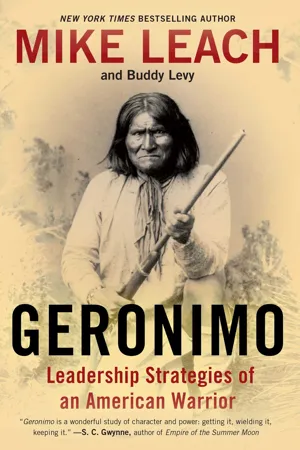
- 304 pages
- English
- ePUB (mobile friendly)
- Available on iOS & Android
eBook - ePub
About this book
“In the hands of Mike Leach and Buddy Levy, the story of this brilliant Apache leader comes into sharp focus, both in their narrative of his life and in spirited commentaries on its meaning” (S.C. Gwynne, author of Pulitzer Prize finalist Empire of the Summer Moon).
Playing cowboys and Indians as a boy, legendary college football coach Mike Leach always chose to be the Indian—the underdog whose success turned on being a tough, resourceful, ingenious fighter. And the greatest Indian military leader of all was Geronimo, the Apache warrior whose name is so symbolic of courage that World War II paratroopers shouted it as they leaped from airplanes into battle.
Told in the style of Robert Greene’s The 48 Laws of Power, Leach’s compelling and inspiring book examines Geronimo’s leadership approach and the timeless strategies, decisions, and personal qualities that made him a success. Raised in an unforgiving landscape, Geronimo and his band faced enemies better armed, better equipped, and more numerous than they were. But somehow they won victories against all odds, beguiling the United States and Mexican governments and earning the respect and awe of those generals committed to hunting him down. While some believed that Geronimo had supernatural powers, much of his genius can be ascribed to old-fashioned values such as relentless training and preparation, leveraging resources, finding ways to turn defeats into victories, and being faster and more nimble than his enemy. The tactics of Geronimo would be studied and copied by the US military for generations.
Pain, pride, humility, family—many things shaped Geronimo’s life. In this “compelling book that humanizes a man many misunderstood” (New York Times bestselling author Brian Kilmeade), Mike Leach illustrates how we too can use the forces and circumstances of our own lives to build true leadership today.
Playing cowboys and Indians as a boy, legendary college football coach Mike Leach always chose to be the Indian—the underdog whose success turned on being a tough, resourceful, ingenious fighter. And the greatest Indian military leader of all was Geronimo, the Apache warrior whose name is so symbolic of courage that World War II paratroopers shouted it as they leaped from airplanes into battle.
Told in the style of Robert Greene’s The 48 Laws of Power, Leach’s compelling and inspiring book examines Geronimo’s leadership approach and the timeless strategies, decisions, and personal qualities that made him a success. Raised in an unforgiving landscape, Geronimo and his band faced enemies better armed, better equipped, and more numerous than they were. But somehow they won victories against all odds, beguiling the United States and Mexican governments and earning the respect and awe of those generals committed to hunting him down. While some believed that Geronimo had supernatural powers, much of his genius can be ascribed to old-fashioned values such as relentless training and preparation, leveraging resources, finding ways to turn defeats into victories, and being faster and more nimble than his enemy. The tactics of Geronimo would be studied and copied by the US military for generations.
Pain, pride, humility, family—many things shaped Geronimo’s life. In this “compelling book that humanizes a man many misunderstood” (New York Times bestselling author Brian Kilmeade), Mike Leach illustrates how we too can use the forces and circumstances of our own lives to build true leadership today.
Tools to learn more effectively

Saving Books

Keyword Search

Annotating Text

Listen to it instead
Information
CHAPTER ONE

The Making of a Warrior (Discipline)
They Called Him Geronimo: What’s in a Name?
GERONIMO WAS BORN in 1823 at the headwaters of the Gila River east of the border of present-day Arizona and New Mexico.I His Bedonkohe (pronounced Bed-on-koh-hey) Apache name was Goyahkla, meaning “One Who Yawns.” But he wasn’t bored or boring. He was defiant, independent, and exceptional. The story of how he got his later name is a good one. In a revenge attack against the Mexicans, the young warrior Goyahkla fought like a fiend, rushing in repeatedly from cover, killing an enemy with every charge, and stealing the dead man’s rifle. Each time he came at them, the Mexicans cried out in terror, “Look out, Geronimo!”—mispronouncing his given name or calling out for the help of Saint Jerome (which translates in Spanish to “Geronimo”). His Apache people took up the battle cry, and “Goyahkla” became “Geronimo.”1
During his raids and escapes across the American Southwest, the mention of his name had the power to enrage the highest brass of the U.S. military—including presidents—and to terrify white settlers who bolted their doors and windows and scribbled frantic letters to the White House begging for protection. Over time, Geronimo’s name has come to symbolize courage, daring, wild abandon, and leadership. Revering his courage, World War II paratroopers shouted “GERONIMO!” as they leaped from airplanes into battle.
The first time I ever heard the name “Geronimo” was as a small child watching Bugs Bunny. I think it involved Yosemite Sam yelling “GERONIMO!” as he was preparing to pull one of his courageous and daring stunts. The last significant time I heard the name Geronimo was when U.S. Navy SEALs moved in to kill Osama bin Laden. The mission was code-named “Geronimo,” which caused considerable controversy. I can’t think of another historical figure whose name has withstood the test of time and been used in as many contexts as Geronimo’s. His name is consistently associated with courage, ingenuity, and resourcefulness.

WARRIOR TRAINING—ONLY THE STRONG SURVIVE
>>Pre–Warrior Training and Apprenticeship
GERONIMO GREW UP on the middle fork of the Gila River, near the famous Gila cliff dwellings in southwestern New Mexico. Geronimo and his people camped there, protected by towering canyon walls. By now the buffalo were all but gone, and the Apache had become mountain people, tough and adaptable, able to thrive in mountains other humans found unlivable. In winter they’d move to the lower valleys to hunt. Though nomadic, the Apache did tend small tracts of beans, corn, melons, and pumpkins, stashing their harvest in secret caves for the lean, harsh winters. Geronimo’s family lived in clusters of dome-shaped brush houses called wickiups, roofed with yucca-leaf strands. They also sometimes slept in taller, peak-shaped tepees like those used by Plains Indians.
Geronimo recalled his childhood fondly: “As a babe I rolled on the dirt floor of my father’s tepee, hung in my tsoch [Apache name for cradleboard] at my mother’s back, or suspended from the bough of a tree. I was warmed by the sun, rocked by the winds, and sheltered by the trees as other Indian babes.”2 His mother taught him the legends of his people, stories about the sky and stars; his father told him of the brave deeds of their warriors, about hunting, and about the “glories of the warpath.”3
From Geronimo’s earliest memories he was a warrior. He and the other boys played hide-and-seek among the rocks and cottonwoods along the river, pretending to be warriors. They practiced sneaking up on made-up enemies—rocks or trees—and hid for many hours, utterly silent, practicing the stealth and patience they would need when they became warriors. This early practice would pay dividends later.
Geronimo’s entire boyhood was a long and rigorous apprenticeship in hunting, gathering, physical fitness, mental toughness, horsemanship, and warfare. To develop their deadly accuracy, the boys cut willow branches, then rolled little mud pellets in their hands and stuck them on the ends for spear points; these were whipped at birds on branches and rodents on the ground. They made slingshots from animal hide and sinew, and they shot bows and arrows from an early age, practicing hours on end for distance and accuracy. They were so into shooting their arrows that they sometimes stayed out all day, never stopping, not even to eat.4

LESSON: Serve an apprenticeship to develop excellence and a useful set of skills.
Geronimo could shoot a bow and arrow with skill by age five. He learned to hunt from his father and elder warriors, who taught him to crawl silently along the ground, snatching prey with his hands. To celebrate his first kill, he ate the animal’s raw heart, showing it respect and gaining his adversary’s strength. To stalk larger game like deer and antelope, he learned how to crawl along the ground for hours wearing the hide, head, and antlers of a deer or antelope as a disguise. He studied his prey’s habits, knew what they ate and where they grazed, knew their different tracks. He hunted rabbits, squirrels, turkeys, and grouse too. Geronimo learned to build small fires at night to lure bats, then heave his moccasins at the creatures in flight with enough accuracy to knock them to the ground—he’d then pounce on them and kill them with his bare hands.5
I really like the Apache technique for hunting ducks—it’s innovative. In early winter, when ducks tend to flock in huge numbers on lakes, the Apache would take hundreds of gourds—dried and hollowed-out pumpkins and big squash—and set them afloat on the lakes. The gourds would blow across the lake and the Apache would go over and retrieve them, then repeat the process. At first the gourds would startle the ducks and they’d fly off. But over time the ducks would get used to the gourds bobbing along the water and floating past. Once the ducks had learned not to fear the gourds, the Apache would take gourds and cut holes for the eyes, nose, and mouth. Then they’d wade neck deep into the water, with only their gourd-head poking out above the surface. They’d sneak up on the ducks while imitating the bobbing gourd motion with their heads; when close enough, they’d drag the ducks under water by their feet and stuff them in a bag. It was ingenious and highly effective.6
LESSON: Be physically better than others and take pride in your physical and mental well-being.
>>Warrior Training
WARRIOR TRAINING WAS brutal. Geronimo had to wake up well before dawn and run up to the top of a mountain and back before sunrise. The goals were discipline, a strong mind, and legs and lungs so developed that no enemy could outrun the Apache warrior. These goals were realized. One elder put it this way to his young son: “Your mind will be developed. . . . Getting up early in the morning, running to the top of that hill and back will give you a strong mind, a strong heart, and a strong body.”7
Running was essential for the Apache way of life, and they worked at it endlessly. They were on foot more than on horseback because there were rarely enough horses to go around, and because they could sneak up on enemies better on foot. As they trained, the runs got longer and more difficult. Sometimes they had to carry heavy packs on their backs and, to prove their endurance and mental tenacity, remain awake continuously for a day and a night or even longer, without food. Part of this training included running many miles before daylight, then an icy morning plunge in a frozen stream in only their breechcloths, all before they were allowed to build a fire.
One of the training tactics I found most interesting was this: Young boys had to run more than ten miles, up and down mountains, carrying water or rocks in their mouths the entire time; they could spit out the rocks or water only at the end of the run. This proved their endurance and toughness. The exercise also taught them to breathe through their noses.8 If they failed, they had to do it again—and again, and again—until they got it right. Geronimo did not fail. Later, as a trainer, he would teach this skill to others.
LESSON: The best are ...
Table of contents
- Cover
- Epigraph
- Foreword by S. C. Gwynne
- Cast of Characters
- Introduction: Geronimo and the American Spirit
- Chapter One: The Making of a Warrior (Discipline)
- Chapter Two: Geronimo’s Warpath Begins (Fortitude)
- Chapter Three: The Coming of the White Men (Lore)
- Chapter Four: The Tan Wolf and the Turkey Gobbler (Independence)
- Chapter Five: Women Warriors and Dreamers (Isolation)
- Chapter Six: The Great Escape (Audacity)
- Chapter Seven: The Great “Rescue” (Passion)
- Chapter Eight: Tragedy in Sonora (Fallibility)
- Chapter Nine: Raiding from the Stronghold (Perseverance)
- Chapter Ten: Encountering an Old Adversary (Rivalry)
- Chapter Eleven: Honoring Commitments (Honor)
- Chapter Twelve: Turkey Creek and Tiswin (Resolve)
- Chapter Thirteen: Speed and Endurance (Fluidity)
- Chapter Fourteen: Once He Moved Like the Wind (Resistance)
- Chapter Fifteen: “Until the Stone Should Crumble to Dust” (Surrender)
- Chapter Sixteen: Prisoners of War (Patriotism)
- Chapter Seventeen: Fame
- Epilogue: Immortality
- Acknowledgments
- A Note on the Text and Sources
- About Mike Leach and Buddy Levy
- Notes
- Selected Bibliography of Works Cited and Consulted
- Index
- Copyright
Frequently asked questions
Yes, you can cancel anytime from the Subscription tab in your account settings on the Perlego website. Your subscription will stay active until the end of your current billing period. Learn how to cancel your subscription
No, books cannot be downloaded as external files, such as PDFs, for use outside of Perlego. However, you can download books within the Perlego app for offline reading on mobile or tablet. Learn how to download books offline
Perlego offers two plans: Essential and Complete
- Essential is ideal for learners and professionals who enjoy exploring a wide range of subjects. Access the Essential Library with 800,000+ trusted titles and best-sellers across business, personal growth, and the humanities. Includes unlimited reading time and Standard Read Aloud voice.
- Complete: Perfect for advanced learners and researchers needing full, unrestricted access. Unlock 1.4M+ books across hundreds of subjects, including academic and specialized titles. The Complete Plan also includes advanced features like Premium Read Aloud and Research Assistant.
We are an online textbook subscription service, where you can get access to an entire online library for less than the price of a single book per month. With over 1 million books across 990+ topics, we’ve got you covered! Learn about our mission
Look out for the read-aloud symbol on your next book to see if you can listen to it. The read-aloud tool reads text aloud for you, highlighting the text as it is being read. You can pause it, speed it up and slow it down. Learn more about Read Aloud
Yes! You can use the Perlego app on both iOS and Android devices to read anytime, anywhere — even offline. Perfect for commutes or when you’re on the go.
Please note we cannot support devices running on iOS 13 and Android 7 or earlier. Learn more about using the app
Please note we cannot support devices running on iOS 13 and Android 7 or earlier. Learn more about using the app
Yes, you can access Geronimo by Mike Leach,Buddy Levy in PDF and/or ePUB format, as well as other popular books in Business & Leadership. We have over one million books available in our catalogue for you to explore.