eBook - ePub
Rightsizing Your Business
Breakthrough Strategies to Create a Flexible and Profitable Business in Any Economy
- 100 pages
- English
- ePUB (mobile friendly)
- Available on iOS & Android
eBook - ePub
Rightsizing Your Business
Breakthrough Strategies to Create a Flexible and Profitable Business in Any Economy
About this book
Ever since the recession hit, “downsizing” has been the corporate mantra. Cut overhead, increase profitability, and the future will take care of itself. Most pundits agree that this is a shortsighted approach, especially in a volatile economy. While cutting overhead increases quarterly profit in the short term, it weakens an organization for the longterm. As result, “rightsizing” has become the new tool remain profitable and competitive. It forces the organization to reevaluate its goals, its market position both past and present, and where it wants to be in the future. This results in constructive measures that underscore the strengths of the organization to meet its goals for the future. Rightsizing Your Business, written by noted management expert, Bill Welter, is the first book either in e-format or print that clearly and concisely explains this important shift in management strategy and shows any business to proceed with effective rightsizing.
Information
Topic
Personal DevelopmentSubtopic
Business GeneralChapter 1
The Secret of Success
More often than not, a business finds itself suddenly confronted with the imperative to rightsize because it has not been paying attention to the larger world. Management either find themselves surprised by an extended down market, going into a crash downsizing effort to get costs under control; or they realize they are “late to the game” and try to ramp up in too short a time.
Rightsizing should be done on a proactive basis as part of your regular strategic planning efforts. You are literally trying to answer the question of “What’s the right size for this company as we move toward our planning horizon?” Once that conversation is underway it must continue on to the decisions that have to be made to change the size of your business.
The Structure of Success: Simple, But Hard
The secret to business success is simple: Match realistic intention and organizational execution — know whom you need as customers and give them what they want. To do this you’ll need to accomplish four things:
- Define goals that, when achieved, will result in profit.
- Prepare plans to achieve the goals.
- Make sure you have the capabilities needed to execute the plans.
- Make sure you have enough of each of the needed capabilities.
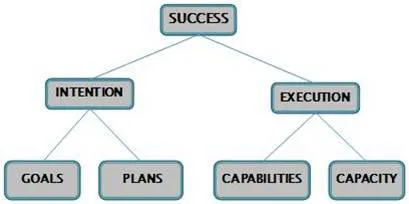
Figure 1. The Structure of Success
Simple, right? Then why is it so hard to build and maintain a rightsized business? Well, think about these four factors in light of your own business.
- Goals: Do you know how realistic your goals are in light of the customers you have (and, more important, need)? Were Kodak’s goals for its film business realistic in the early part of the twenty-first century?
- Plans: Do you have specific plans for the societal and industry changes that will determine the future of your business? Were magazines and newspapers really planning for a digital future?
- Capabilities: Do you have the knowledge, skills, and other resources needed for the future of your business? What don’t you have that you should? Does Microsoft have the capabilities it needs to compete with Google?
- Capacity: What shortages will impact you? Where do you have “excess” resources? What will happen to RR Donnelley’s printing plants when the Yellow Pages disappears?
How should you go about answering these questions? Many people tell you to “think outside of the box”; I simply want you to think in bigger boxes. You should do this because the future of your business can usually be seen in the context of the bigger boxes surrounding you.
The Context for Success
As of Fall 2011, Apple is changing at least three industries simultaneously: the music distribution industry, the telephone industry, and the personal computer industry. You’d probably love to be in the position of changing/leading your industry, but that’s not realistic for the vast majority of businesses. Most of us have to respond to changes in our industry that are out of our control.
The challenge of responding to industry evolution in encapsulated in the phase attributed to Joseph Schumpeter, the Austrian American economist who studied innovation in the 1930s and 1940s — creative destruction. Simply put, industries evolve because of constantly changing needs, wants, and capabilities. They do so in an amoral sense — creative destruction is neither good nor bad; it just happens. Some companies take advantage of the opportunities created by this evolution. At the same time, the change destroys opportunities that other companies, unfortunately, were based upon.
Semiconductors, for example, created opportunities for Fairchild and Intel, but made RCA and Sylvania irrelevant. The Internet has created wonderful opportunities for Google and Facebook, but has nearly destroyed the newspaper industry. The rise in oil prices has been good for Toyota, but seemingly caught GM by surprise. And social media is turning the advertising industry on its head.
In order to respond to these changes in a timely and accurate manner you need to consider the context for most change in the business world. You need to consider the bigger boxes of your industry, the economy, and society.
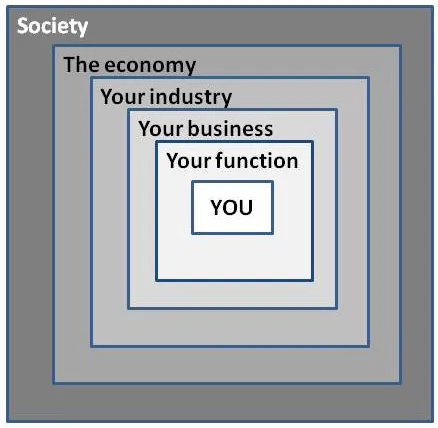
Figure 2. The Context for Success
All of the bigger boxes have the potential to trigger waves of creative destruction and will gently or not-so-gently bring about the need for you to rightsize your business. The desire to buy McMansions in the 1990s triggered an upsizing at many homebuilding companies. Unfortunately, the Great Recession of 2008 triggered a drastic downsizing for the same companies. The advent of MP3 technology brought Sony low and raised Apple high. The fall of the Berlin wall triggered a series of events that caused the downsizing of many defense companies, but the terror attacks of 9/11 reversed the tide.
Most of the changes affecting your business come from the bigger boxes. If you stay aware of changes in society, the economy, and your industry you have a chance at proactively rightsizing your business. If you ignore the winds of change you will always be reacting — a bit too late.
A Process to Guide Your Thinking
If creative destruction is real — and it is — the rightsizing challenge is to sense the signals of change coming from the “bigger boxes” and to respond to these signals in an appropriate and timely manner. Furthermore, unless you are getting ready to retire soon, you will have to do this again and again. With that in mind, consider a simple cycle to use as you think about the need to rightsize your business and the foundation that underpins this need.
The cycle shown in Figure 3 is the sense-response cycle (SRC).

Figure 3. The Sense-Response Cycle
The cycle is based on the vision, values, and goals that you have for your business. They are your foundation, and you and your team need common understanding and plenty of discussion about this foundation before you take any actions to rightsize the business.
The SRC Foundation
- Vision: This is important when it comes to rightsizing your business! What size do you envision for your business? Is bigger better? Is smaller better? Is survival the issue? Is controlled growth what you want? What is the vision you hold for your business? Discuss it and come to agreement as best you can.
- Values: This is a bit tricky because many of us want to think that we are “good guys” and will do what’s right for the business. However, if you value profit above all else you will inevitably run an anorexic organization because all of your efforts will focus on cost reduction.
- Goals: Let’s make this simple. You’re reading this book because you want an organization that is the right size.
The Sense-Response Cycle
The SRC describes the basic set of responsibilities of any business leader. If you are in a leadership role then it’s your responsibility to sense the signals of change, make sense of those signals, decide on changes that you need to make to your business, and then act on those decisions in an effective manner.
Furthermore, you have to complete the cycle in the time available to you. Today there’s virtually no industry that is not experiencing change, but some are evolving faster than others. For example, the cycle is running gently for my local dry cleaner but spinning like a top for my local bank. The reality for all businesses is that it’s running faster than ever before.
Think about your own business and see if any of the following comments apply to you.
- Sense: Look for changes in your competitive landscape and in the bigger boxes of society, economy, and industry.
- What are customers expecting that’s new to you? For example, do you use social media as part of your customer interaction?
- What products and services are emerging that have the potential to make obsolete some or all of your offerings? For example, statins “replaced” much of the need for open-heart surgery, and many hospitals found themselves with excess cardiac care space.
- Make Sense: How wil...
Table of contents
- Cover
- Title Page
- Dedication
- Acknowledgments
- Contents
- Introduction
- Chapter 1. The Secret of Success
- Chapter 2. Nine Factors That Define Your Capabilities
- Chapter 3. Target Markets
- Chapter 4. Products and Services
- Chapter 5. Organization and Staffing
- Chapter 6. Resources Employed
- Chapter 7. Locations
- Chapter 8. Infrastructure Technology
- Chapter 9. Policies and Procedures
- Chapter 10. Metrics
- Chapter 11. Partners
- Chapter 12. Putting It All Together
- Resource List
- Also Available
- Copyright Page
Frequently asked questions
Yes, you can cancel anytime from the Subscription tab in your account settings on the Perlego website. Your subscription will stay active until the end of your current billing period. Learn how to cancel your subscription
No, books cannot be downloaded as external files, such as PDFs, for use outside of Perlego. However, you can download books within the Perlego app for offline reading on mobile or tablet. Learn how to download books offline
Perlego offers two plans: Essential and Complete
- Essential is ideal for learners and professionals who enjoy exploring a wide range of subjects. Access the Essential Library with 800,000+ trusted titles and best-sellers across business, personal growth, and the humanities. Includes unlimited reading time and Standard Read Aloud voice.
- Complete: Perfect for advanced learners and researchers needing full, unrestricted access. Unlock 1.4M+ books across hundreds of subjects, including academic and specialized titles. The Complete Plan also includes advanced features like Premium Read Aloud and Research Assistant.
We are an online textbook subscription service, where you can get access to an entire online library for less than the price of a single book per month. With over 1 million books across 990+ topics, we’ve got you covered! Learn about our mission
Look out for the read-aloud symbol on your next book to see if you can listen to it. The read-aloud tool reads text aloud for you, highlighting the text as it is being read. You can pause it, speed it up and slow it down. Learn more about Read Aloud
Yes! You can use the Perlego app on both iOS and Android devices to read anytime, anywhere — even offline. Perfect for commutes or when you’re on the go.
Please note we cannot support devices running on iOS 13 and Android 7 or earlier. Learn more about using the app
Please note we cannot support devices running on iOS 13 and Android 7 or earlier. Learn more about using the app
Yes, you can access Rightsizing Your Business by Bill Welter in PDF and/or ePUB format, as well as other popular books in Personal Development & Business General. We have over one million books available in our catalogue for you to explore.