
eBook - ePub
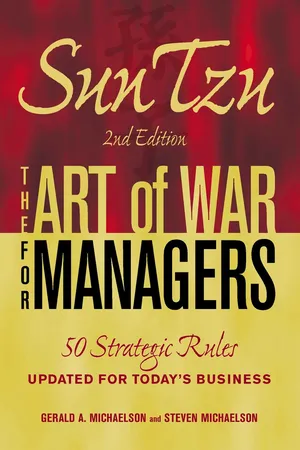
Sun Tzu - The Art of War for Managers
50 Strategic Rules Updated for Today's Business
- 224 pages
- English
- ePUB (mobile friendly)
- Available on iOS & Android
eBook - ePub
Sun Tzu - The Art of War for Managers
50 Strategic Rules Updated for Today's Business
About this book
Seize the advantage from your competitors and conquer today’s competitive business world with these 50 strategic business rules from the tried-and-tested wisdom of Sun Tzu.
In today’s competitive business world, you must capture the high ground and defend it against your rivals. The secret lies in mastering the strategic arts taught by the ancient Chinese military theorist Sun Tzu. Gerald A. Michaelson’s classic book breaks down Sun Tzu’s lessons to help you move from manager to leader and vanquish your competition. In this fully updated edition, Steven Michaelson offers new examples drawn from companies ranging from Amazon to Toyota to Google, putting Sun Tzu at your side for today's business challenges.
Here is the wisdom—tested for twenty-five centuries—that will help you seize the advantage, storm your competitors’ gates, and conquer the marketplace!
In today’s competitive business world, you must capture the high ground and defend it against your rivals. The secret lies in mastering the strategic arts taught by the ancient Chinese military theorist Sun Tzu. Gerald A. Michaelson’s classic book breaks down Sun Tzu’s lessons to help you move from manager to leader and vanquish your competition. In this fully updated edition, Steven Michaelson offers new examples drawn from companies ranging from Amazon to Toyota to Google, putting Sun Tzu at your side for today's business challenges.
Here is the wisdom—tested for twenty-five centuries—that will help you seize the advantage, storm your competitors’ gates, and conquer the marketplace!
Frequently asked questions
Yes, you can cancel anytime from the Subscription tab in your account settings on the Perlego website. Your subscription will stay active until the end of your current billing period. Learn how to cancel your subscription.
No, books cannot be downloaded as external files, such as PDFs, for use outside of Perlego. However, you can download books within the Perlego app for offline reading on mobile or tablet. Learn more here.
Perlego offers two plans: Essential and Complete
- Essential is ideal for learners and professionals who enjoy exploring a wide range of subjects. Access the Essential Library with 800,000+ trusted titles and best-sellers across business, personal growth, and the humanities. Includes unlimited reading time and Standard Read Aloud voice.
- Complete: Perfect for advanced learners and researchers needing full, unrestricted access. Unlock 1.4M+ books across hundreds of subjects, including academic and specialized titles. The Complete Plan also includes advanced features like Premium Read Aloud and Research Assistant.
We are an online textbook subscription service, where you can get access to an entire online library for less than the price of a single book per month. With over 1 million books across 1000+ topics, weāve got you covered! Learn more here.
Look out for the read-aloud symbol on your next book to see if you can listen to it. The read-aloud tool reads text aloud for you, highlighting the text as it is being read. You can pause it, speed it up and slow it down. Learn more here.
Yes! You can use the Perlego app on both iOS or Android devices to read anytime, anywhere ā even offline. Perfect for commutes or when youāre on the go.
Please note we cannot support devices running on iOS 13 and Android 7 or earlier. Learn more about using the app.
Yes, you can access Sun Tzu - The Art of War for Managers by Gerald A Michaelson,Steven W Michaelson in PDF and/or ePUB format, as well as other popular books in Business & Business General. We have over one million books available in our catalogue for you to explore.
Information
PART ONE
New Translation of
THE ART OF WAR
with Managerās Commentary
THE ART OF WAR
with Managerās Commentary
Reflecting on Sun Tzuās work is to the business manager what weightlifting is to the champion athleteāan exercise that makes one stronger.
John Kohut
Beijing Bureau Chief
South China Post
Beijing Bureau Chief
South China Post
Chapter 1
Laying Plans
Strategic Rules


The vision of what the organization wants to be must be planned with an awareness of reality. That is why this chapter focuses on assessment.
The vision components articulate purpose, mission, guiding values, and a vivid image of the organizationās future. From the vision, leaders can determine the strategy, set strategic initiatives, and align the organization.
The more sophisticated the planning process becomes, the harder it is to introduce the flexibility to accommodate changes in the situation. In rigid systems, planning and obedience to the plan are regarded as the key to victory. Carefully laid plans rigorously implemented without deviation are regarded as the way to overcome the inevitable confusion. As ever-increasing time and attention are focused on āthe process of planning,ā the successful execution of the plan can become secondary. However, any football coach can tell you that rigidity does not win games. Every coach has plans that allow for flexibility in formations to adapt to reality. It follows that it is not strategists who cause changes in the planāit is reality.
A common mistake is to consider planning as only a mental process, an idea in our head that simply looks at the past and adjusts for the future. If your plan is not in writing, you do not have a plan at all. Instead, you have only a dream, a vision, or perhaps even a nightmare. The simple written plan works best.
Clearly define the problem before seeking a solution. Do not limit your planning horizon to what can be accomplished with existing tools. If the only tool you have is a hammer, everything will look like a nail.
THOROUGHLY ASSESS CONDITIONSāTRANSLATION
Sun Tzu says:
War is a matter of vital importance to the state; a matter of life and death, the road either to survival or to ruin. Hence, it is imperative that it be thoroughly studied.
Therefore, to make assessment of the outcome of a war, one must compare the various conditions of the antagonistic sides in terms of the five constant factors:*
1. Moral influence
2. Weather
3. Terrain
4. Commander
5. Doctrine
These five constant factors should be familiar to every general. He who masters them wins; he who does not is defeated.
*Business Parallels to Five Constant Factors
1. Moral influence means a āspirit of mission.ā The strength of belief that the purpose is morally sound rallies a fighting spirit and generates a firestorm of commitment.
2. Weather equates to āoutside forces.ā The surge of consolidation that is sweeping through every industry is an outside force, as is the emergence of world competition and the influence of environmentalism.
3. Terrain is the āmarketplace.ā As the general must know the terrain, so the strategist must consider the scene of actionāpeople, place, product, promotion, price, etc.
4. Commander has an equivalent in āleadership.ā The names keep changing, but the principles of leadership remain the same.
5. Doctrine is comparable to āguiding principles.ā Understand and apply the fundamental principles that determine success.
THOROUGHLY ASSESS CONDITIONSā
MANAGERāS COMMENTARY
Good assessment is the foundation of a successful operation.
When the management of a major pharmaceutical company found that product development activity was decreasing, an assessment revealed the reason. Although senior managers claimed development was a team effort, analysis of their twenty-five most profitable drugs revealed that two people initiated ten of them. The reason product development declined was because both people had moved to positions where they were no longer in the development stream.1
Every assessment must include a thorough analysis of how to increase business with existing customers. As proof, an Ogilvy & Mather analysis showed that the return on the marketing investment to existing customers can be many times greater than to prospective customers. The greatest source of increased sales and profits is from those who know you and are already purchasing your products.
In todayās business world, the assessment before the plan is often ignored in the rush to action. When action is taken without a thorough assessment of the situation, too often people begin working on the wrong things. In these circumstances, the result will be a lot of effort expended with no gain.
Assessments are simply methodologies for gathering data in a structured process designed to elicit facts or perceptions. Assessments can be internal or external and they can be conducted by one or more individuals. Assessments can be surveys distributed to everyone or interviews conducted across a vertical slice of the organization.
Good assessments go beyond the current situation. They dig into underlying causes and search for new and better ways to achieve success. To achieve good results, ask questions in pairs so the first question determines the perception of the current status and the second reveals opportunities. For example, the first question might ask for a definition of an objective, while the second would ask for ideas about how the objective should be achieved.
When assessments are conducted by an external organization, respondents usually feel they have a better chance of giving anonymous input, which provides more accurate data. Internally, the assessment provides information on strengths and weaknesses that can energize and direct self-renewal. Externally, the assessment reveals threats and opportunities.
COMPARE ATTRIBUTESāTRANSLATION
Sun Tzu continues:
Therefore, to forecast the outcome of a war the attributes of the antagonistic sides should be analyzed by* making the following seven comparisons:
1. Which sovereign possesses greater moral influence?
2. Which commander is more capable?
3. Which side holds more favorable conditions in weather and terrain?
4. On which side are decrees better implemented?
5. Which side is superior in arms?
6. On which side are officers and men better trained?
7. Which side is stricter and more impartial in meting out rewards and punishments?
By means of these seven elements, I can forecast victory or defeat.
If the sovereign heeds these stratagems of mine and acts upon them, he will surely win the war, and I shall, therefore, stay with him. If the sovereign neither heeds nor acts upon them, he will certainly suffer defeat, and I shall leave.
*We must compare ourselves with our foe.
āA. L. Sadler
āA. L. Sadler
A Strategic Moral
Following the success of the Prussian army in the Franco-Prussian War, the British General Staff sent a team of aristocrats to find out the secret of success. They reported the Prussian troops were all clean-shaven with short-cropped hair. The British Army copied this; it remains a law to this day.
The moral of the story is: Donāt copy the wrong thing! (Or, donāt send aristocrats to do competitive studies.)
COMPARE ATTRIBUTESāMANAGERāS COMMENTARY
Compare competitive strengths and weaknesses.
When Coke and Pepsi engage in competitive battles, or when P&G determines how to increase market share, these organizations use competitive marketing research as an input ingredient. When Xerox determined it wanted to be a world-class competitor, it benchmarked every process to determine how to make that process the best in its class.
Comparisons of attributes can be made by either a direct competitive comparison of strengths and weaknesses or benchmarking that studies comparable processes in any other organization. Benchmarking is a learning experience that āsteals shamelesslyā from ...
Table of contents
- Cover Page
- Title Page
- Copyright
- Contents
- Foreword to the Second Edition
- The Lesson of the Concubines
- Introduction
- Part One: New Translation of The Art of War with Managerās Commentary
- Chapter One: Laying Plans
- Chapter Two: Waging War
- Chapter Three: Attack by Stratagem
- Chapter Four: Disposition of Military Strength
- Chapter Five: Use of Energy
- Chapter Six: Weakness and Strength
- Chapter Seven: Maneuvering
- Chapter Eight: Variation of Tactics
- Chapter Nine: On the March
- Chapter Ten: Terrain
- Chapter Eleven: The Nine Varieties of Ground
- Chapter Twelve: Attack by Fire
- Chapter Thirteen: Employment of Secret Agents
- Part Two: Applying Sun Tzuās Wisdom
- Practical Applications
- Outline of Key Concepts
- Bibliography
- Translatorās Bibliography
- About the Authors