- 432 pages
- English
- ePUB (mobile friendly)
- Available on iOS & Android
eBook - ePub
About this book
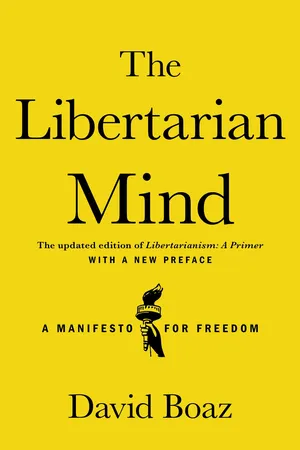
An updated edition of David Boaz’s timeless primer on libertarianism, with a new preface by the author.
Libertarianism—the philosophy of personal and economic freedom—has deep roots in Western civilization and in American history, with increasing appeal to those dissatisfied with the status quo. The growth of executive power, chronic deficits, counterproductive foreign military interventions, protectionist trade measures, a costly drug war, and many other threats to civil liberties have pushed millions of Americans in a libertarian direction.
The Libertarian Mind is a comprehensive guide to the history and philosophy of this movement. This updated edition delves into the principles of libertarianism, exploring its roots and its development over time. It offers a rich collection of ideas that present a compelling case for individual liberty and mutual cooperation. Challenging the notion of top-down governmental control, the book advocates instead for a society built on freedom and individual rights.
But The Libertarian Mind is more than just a book; it’s a manifesto for freedom. It’s a call to action for those who believe in the sovereignty and fundamental dignity of the individual and the importance of political freedom.
Libertarianism—the philosophy of personal and economic freedom—has deep roots in Western civilization and in American history, with increasing appeal to those dissatisfied with the status quo. The growth of executive power, chronic deficits, counterproductive foreign military interventions, protectionist trade measures, a costly drug war, and many other threats to civil liberties have pushed millions of Americans in a libertarian direction.
The Libertarian Mind is a comprehensive guide to the history and philosophy of this movement. This updated edition delves into the principles of libertarianism, exploring its roots and its development over time. It offers a rich collection of ideas that present a compelling case for individual liberty and mutual cooperation. Challenging the notion of top-down governmental control, the book advocates instead for a society built on freedom and individual rights.
But The Libertarian Mind is more than just a book; it’s a manifesto for freedom. It’s a call to action for those who believe in the sovereignty and fundamental dignity of the individual and the importance of political freedom.
Frequently asked questions
Yes, you can cancel anytime from the Subscription tab in your account settings on the Perlego website. Your subscription will stay active until the end of your current billing period. Learn how to cancel your subscription.
No, books cannot be downloaded as external files, such as PDFs, for use outside of Perlego. However, you can download books within the Perlego app for offline reading on mobile or tablet. Learn more here.
Perlego offers two plans: Essential and Complete
- Essential is ideal for learners and professionals who enjoy exploring a wide range of subjects. Access the Essential Library with 800,000+ trusted titles and best-sellers across business, personal growth, and the humanities. Includes unlimited reading time and Standard Read Aloud voice.
- Complete: Perfect for advanced learners and researchers needing full, unrestricted access. Unlock 1.4M+ books across hundreds of subjects, including academic and specialized titles. The Complete Plan also includes advanced features like Premium Read Aloud and Research Assistant.
We are an online textbook subscription service, where you can get access to an entire online library for less than the price of a single book per month. With over 1 million books across 1000+ topics, weâve got you covered! Learn more here.
Look out for the read-aloud symbol on your next book to see if you can listen to it. The read-aloud tool reads text aloud for you, highlighting the text as it is being read. You can pause it, speed it up and slow it down. Learn more here.
Yes! You can use the Perlego app on both iOS or Android devices to read anytime, anywhere â even offline. Perfect for commutes or when youâre on the go.
Please note we cannot support devices running on iOS 13 and Android 7 or earlier. Learn more about using the app.
Yes, you can access The Libertarian Mind by David Boaz in PDF and/or ePUB format, as well as other popular books in Politics & International Relations & Political Philosophy. We have over one million books available in our catalogue for you to explore.
Information
Chapter 1
The Coming Libertarian Age
Libertarianism is the philosophy of freedom. Itâs the philosophy that has in different forms inspired people throughout history who fought for freedom, dignity, and individual rightsâthe early advocates of religious tolerance, the opponents of absolute monarchy, the American revolutionaries, the abolitionists, antiwar and anti-imperialist advocates, opponents of National Socialism and communism.
Libertarians believe in the presumption of liberty. That is, libertarians believe people ought to be free to live as they choose unless advocates of coercion can make a compelling case. Itâs the exercise of power, not the exercise of freedom, that requires justification. If we followed the presumption of liberty, our lives would be freer, more prosperous, and more satisfying.
The burden of proof ought to be on those who want to limit our freedom.
We should be free to live our lives as we choose so long as we respect the equal rights of others. The presumption of liberty should be as strong as the presumption of innocence in a criminal trial, for the same reason. Just as you canât prove your innocence of all possible charges against you, you cannot justify all of the ways in which you should be allowed to act.
But too often weâre told that we have to justify each exercise of our freedom. Want to add a room onto your house? Smoke marijuana? Own a gun? Surf the Internet in privacy? Open a new taxi company? Prove that you need such a freedom.
When New York mayor Michael Bloomberg tried to impose a ban on sodas larger than sixteen ounces, nanny-state activists proclaimed that âno one needs a large soda.â Maybe not, but what if they want one? Donât people have a right to choose what they eat and drink? Former senator Richard Lugar said that he wanted to ban certain firearms âfor which I see no legitimate social purpose.â What other products might not have a âlegitimate social purposeââcigarettes? Electric toothbrushes? Light beer? Politiciansâ autobiographies? In a free society politicians and political majorities shouldnât be arbiters of what can be sold by willing sellers to willing buyers.
Similarly, defenders of massive surveillance of our phone calls and web surfing demand that we make the case for our freedom and privacy. They are wrong. The burden of proof should be on those who would compile sweeping databases of our activities. Liberty should be the presumption. Restrictions on liberty need justification.
We do get exercised about limits on our freedom, but not often enough. Just look at the restrictions government has imposed on us. Government takes as much as half the money we earn. It tells us where to send our children to school and how to save for retirement. It tells us what we may eat, drink, and smoke. It tells us whether we may marry the person we love.
Fortunately, we do still have a lot of freedom, in the United States and in more and more parts of the world.
Sometimes we forget just how much of our life is in fact free. We make thousands of choices every day, engage in thousands of interactions with others, without any coercion. We donât ask Congress where we should work. We donât expect the police to get our kids out of bed in the morning. We donât call the mayor to fix our cars. We donât go to city hall to buy a new computer. We donât want the federal bureaucracy to write books, make movies, compose music, or provide us with a place to worship. Freedom has a central place in our lives, and every day people create peace and order without central direction.
Itâs not easy to define freedom. The author Leonard Read said, âFreedom is the absence of man-concocted restraints against the release of creative energy.â The Nobel laureate F. A. Hayek referred to âa state in which each can use his knowledge for his purposeâ and also to âthe possibility of a personâs acting according to his own decisions and plans, in contrast to the position of one who was irrevocably subject to the will of another, who by arbitrary decision could coerce him to act or not to act in specific ways.â Perhaps itâs best to understand freedom as the absence of physical force or the threat of physical force. John Locke offered this definition of freedom under the rule of law:
[T]he end of Law is not to abolish or restrain, but to preserve and enlarge Freedom: For in all the states of created beings capable of Laws, where there is no Law, there is no Freedom: For Liberty is to be free from restraint and violence from others which cannot be, where there is no Law: But Freedom is not, as we are told, A Liberty for every Man to do what he lists: (For who could be free, when every other Manâs Humour might domineer over him?) But a Liberty to dispose, and order, as he lists, his Persons, Actions, Possessions, and his whole Property, within the Allowance of those Laws under which he is; and therein not to be subject to the arbitrary Will of another, but freely follow his own.
That is, a free person is not âsubject to the arbitrary will of anotherâ and is free to do as he chooses with his own person and property. But you can have those freedoms only when the law protects your freedom and everyone elseâs.
However we define freedom, we can certainly recognize aspects of it. Freedom means respecting the moral autonomy of each person, seeing each person as the owner of his or her own life, and each free to make the important decisions about his life.
Freedom allows each of us to define the meaning of life, to define whatâs important to us.
And thus each of us should be free to think, to speak, to write, to paint, to create, to marry, to eat and drink and smoke, to start and run a business, to associate with others as we choose. When we are free, we can construct our lives as we see fit.
The social consequences of freedom are equally desirable. Freedom leads to social harmony. We have less conflict when we have fewer specific commands and prohibitions about how we should liveâin terms of class or caste, religion, dress, lifestyle, or schoolsâas weâll see throughout this book.
Economic freedom means that people are free to produce and to exchange with others. Freely negotiated and agreed-upon prices carry information throughout the economy about what people want and what can be done more efficiently. For an economic order to function, prices must be free to tell the truth. A free economy gives people incentives to invent, innovate, and produce more goods and services for the whole society. That means more satisfaction of more wants, more economic growth, and a higher standard of living for everyone.
That process has taken us in barely 250 years of economic freedom from the backbreaking labor and short life expectancy that were the natural lot of mankind since time immemorial to the abundance we see around us today in more and more parts of the world (though not yet enough of the world).
Not everyone realizes just how poor the world was for so long. The living standard we enjoy today did not build steadily over the centuries. In fact, average GDP per capitaâthe standard of living of the average person in the worldâwas essentially stagnant from the year 0, or maybe even from ten thousand years before that, until around 1700 in northern Europe. And then a wealth explosion happened: Real income per person grew by a factor of ten, twenty, maybe even one hundred in the space of three centuries, first in northwestern Europe and the United States and then in more parts of the world. This chart is based on the work of the economic historian Angus Maddison.
China and Western Europe GDP per capita
1000 CE â 2003 CE
1000 CE â 2003 CE

Whatâs changed to make us so much wealthier? Freedom. A political system of liberty gives us the opportunity to use our talents and to cooperate with others to create and produce, with the help of a few simple institutions that protect our rights. And those simple institutionsâproperty rights, the rule of law, a prohibition on the initiation of forceâmake possible invention, innovation, and progress in commerce, technology, and styles of living. When libertarians defend limited government, we are defending freedom and the progress it brings.
WHAT IS LIBERTARIANISM?
Libertarianism is the view that each person has the right to live his life in any way he chooses so long as he respects the equal rights of others. (Throughout this book I use the traditional English âheâ and âhisâ to refer to all individuals, male and female; unless the context indicates otherwise, âheâ and âhisâ should be understood to refer to both men and women.) Libertarians defend each personâs right to life, liberty, and propertyârights that people possess naturally, before governments are instituted. In the libertarian view, all human relationships should be voluntary; the only actions that should be forbidden by law are those that involve the initiation of force against those who have not themselves used forceâactions such as murder, rape, robbery, kidnapping, and fraud.
Most people habitually believe in and live by that code of ethics. We donât hit people, break down their doors, take their money by force, or imprison them if they live peacefully in ways that we donât like. Libertarians believe this code should be applied consistentlyâand specifically, that it should be applied to actions by governments as well as by individuals. Governments should exist to protect rights, to protect us from others who might use force against us. For most libertarians, that means police to prevent crime and arrest criminals, courts to settle disputes and punish wrongdoers, and national defense against external threats. When governments use force against people who have not violated the rights of others, then governments themselves become rights violators. Thus libertarians condemn such government actions as censorship, the draft, price controls, confiscation of property, and intrusion into our personal and economic lives.
Put so starkly, the libertarian vision may sound otherworldly, like a doctrine for a universe of angels that never was and never will be. Surely, in todayâs messy and often unpleasant world, government must do a great deal? But hereâs the surprise: The answer is no. In fact, the more messy and modern the world, the better libertarianism works, especially when compared with monarchy, dictatorship, and even postwar Western welfare-statism. The political awakening in America today is first and foremost the realization that libertarianism is not a relic of the past. It is a philosophyâmore, a pragmatic planâfor the future. In American politics it is the leading edgeânot a backlash, but a vanguard.
Government is serious business. But some deep insights into government have been expressed by comic writers, including P. J. OâRourke, who summed up his political philosophy this way: âGiving money and power to government is like giving whiskey and car keys to teenage boys.â Thomas Paineâs view of government echoes in Dave Barryâs explanation: âThe best way to understand this whole issue is to look at what the government does: it takes money from some people, keeps a bunch of it, and gives the rest to other people.â
In short, we might say: Libertarianism is the idea that adult individuals have the right and the responsibility to make the important decisions about their own lives.
THE LIBERTARIAN SURGE
Libertarianism is an old idea in America and elsewhere, as Iâll discuss more in chapter 2, but thereâs been a remarkable surge in libertarian thinking lately. A series of CNN polls found that total support for a combination of libertarian positions had risen 30 percent between 2002 and 2012. Journalists now talk about a libertarian faction in Congress and in the electorate. Libertarian organizations are booming.
And no wonder. In the past few years politicians have given us many reasons to doubt the wisdom and efficacy of big, activist government. Endless wars. Economic collapse. Corporate bailouts. The highest government spending and national debt ever. An unimaginable level of spying on citizens.
There are many kinds of âlibertarians,â of course. Some are people who might describe themselves as âfiscally conservative and socially liberal,â or say they want the government âout of my pocketbook and out of my bedroom.â Some believe in the philosophy of the Declaration of Independence and want the government to remain within the limits of the Constitution. Some just have an instinctive belief in freedom or an instinctive aversion to being told what to do. Some are admirers of Dr. Ron Paul and his son, Senator Rand Paul, and their campaigns against war, government spending, the surveillance state, and the Federal Reserve. Some like the writings of Thomas Jefferson or John Stuart Mill. Some have studied economics. Some have noticed that war, prohibition, cronyism, racial and religious discrimination, protectionism, central planning, welfare, taxes, and government spending have deleterious effects. Some are so radical they think all goods and services could be provided without a state. In this book I welcome all those people to the libertarian cause. When I talk about libertarian ideas, Iâll generally be referring to the central arguments that have been developed by thinkers from John Locke and Adam Smith to F. A. Hayek, Ayn Rand, Murray Rothbard, Robert Nozick, and Richard Epstein, which have generally been known as liberalism, classical liberalism, or libertarianism.
The recent libertarian resurgence has taken many forms. Books such as Randâs Atlas Shrugged and Hayekâs Road to Serfdom became bestsellers, along with copies of the U.S. Constitution. Libertarian student groups emerged and grew rapidly.
When the financial crisis hit in the fall of 2008, the politicians in Washington had one response: start printing money and bailing out big businesses. First Bear Stearns, then Fannie Mae and Freddie Mac, then most of Wall Street through the Bush administrationâs TARP plan. But voters had a different response. Polls showed widespread opposition to the bailouts, and voter outrage defeated the first vote in the House of Representatives on TARP. In the end, though, Congress took a second vote, and the lobbyists won. Wall Street got its bailout. And we can date the birth of the Tea Party movement to the week that Congress defied the people and bailed out Wall Street.
A couple of years later another grassroots movement emerged, Occupy Wall Street. It was perceived as left-wing and anticorporate, just as the Tea Party was seen as right-wing and anti-Obama. But there were a lot of libertarian themes at Occupy protests: concerns about war and empire, bailouts and debt, business-government cronyism, police abuse, the vast powers of the Federal Reserve. You could see âEnd the Fedâ banners and âDonât Tread on Meâ flags at both Tea Party and Occupy events.
The two groups had another thing in common: They both got some unwanted attention from the IRS, the FBI, and the Department of Homeland Security.
DISTRUST OF GOVERNMENT IS IN AMERICAâS DNA
In May 2013, a few weeks before revelations about the National Security Agencyâs massive surveillance of Americansâ phone calls and emails hit the headlines, President Obama gave the commencement address at Ohio State University. He almost seemed to anticipate the looming outcry over privacy when he denounced âvoicesâ that would encourage distrust of government: âUnfortunately, youâve grown up hearing voices that incessantly warn of government as nothing more than some separate, sinister entity thatâs at the root of all our problems; some of these same voices also doing their best to gum up the works. Theyâll warn that tyranny is always lurking just around the corner. You should reject these voices.â He sounded a lot like President Bushâs attorney general, John Ashcroft, in 2001: âTo those who scare peace-loving people with phantoms of lost liberty, my message is this: Your tactics only aid terroristsâfor they erode our national unity and diminish our resolve. They give ammunition to Americaâs enemies.â
New York Times columnist David Brooks fretted that the revelations about how our government spies on us reflected a distressing âdeep suspicion of authorityâ and would corrode the âinvisible bondsâ that hold us together. Yes, itâs entirely possible that making those bonds visible will make people suspicious of those who fastened them around us.
The political class doesnât like to be distrusted. But distrust of government is in Americaâs DNA. It turned out that Americans arenât entirely persuaded by the explanation that the executive branch, a few members of Congress, and a few unknown federal judges have secretly ...
Table of contents
- Cover
- Title Page
- Preface to the 2025 Edition
- Chapter 1: The Libertarian Promise
- Chapter 2: The Roots of Libertarianism
- Chapter 3: What Rights Do We Have?
- Chapter 4: The Dignity of the Individual
- Chapter 5: Pluralism and Toleration
- Chapter 6: Law and the Constitution
- Chapter 7: Civil Society
- Chapter 8: The Market Process
- Chapter 9: What Big Government Is All About
- Chapter 10: Contemporary Issues
- Chapter 11: The Obsolete State
- Chapter 12: The Libertarian Future
- Appendix: Are You a Libertarian?
- For Further Reading
- Acknowledgments
- About the Author
- Index
- Copyright