
eBook - ePub
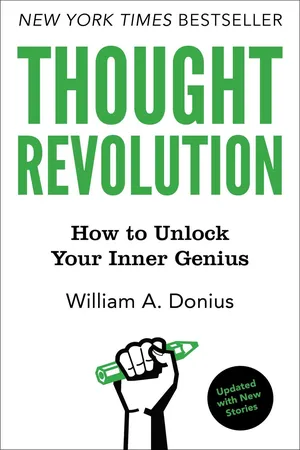
Thought Revolution - Updated with New Stories
How to Unlock Your Inner Genius
- 224 pages
- English
- ePUB (mobile friendly)
- Available on iOS & Android
eBook - ePub
About this book
Discover your hidden brainpower with this newly expanded guide to the simple but powerful technique that unlocks potential in all areas of your life.
Former banker and CEO Bill Donius drove his bank’s eightfold growth over twelve years. And the surprising secret to his success is something we all have access to, right in our own two hands.
The methodology described in Thought Revolution is simple and revolutionary—so simple, it begins by moving your pen from one hand to the other. Whether you’re right-handed or left-handed, a whole world of change is possible. Writing with your non-dominant hand opens you up to creative solutions, giving you the ability to see new ways through problems in your business, career, relationships, health, and spiritual life.
In Thought Revolution, Donius explains the science behind non-dominant handwriting and teaches you how to incorporate the technique into your business and your life.
New stories from Donius’s extensive seminars illuminate how employees and managers can unite in a new vision for their company’s growth and culture, increase employee and customer satisfaction, and improve profits. Thought-provoking, easy-to-do exercises and prompts show how to connect more fully with your subconscious right brain to help you reduce stress, discover your hidden talents, heal from trauma, and come to a deeper spiritual awareness.
Thought Revolution shows how your non-dominant hand serves as a direct pipeline to the right brain’s wisdom. Incorporate this simple practice into your career and your life, and you’ll find insights that lead to lasting change.
Former banker and CEO Bill Donius drove his bank’s eightfold growth over twelve years. And the surprising secret to his success is something we all have access to, right in our own two hands.
The methodology described in Thought Revolution is simple and revolutionary—so simple, it begins by moving your pen from one hand to the other. Whether you’re right-handed or left-handed, a whole world of change is possible. Writing with your non-dominant hand opens you up to creative solutions, giving you the ability to see new ways through problems in your business, career, relationships, health, and spiritual life.
In Thought Revolution, Donius explains the science behind non-dominant handwriting and teaches you how to incorporate the technique into your business and your life.
New stories from Donius’s extensive seminars illuminate how employees and managers can unite in a new vision for their company’s growth and culture, increase employee and customer satisfaction, and improve profits. Thought-provoking, easy-to-do exercises and prompts show how to connect more fully with your subconscious right brain to help you reduce stress, discover your hidden talents, heal from trauma, and come to a deeper spiritual awareness.
Thought Revolution shows how your non-dominant hand serves as a direct pipeline to the right brain’s wisdom. Incorporate this simple practice into your career and your life, and you’ll find insights that lead to lasting change.
Frequently asked questions
Yes, you can cancel anytime from the Subscription tab in your account settings on the Perlego website. Your subscription will stay active until the end of your current billing period. Learn how to cancel your subscription.
No, books cannot be downloaded as external files, such as PDFs, for use outside of Perlego. However, you can download books within the Perlego app for offline reading on mobile or tablet. Learn more here.
Perlego offers two plans: Essential and Complete
- Essential is ideal for learners and professionals who enjoy exploring a wide range of subjects. Access the Essential Library with 800,000+ trusted titles and best-sellers across business, personal growth, and the humanities. Includes unlimited reading time and Standard Read Aloud voice.
- Complete: Perfect for advanced learners and researchers needing full, unrestricted access. Unlock 1.4M+ books across hundreds of subjects, including academic and specialized titles. The Complete Plan also includes advanced features like Premium Read Aloud and Research Assistant.
We are an online textbook subscription service, where you can get access to an entire online library for less than the price of a single book per month. With over 1 million books across 1000+ topics, we’ve got you covered! Learn more here.
Look out for the read-aloud symbol on your next book to see if you can listen to it. The read-aloud tool reads text aloud for you, highlighting the text as it is being read. You can pause it, speed it up and slow it down. Learn more here.
Yes! You can use the Perlego app on both iOS or Android devices to read anytime, anywhere — even offline. Perfect for commutes or when you’re on the go.
Please note we cannot support devices running on iOS 13 and Android 7 or earlier. Learn more about using the app.
Yes, you can access Thought Revolution - Updated with New Stories by William A. Donius in PDF and/or ePUB format, as well as other popular books in Desarrollo personal & Éxito personal. We have over one million books available in our catalogue for you to explore.
Information
Topic
Desarrollo personalSubtopic
Éxito personalPART ONE
STOP LYING, START LIVING
CHAPTER 1
Taking Better Advantage of the Whole Mind
DO YOU SOMETIMES feel like a laboratory animal lost in a maze as you pursue life, success, and happiness? Try this little experiment. Take a blank piece of paper. At the top, write this question:
If I were an animal, what animal would I be?
Take a few seconds to clear your mind. Now write down the question and your answer. Next, draw a line across the page below what you’ve written. Switch your pen or pencil to the other hand, and don’t switch it back. Reread the question you wrote at the top of the page. Take a deep breath and let your lungs expand. Clear your mind. Remember, this is an experiment. Suspend judgment about how your handwriting will look or whether you’ll be able to succeed in the exercise. Trust yourself, and allow your nondominant hand to write its answer to the question. Put your writing instrument down on top of the paper . . . and read on.
We go through life wounded by various negative experiences. We heal from these experiences and develop emotional scar tissue. As does the child who gets burned by touching something on a hot stove, we get tougher and learn to avoid certain topics and issues as we grow. The good news is we keep ourselves emotionally safe from potential trauma. The bad news is we close ourselves off from risk taking. Consequently, we are more cautious and less interested in going in a new direction, especially if it is attached to a topic that has “burned” us previously. Most of the time, we end up staying within the confines of the lives we have created for ourselves. We abandon the idea of risk in order to get what we really want out of life.
We can learn to tap into a broader range of our thought processes. These thoughts are always present but often get shut down immediately because of past experiences in which we learned to protect ourselves from danger. Certainly, we don’t want to unlearn what has kept us safe from harm, nor do we want to stay stuck in risk-negative behaviors keeping us from reaching our true potential. How do we achieve a healthy balance?
This book explores the ways we arrive at various limiting positions in life. I call these the eight lies we tell ourselves. I believe these lies are perpetuated by the dominant linear thinking style of our left brain.
Life can be the experience of what we came here to learn, or it can become what we choose to suppress. We have a choice. But it takes courage to act, to become aware, to be intentional about what we do. This book is about helping you find a place of inner peace and wisdom that will allow you to discover the steps you need to take to find the greatest amount of meaning in your life. It may even ignite a revolution in your traditional thought process.
We have an opportunity to reach our true potential; however, we must be purposeful about getting where we want to go—making the changes necessary to unravel the ties that bind us. Thought Revolution will help you get clear about your intentions in life.
If you think I’m the leader of the pack who has all the answers to your questions about life, success, and happiness, you’re dead wrong. Still, I’ve learned a few things, and you may find them helpful. The experiment at the start of this chapter could be the beginning of any number of lessons you can learn. I know it’s taught me a lot about myself. I’ve also watched it start many of my friends and acquaintances on the road to important discoveries about themselves. Consider it a preview to equally fascinating exercises provided in Parts Two and Three of this book.
Since humankind climbed down from the trees, we have looked for ways to improve our circumstances. Maybe we want a better environment to live in, more suitable people to relate to, or more gratifying work. In any case, we think and scheme constantly about how we can better spend the short but precious time we have on earth. When we are lucky and blessed, we make progress along the path through life. Other times, though, we feel thwarted and blocked.
In my life, I’ve noticed that sometimes a veil obscures my vision of the solutions I know ought to be right in front of me. Procrastination is the perfect example of me getting in my own way. I don’t like the pressure of having to crank out some project because the due date is uncomfortably close. Yet, absurdly, many times in my life I found myself back in exactly the same uncomfortable spot. It was a pattern I just couldn’t break, no matter how conscious I was of its detrimental effects on my psyche and my work. And we all have patterns—some positive, some negative. Our good intentions tell us, usually at New Year’s or on our birthdays, that we will change our minds—change the way our brains operate to experience a new way of living that will enhance our decision making and positively affect our choices. We understand that we must first recognize our patterns in order to break them. But it’s easier said than done, and we often find ourselves—as I did with procrastination—back where we started. Why are our thought processes so seemingly difficult to change?
THE AMAZE-ING MIND
The brain is like a maze in which our patterns of behavior are lab mice scurrying through, hunting for the proverbial bits of cheese—goals and desires. When we achieve the desired aim of our behavior, we think, “Aha! That’s what I was looking for. I’ve got to remember the path I followed to get here because I know I’m going to want some more of this excellent cheese later!”
After lunch, the scientist puts us back at the beginning of the maze and lets us go again. Scurry, scurry, scurry, and we get the cheese a second time! Repeat the test again; the mouse learns the lesson almost perfectly. In fact, the mouse will eventually run the maze it learned by habit without caring if the cheese is to its preference or existent at all. Humans do the same thing. Once we plot a route that produces results, we habitually go about that route no matter what is there waiting for us. For the most part, we get very used to any repeated process. The tunnels, the turns, the switchbacks and straightaways begin to feel like home. Over time, the maze becomes completely familiar. Then the learned patterns and approaches to conflicts, problems, or solutions become so ingrained that we fail to see any other possible way . . . cheese or no cheese.
But here is the kicker: Once we get to the end of our maze, no matter what is there waiting for us, we will tell ourselves that is what we wanted or, worse, what we deserved. We lie to ourselves to cover up the disappointment because we crave inner peace. It’s easier to believe the lie than to face the truth.
We save face by convincing ourselves that we didn’t settle for the wrong significant other when we are pining for a lost love, or that we are in the right job when we keep getting passed over for promotion. What about when we tell ourselves that we deserve to be trampled on by family members or used by friends; that we are less than everybody else and should be happy with what we have? Does any of this sound familiar? It’s tough to invest time, emotion, and sometimes money in ventures that turn out to produce a less-than-desired outcome, so doesn’t it make sense to preserve our egos by lying to ourselves? “Of course this is what I wanted,” or “This isn’t exactly what I planned, but it’s better than nothing.”
These are only a few of the lies we tell ourselves. In fact, through researching brain science and writing with the nondominant hand, I have identified eight common lies we tell ourselves when we are trapped in this mind maze. This book will demonstrate reasons why we tell ourselves these lies and explore why we have a vested interest in believing them. We will also explore what actions we can take to make progress in breaking through these limitations so we have a better chance of realizing our full potential in life. We need to jump out of the maze when the cheese goes missing.
MY STORY
How would I know? I offer myself as Exhibit A. I was the prototypical right-handed, left-brained, linear, logical thinker. For thirty years, these traits helped me climb the corporate ladder until I reached the top rung as chairman and CEO of a public company. For over a dozen years, I ran a very successful bank. Surely banking is the epitome of rational and logical business. In banking everything has to make sense. I mean, literally, it must all add up or the bank closes its doors!
Although my rational mind was a terrific asset in my career, I found it much less helpful when I needed to resolve issues in my personal life. I felt way too much like the guy who keeps doing the same thing over and over expecting a different result each time. But my problems were unavoidable. Even procrastination couldn’t put off attending to them forever.
What to do? Faced with serious roadblocks in my personal life, I was tempted to focus only on those parts of my life where I succeeded, and I did so for a decade or more. My career proceeded unhampered, no matter how confusing my personal life. Yes, my myriad successes and the perks and spoils of my job gratified me. But as much as I enjoyed them, they ultimately did not content me. After reaching a sense of desperation—an emptiness that kept me unfulfilled and alone—I decided I had to face the personal issues or risk a life of perpetual unhappiness.
Finally, I took these issues to my psychotherapist, who recommended I read Lucia Capacchione’s breakthrough book, Recovery of Your Inner Child. That book made me understand that the part of myself I suppressed—the part that was not running a bank but failing in intimate relationships and creative expression—lived in my underactive, underdeveloped, and underutilized right brain. It was the part of my brain that was not satisfied with the lack of cheese at the end of my maze but was told lies to ease the disappointment. I did not want to settle for Kraft Singles when I might be able to have aged Gouda. My right brain was suffering, and I needed to tend to it in order to heal it and discover my truth.
I was spending fifty to seventy hours a week on work, so I began activating my right brain by writing with my nondominant left hand a response to the question “How can I achieve better balance in life?”
The answer I wrote with my left hand was “You could spend less time on work-related pursuits and accept fewer work-related activities or projects; reserve at least two or three nights a week as Bill time.”
Although this may not seem like an incredible insight, it was very helpful for me at the time. I stopped taking on additional projects and devoted more time to my pursuits. As you will discover when it’s your turn to participate in the nondominant-hand exercises, oftentimes the insights we uncover seem obvious to outsiders but not to us.
By exploring my right brain through writing with my nondominant left hand, I learned to access the place where I had locked some memories tightly away. After a time I was able to unlock some of my own mysteries and break through barriers that had stymied me for decades. The solution for me involved learning how to set loose material I had repressed, and when I did, I gained insights into who I really am and the things I truly desire. I’ll share more about these insights in Part Two. The technique I used to achieve this breakthrough involved posing a series of questions, prompts, and drawing exercises to myself and using my nondominant hand to answer them. I call this process “intuitive writing” or “right-brain writing,” and will use these terms interchangeably throughout the book. As weird as it felt to my ordinarily rational mind, the process has proved to be revolutionary and transformational in my life.
What I found particularly extraordinary was how naturally personal change came through intuitive writing. Once my subconscious right brain was unblocked and a pathway was created to the left brain, my old habits and ways of thinking moved aside to make room for the new approaches suggested by the right brain. Scientists are still not certain about how this process works. However, in my personal experience the thought or idea that is jogged from activation of the right brain can instantly feel like a really good one—intuitively and instinctually. The messages from the right brain are recognized and then validated by the whole mind as good ideas—like a lightbulb going on—which supports the power of the subconscious mind. Perhaps the question we pose to our right brain is answered and its answer accepted so readily because the truth has been lingering in the deep recesses of our mind for a long time. Therefore, on some level, what we unlock is not foreign to us after all.
Today I’m generally a more balanced thinker. I make better personal decisions. I can now draw fairly equally from my innate style of rational, linear thinking while not neglecting sparks of creativity, insight, and intuition that reside in parts of my right brain that I didn’t use effectively before. I apply different techniques today, and my creativity has blossomed. I can think “outside the box” about issues at work as well as at home and possess a “big-picture” view of my life. My thought revolution prohibits me from telling myself lies, so I can stay in pursuit of my truths.
Before we can get to this payoff, I will need to set the stage by addressing the roles our left and right brains play in the way we think about what is possible in our lives. I will offer techniques and processes to evaluate potential opportunities in a new light. My goal is to help you make better decisions by taking advantage of your whole mind. I have intentionally oversimplified the manner in which the left and right brains work by calling it “Left-Brain Lies, Right-Brain Answers.” In fact, you will be using both hemispheres of your brain as you work through the prescribed steps. The information you get from this process will feel as if it was pulled from your brain. This is where it gets really interesting.
CHAPTER 2
Of Two Minds: A Relatively Recent Discovery
THE THREE-POUND, crumpled-looking thing in our head we know as our brain is still one of the most complicated organisms on the planet. The typical brain consists of some 100 billion cells, each of which communicates with up to 10,000 of its colleagues. Together they forge an elaborate network of some quadrillion (1,000,000,000,000,000) connections guiding how we talk, eat, breathe, and move. James Watson, who won the Nobel Prize for helping discover DNA, described the human brain as the “most complex thing we have yet discovered in our universe.”
In the 1950s, the Cal Tech professor Roger Sperry reshaped our understanding of the human brain. He studied patients who had epileptic seizures that required removal of the corpus callosum,...
Table of contents
- Cover
- Dedication
- Preface to the New Edition
- Foreword
- Part One: Stop Lying, Start Living
- Part Two: Lifting the Eight Lies
- Part Three: Right-Brain Thinking in the Workplace
- Thought Revolution Journal
- Acknowledgments
- About William A. Donius
- Index
- Copyright