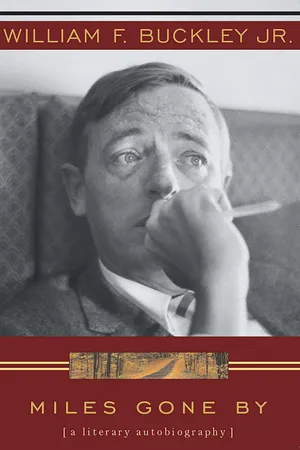
Miles Gone By
eBook - ePub

Miles Gone By

A Literary Autobiography

  1. 594 pages
  2. English
  3. ePUB (mobile friendly)
  4. Available on iOS & Android
eBook - ePub

Miles Gone By

A Literary Autobiography

About this book

Here is a unique collection of fifty years of essays chosen to form an unconventional autobiography and capstone to his remarkable career as the conservative writer par excellence. Included are essays that capture Buckley's joyful boyhood and family life; his years as a conservative firebrand at Yale; the life of a young army officer; his love of wine and sailing; memories of his favourite friends; the great influences of music and religion; a life in politics; and exploring the beauty, diversity, and exactitude of the English language.

Frequently asked questions

Yes, you can cancel anytime from the Subscription tab in your account settings on the Perlego website. Your subscription will stay active until the end of your current billing period. Learn how to cancel your subscription.
No, books cannot be downloaded as external files, such as PDFs, for use outside of Perlego. However, you can download books within the Perlego app for offline reading on mobile or tablet. Learn more here.
Perlego offers two plans: Essential and Complete
  • Essential is ideal for learners and professionals who enjoy exploring a wide range of subjects. Access the Essential Library with 800,000+ trusted titles and best-sellers across business, personal growth, and the humanities. Includes unlimited reading time and Standard Read Aloud voice.
  • Complete: Perfect for advanced learners and researchers needing full, unrestricted access. Unlock 1.4M+ books across hundreds of subjects, including academic and specialized titles. The Complete Plan also includes advanced features like Premium Read Aloud and Research Assistant.
Both plans are available with monthly, semester, or annual billing cycles.
We are an online textbook subscription service, where you can get access to an entire online library for less than the price of a single book per month. With over 1 million books across 1000+ topics, we’ve got you covered! Learn more here.
Look out for the read-aloud symbol on your next book to see if you can listen to it. The read-aloud tool reads text aloud for you, highlighting the text as it is being read. You can pause it, speed it up and slow it down. Learn more here.
Yes! You can use the Perlego app on both iOS or Android devices to read anytime, anywhere — even offline. Perfect for commutes or when you’re on the go.
Please note we cannot support devices running on iOS 13 and Android 7 or earlier. Learn more about using the app.
Yes, you can access Miles Gone By by William F. Buckley in PDF and/or ePUB format, as well as other popular books in Media & Performing Arts & Journalist Biographies. We have over one million books available in our catalogue for you to explore.

Information

CHAPTER FOUR
SAILING
(AND SKIING, AND ONE FLY-BY)
We Must Sail across the Ocean!
I have sailed a lot, beginning at age thirteen on a mile-square lake near Sharon, Lake Wononscopomuc. After college, I bought first a cutter, then a yawl, then a schooner, and finally a sloop. Four times I sailed across an ocean, and raced as many times from Newport to Bermuda. In this section I offer selections acknowledging the continuing mystique of the sea, which Homer first told us of, and which will surely be written about in wonder and awe in the closing days of literary life on the planet.
The first time I sailed across the Atlantic was in 1975. Here is the genesis of that trip.
“Peter,” I said, late on a white summer afternoon around 1960, to Peter Starr, who had been sailing with me and looking after my boat during the summers since he was thirteen, “let’s face it. Someday we’ll have to sail across the Atlantic.” We were walking gingerly about the mossy rocks that surround York Harbor, in Maine, getting some exercise after a long day’s sail from Gloucester, before returning to The Panic, moored in the Hanseland-Gretel harbor, for dinner. The first three days of our sail we—my wife and I, Peter, and some friends—had raced with the New York Yacht Club on its summer regatta. Then we struck out to cruise in Maine.
Peter agreed. Yes, we must sail across the ocean.
I had by then acknowledged widely my unalterable affection for Peter. In the five years I had known him, he had never said No to any request I made (“Please paint the hull black by next weekend”), never implied by any inflection the implausibility of any proposal I made (“Can you get a week off from school and sail to Bermuda with us in October?”), never betrayed any lack of enthusiasm for any suggestion I made anytime, anywhere. I would think nothing of calling him at his home in Stamford, a mile from my own, at eleven or twelve at night on a Friday, late in the season.
“Peter, let’s sail.”
“Sure!”
“I’ll pick you up in ten minutes”—Peter wasn’t old enough for a driver’s license when I first knew him—and in twenty minutes we would be powering out of Stamford Harbor; in another ten minutes the sails would be up. In an hour or so, depending on the wind, we would make out the little flashing red light signaling the entrance to the tortuous channel, rocks on either side, winding into the little harbor off Treasure Island. It is actually Eatons Neck Point, but we came to call it Treasure Island because it was there that we took Christopher in midsummer when he was six, with his little friend Danny Merritt, and the pirate’s map that my old friend Reggie Stoops, an MIT graduate who could draft the inside of an HP-65 computer, had so painstakingly contrived the day before, marking where a chest of treasure was said to have been buried during the seventeenth century. I have a movie of Christopher, in short pants and solemn mien, counting out the steps—stretching out his legs to approximate the distance Long John Silver would have intended to suggest when writing, “Count 20 paces NNW”—treasure chart in hand, with Reggie, head bent over the hand compass, pointing the way.
“I figure it ought to be about here,” Reggie said finally, reflectively, and Christopher and Danny went down on their knees and began with bare hands to shovel out the sand—two inches, four inches, eight inches . . .
“Try a little deeper, Christopher. After all, if it’s still here, it’s been here three hundred years.” And then the yelps of joy as they spotted wood and, after furious application, hauled out, reverently, a small old chest. The padlock was conveniently rusted, and Reggie pried it open for them. They were agog. A crock of jewels. Pearl necklaces, gold brooches, huge amethyst rings, diamond bracelets: It had taken Pat an hour at Woolworth’s the morning before to accumulate the treasure, and she complained of having had to spend well over ten dollars. Christopher and Danny, though they had exchanged vows of eternal fidelity, clearly did not trust each other to exclusive dominion, however temporary, over their precious burden. So, although it did not weigh five pounds, they walked off in tandem, in elated silence, four arms around the little chest.
What happened that fall is a subject we didn’t bring up for a while, not until Pat’s sense of humor caught up with her, which it always does. Christopher, through the balance of the summer, couldn’t get over the fixation that there might be yet more treasure on “Treasure Island,” and he pestered Reggie on the point until, unguardedly, Reggie divulged that indeed he had heard that someone in New York—a great-great-great-great-great-great-great-(Reggie furrowed his brows, as though counting carefully down the generations from the middle of the seventeenth century to the present, 1959) granddaughter of a famous pirate—indeed survived, who had a chart of another buried treasure chest. When we couldn’t put the second search off any longer, Reggie busied himself creating the new chart, ten times as ornamental as its predecessor. Pat, fearing that another assortment from Woolworth’s might arouse suspicion, collected four or five superb Georgian silver pieces of various designs that her mother had given her and that had just arrived in a wooden crate, the contents as yet unseen by Christopher. When Christopher discovered them on Treasure Island, Pat would “buy” them from him. Besides, the silver was safer for another reason. In a characteristic access of generosity, two days after the original discovery on Treasure Island, Christopher asked his nurse for some wrapping paper and ribbon, and then mysteriously disappeared. When Pat and I went to bed, a bulky package lay under her pillow. It contained Christopher’s half of the ancient treasure, with a six-year-old’s love note. This, of course, required Pat during that long summer to wear, whenever Christopher was anywhere in sight, which was most of the time, a full suit of Woolworth’s jewelry, which was bad enough when just Christopher was around, but positively arresting when there were a lot of other people around who clearly wondered what on earth had happened to the taste in jewelry of the chic and stunning Mrs. Buckley. Exhibiting her son’s pirate collection of Georgian silver she could contemplate doing with serenity.
On Friday, Peter, Reggie, and I sailed across Long Island Sound to Eatons Neck Point and buried the box, leaving a telltale stick to guide us the next day, even as we would affect to be guided only by the compass markings on the chart.
CHRISTOPHER AND HIS MOTHER, IN SEARCH OF TREASURE ISLAND
Unfortunately, that Saturday we got not our happy little picnic sail across the Sound, but Hurricane Hilda. By the time Hilda had allowed the seas to settle down, three days had passed. Instantly we set out, and Christopher and Danny went through their paces, using the new chart. Two hours and six excavations later, Pat’s sober expression having graduated to fixed stares of stupefaction and loathing aimed alternately at Reggie and me when the boys were not looking, we had to give up. Back on board, after the boys were asleep in the forward section, she demanded in no uncertain terms that we find her beautiful Georgian silver. “There, there,” we said, “of course we’ll find it.” Reggie and I conferred privately and wondered what we would have to do to lease a metal detector from the Army Corps of Engineers. We tried a half dozen times over the next months to find the buried casket. It is still there, somewhere.
“Of course, we must cross the Atlantic,” Peter said, without looking up from the mossy stones he glided over. “Is there anything else we haven’t done on The Panic?”
That was my first ocean boat, and I loved her dearly. I raced her to Bermuda and cruised her to Nova Scotia and up the St. John River, and a dozen times all along the Maine coast. One day in November of 1961 I called from Washington to the harbormaster at the Stamford Yacht Club and asked him to check the mooring lines of The Panic, as a hurricane was predicted. Two days later he called my house and asked me to come down. The storm had subsided, but one of the boats had come loose and was piled on the jetty at the harbor entrance. “I think it’s The Panic.” He took me, in the club launch, as close as we could get—the winds were still at gale force. I looked at her, grinding into the rocks with every onset of waves, and estimated that her steel hull must be punctured in a hundred different places. Only her single rugged mast—she was a cutter—was clearly visible in the high tide. At low tide, her broken body was fully, immodestly exposed, like a ravaged corpse with the bed-sheet drawn back.
That night Peter called, enthusiastic as always, from Georgetown University, where he was a sophomore, to tell me the new spinnaker for next year’s Bermuda race was ready and he would pick it up at the sailmaker’s in Annapolis and bring it to Stamford, as he was coming home for the weekend in any case. I gave him the news. He had to put down the telephone after the first sob. That reaction was not only the teenager’s who had grown up with The Panic. I gave the same news to the critic Hugh Kenner. He reacted in a letter that ended: “She had done much for her friends, in the summers before her side was stove in. She had . . . made for them a place of adventure and refreshment and peace; and taught them this, that beyond illusion it is possible to be for hours and days on end perfectly and inexpressibly happy.”
This was what Hugh remembered about The Panic! Mercifully his memories of his initial cruise were less distinct; or perhaps, on the occasion, they were merely. . . transcended. He and his first wife (Mary-Jo, RIP) and I flew to Portland, Maine. Peter was waiting for us, having just unloaded a charter party. Though it was very late in the afternoon, and Peter had been working since six in the morning, and Hugh was exhausted from a round of lectures and meetings with publishers, we decided exuberantly to set out forthwith across the hundred-mile track of ocean to Provincetown, Massachusetts. Peter and Mary-Jo took the watch from eight to midnight. It began to storm at eleven, and Mary-Jo was blue with fear and mal de mer, while Peter was very nearly faint from having to cope, virtually alone, with the sail-shortening. But they stuck it out till watch change at twelve (an iron protocol aboard ship, except in case of emergency). Peter came forward and woke me, and I, grabbing every fixed object en route to keep my balance, went aft and nudged Hugh. He sat up in the bunk stark white, put on his glasses with great, silent dignity, looked at me as if I were a perfect stranger, rose, walked uncertainly forward to the head, clutched two handy pipes, leaned over, vomited a day’s food into the toilet, groped his way somnambulistically back to his bunk, got in, pulled the covers over himself, and passed out. Mary-Jo, wrestling with the strange tiller, wasn’t good for another ten minutes. Peter looked up at me—he looked as young as on the day, three years earlier, when he had bicycled to my house to apply for a job he hoped to find more interesting than his paper route. “I’ll stay awake with you, Mr. Buckley.”
KNOCKDOWN AT THE START OF THE BERMUDA RACE, 1956, ABOARD THE PANIC
“Go to bed,” I told him. “I’ll call you if I need you.” I put on foul-weather gear, relieved Mary-Jo at the wheel, felt the boat surging at hull speed with only the No. 3 jib and reefed main, and wondered (this happens at sea as often as people who write about the sea tell you it does)—facing four hours alone, already soaked, beginning to feel the cold, the boat’s erratic needs exacting every nerve of concentration, arm and back muscles taxed like a galley slave’s, facing God knows what ahead, the human reserves aboard comprising one seasick poet, his incapacitated wife, and an exhausted sixteen-year-old—what madness finds me here, in these conditions, at this time. The hoariest line in the literature, which even so never ceases to amuse me, is: “Ocean racing is like standing under an ice-cold shower, tearing up thousand-dollar bills.”
There was a lot to think about during that long and hectic night, but Walt Disney was in his heaven, and by the time the sun rose, the storm had abated; and I even managed to hoist the spinnaker utterly alone—sad, in the radiant early sun, the wind steady off the port quarter, only that no one was witness to this feat of virtuosity. Finally I woke the ship’s company and they were all, miraculously, quite cured and ravenously hungry. As we chatted—picking up now a land speck on the horizon, the tower at the tip of Cape Cod, validating a night of navigation by dead reckoning—spirits soared, and I mentioned to Hugh that one day Peter and I would cross the Atlantic. But even though, seventeen years later, the voyage had been set, and even though the date of departure was fixed fifteen months ahead, when we did set out from Miami, on May 30, 1975, Peter was not aboard. He was thirty-three now and had discovered the well-known American phenomenon called the Business Crisis. Three days before our departure, he called to blurt out, in a voice that took me back to the phone call from Georgetown about The Panic, news I had known for three weeks was coming. Not intuition. Peter was president and chief executive officer of a company of which I was board chairman, and I knew something about the crisis in which, as it happened, our common sailing experience figured tangentially. I wondered, when Peter called, whether I could imagine any crisis such as would cause me to cancel the B.O., as we had come to refer to it—the Big One. I refused to let my imagination travel across that Stygian frontier.
Having undertaken, however vaguely, to set out one unspecified day to sail across the Atlantic, I found myself focusing haphazardly on the trials of such a passage. These questions would acco...

Table of contents

  1. Cover
  2. Title Page
  3. Copyright
  4. Dedication
  5. Contents
  6. Introduction
  7. At Home
  8. Yale
  9. Wartime
  10. Sailing (And Skiing, and One Fly-By)
  11. People
  12. Remembering
  13. Language
  14. Getting About
  15. Politics
  16. Social Life
  17. Epilogue
  18. Thoughts on a Final Passage
  19. Acknowledgments
  20. Index