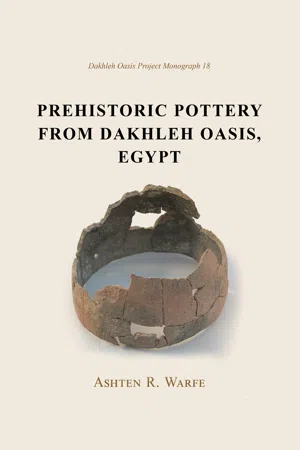
As one of the few surviving artifacts from the late prehistory of northeast Africa, pottery serves as an essential material category by which to explore long-term human development. This book presents a major study on the ceramics recovered from early and mid-Holocene sites in Egypt's Dakhleh Oasis, which come from 96 registered sites and five other findspots and comprise more than 10, 000 sherds. In addition, there is little proxy evidence to support the manufacture of pottery in the form of kilns, clay firedogs, and other firing equipment. None of the ceramic objects come from burials, they derive instead from settlement sites that display evidence of living activities (hut circles, hearths, chipped stone scatters, etc.), or sites for which there is no other evidence of human activity. Through detailed description, classification, and quantification, a detailed cultural sequence has been determined, demonstrating descrete stylistic variations between sites and over time, highlighting growing diversity and innovation in local pottery-making from the late seventh to mid-third millennia cal. BC. These shifts help to refine the characterization of local cultural units within the Holocene sequence for Dakhleh Oasis, and to compare against parallel pottery traditions elsewhere in the desert. A firmer grounding in the oasis ceramics, as detailed here, offers inroads to examine social practices and the interconnectedness of desert groups of the ancient Eastern Sahara.
- 144 pages
- English
- ePUB (mobile friendly)
- Available on iOS & Android
eBook - ePub
Prehistoric Pottery from Dakhleh Oasis, Egypt
About this book
Trusted by 375,005 students
Access to over 1.5 million titles for a fair monthly price.
Study more efficiently using our study tools.
Information
Subtopic
Egyptian Ancient HistoryIndex
HistoryChapter 1
Introduction
This study presents a description, classification and quantitative analysis of the pottery recovered from prehistoric sites in Dakhleh Oasis, south central Egypt (Fig. 1). Surveying conducted during the first field season of the Dakhleh Oasis Project1 confirmed the existence of rich prehistoric remains on a few sites in the northwest corner of the oasis. Now, after four decades of fieldwork, several hundred Holocene sites have been recorded throughout the oasis yielding a significant quantity of archaeological material including groundstone items, architectural features, rock art panels, animal remains, and a rich array of chipped stone tools. The study of this material reveals an almost continuous sequence of human occupation from the early Holocene settlement of the oasis during the ninth millennium (cal. BC), to the arrival of Old Kingdom colonists during the mid-third millennium, at which time the oasis was drawn into the administrative orbit of the Nile Valley, a state of existence in which it has remained since (Hope 2007; Hope et al. in press).
Studies on the Holocene inhabitants have proceeded under the direction of Mary McDonald as principal DOP investigator for the Holocene prehistory. The picture to emerge is one of long-term transformation in the social landscape patterned to shifting environmental conditions. The early Holocene wetting of northeast Africa (Kuper and Kröpelin 2006) saw small groups of hunter-gatherers migrate to the oasis, while improved climatic conditions c. 7000 cal. BC resulted in an influx of new arrivals providing a new and more dynamic social environment. The aridity to follow, beginning around 5300 cal. BC, witnessed an abrupt shift in this process, with late Holocene groups becoming increasingly marginalised as the desert dried around them. Broadly speaking, these developments coincide with the cultural sequence for the oasis, which consists of three core units: the Masara, Bashendi and Sheikh Muftah.2
The oldest of these, the Masara cultural unit (8300–6500 cal. BC), represents the ‘Epipalaeolithic developmental stage’ in Dakhleh (McDonald 2003, 43). The record consists of short-term campsites scattered across the oasis (Fig. 2), usually identifiable by chipped stone scatters, grinding equipment, and sometimes a few hearths (Masara A). There is also evidence for more settled activities, in the form of stone slab architecture, with sites clustered in an area to the southeast of the oasis proper (Masara C). The Masara A and C variants are believed to be roughly contemporaneous (McDonald 2009, 9).3
The following Bashendi unit represents a period of Neolithisation in the oasis, involving two-stage development. The Bashendi A occupants (c. 6400–5650 cal. BC) continued a settled lifestyle, mostly confined to the southeast of the oasis, with an expanded toolkit and material indications for increased social differentiation (McDonald 2008; 2016).4 With the Bashendi B occupation (5600–3800 cal. BC) comes the first clear signs for food-production in the form of livestock keeping (goat and cattle). The new subsistence base apparently prompted a reversion to the more mobile lifestyle, though one that maintained elements of increasing social differentiation as evidenced in the material record (McDonald 2002a; 2008; 2016, 189–90). The last period of indigenous occupation belongs to the Sheikh Muftah cultural unit, which emerged at the end of the Bashendi period and remained active in the oasis into the mid-third millennium (Hope et al. in press). These people were highly mobile hunter-herders who may have lived a fairly meagre existence while spending much of their time adapting to the increasingly arid environment (McDonald et al. 2001). Some 70 sites have been recorded for the Sheikh Muftah.5 While these groups seem to have concentrated their activities in and around the oasis lowlands, presumably to tap the last remaining pools of standing water (McDonald et al. 2001; McDonald 2013, 179), research in the desert surrounding the oasis also indicates travel beyond the oasis confines (Riemer 2009; 2011; Wagner and Heller 2012, 356–7).
In 2001 the pottery collection became the subject of a new investigation intended to build on the picture of social and economic development in the oasis, providing details where other archaeological materials remain scant. The pottery collection is ideally suited to the task. As a robust material it survives in relatively good condition, it is present on several Holocene sites and well represented on those belonging to the final stages of prehistory, and it demonstrates discrete stylistic variations that can be mapped in time enabling the determination of a cultural sequence and connections to be drawn between sites. While this has already been demonstrated through interim studies on the collection (e.g. Tangri 1992; Hope 2002; Warfe 2006), research is now at the stage of offering a more comprehensive overview that begins with identifying, in more precise terms, the range and types of pottery from early and mid-Holocene sites.

Figure 1. Map of Egypt showing Dakhleh Oasis.
1.1 Methodology and structure of study
Part I of the study sets about doing this in three interrelated steps. It begins by outlining a process for identifying and describing the range of pottery properties in the collection that are suitable for analysis. The focus rests on fabric inclusions, manufacturing technology, surface treatments and vessel dimensions. A broad set of ceramic properties are present in the collection from which a range is selected to identify fabrics. These are matched with surface treatment to identify wares, forming the second step – a pottery classification. As a ware-based system, the information is scaffolded to produce a definable type. The study then proceeds to an investigation of fabric type, surface treatment and shapes that appear on sites belonging to the three cultural units: the Masara, Bashendi and Sheikh Muftah. As a quantitative analysis this process relies on statistical applications to deal with the large sets of data. It seeks to identify the frequencies in which pottery types appear on sites with the aim of establishing patterns amongst the data that are relative to time. Put simply, this final step seeks to characterise the pottery traditions for each cultural unit, drawing attention to the differences and similarities that define each tradition, and in doing so revealing long-term variation in the technology.

Figure 2. Map of Dakhleh showing early and mid-Holocene cultural unit sites and modern centres of activity.
By following these steps the study provides a baseline for research, an anchor point for exploring changes in the pottery corpus that point to social developments, economic organisation and cultural boundary formation. All of these are valuable avenues for research that are being pursued as part of the broader investigation (Warfe 2015; 2016; forthcoming a; forthcoming b) but are not included here in the interests of presenting a containable publication upon which interpretations will be grafted in other publications. In short, this study offers a comprehensive introduction to the prehistoric pottery of the oasis. It is essentially the first step in the broader program of investigation on the ceramic evidence.
Having made this point, it is hoped that this study will provide a foundation for exploring the Dakhleh tradition within the wider sphere of pottery activity in the Egyptian Western Desert. As a localised study, the focus is necessarily inward looking, though attempts have been made to match the report in substance and style to ceramic studies from elsewhere: the Nile Valley (Nordström 1972; Nordström and Bourriau 1993; Friedman 1994) and desert regions (e.g. Nelson and Associates 2002; and especially the system developing out of the Arid Climate Adaptation and Cultural Innovation in Africa (ACACIA) project, see in particular Riemer 2011, 33–73 and also the North East African Prehistoric Pottery (NEAPPO) http://www.uni-koeln.de/sfb389/a/a1/a1_informations.htm#riemer6 ). The objective is to find a common language through which technical information may be shared on an appreciable level. This aim is borne out, partly, in the terminology as well as the technical methods. Many of these are not new to ceramicists and draw from standards long established.
With similar intent, Part II of the study offers grounds for comparison with other ceramic traditions through a discussion of provenance accompanied by thin-section analysis. The Dakhleh inhabitants, like those from neighbouring regions (Wendorf, Schild and Associates 2001; Gehlen et al. 2002; Kindermann 2010; Riemer 2011; Barich et al. 2014), were not locked in place and thrived as part of a wider cultural complex that extended across northeast Africa from the Western Desert oases to the Nile Valley and into present-day Sudan. This is evidenced by a process in which local Dakhleh adaptations were largely in step with desert-wide developments and also in the spread of cultural materials: amazonite beads and marine shells, Ounan points and the decorated wares identified by Arkell (1949; 1953) and reported widely across the Sahara (Riemer and Jesse 2006; Jesse 2010). Although the Dakhleh pottery tradition does not belong directly to the decorated tradition (Warfe 2003b; 2006), both were nonetheless part of the material assemblage through which social relations were operationalised and transmitted regionwide. Other examples drawn in Part II extend to the Nile Valley and elsewhere in the Western Desert.
1.2 Research history on the pottery collection
The ceramic objects forming the subject of this book come from 96 registered sites and five findspots6 within the DOP concession zone – the appendix provides a list of sites and associated pottery finds. With the exception of a few pieces, now housed in the Royal Ontario Museum, the collection is kept in field facilities provided by the Dakhleh Oasis Project. The objects in the museum and some finds reported by Hope (2002) are not analysed in the current study.7 Notwithstanding these pieces, more than 10,000 sherds were examined forming what is now the most comprehensive study of the early Dakhleh pottery.
Some of this material has been examined previously and published as part of the ongoing researches of the DOP. In all cases, studies were performed by Colin Hope as principal ceramicist for the Dakhleh Oasis Project or by analysts working under Hope’s supervision: in the late 1980s Daniel Tangri (1989) examined part of the collection for his undergraduate Honours thesis at Sydney University, Australia, and in the late 1990s Mark Eccleston (1997) analysed several samples as part of his undergraduate Honours thesis at Monash University, Australia. In 2001 the collection was offered to the current author for research purposes.
The publications stemming from earlier studies appear mostly in the form of brief field reports (Hope 1979; 1980; 1981; 1983) or concise overviews (Edwards and Hope 1987; 1989; Hope 1998; 2002; 2007; Hope and Tangri 1999). Other than this, the list includes publications by Tangri (1991a; 1991b; 1992), Eccleston (2002) and myself (McDonald et al. 2001; Warfe 2003a; 2003b; 2005; 2006; 2015; 2016; see also Warfe forthcoming a; forthcoming b; Jamieson and Warfe 2005a; 2005b; Warfe and Jamieson 2006). A two-page contribution by Segnit in Edwards and Hope (1987) completes the list.
With the exception of Hope (2002), these publications are mostly characterisation studies based on individual samples or small selections of material. They differ more in methods of analysis than overall aims: the studies are generally focussed on identifying temporal trends in the collection as well as imports. The methods of analysis have included macroscopic identifications of fabric, surface treatment and shape (Hope 1979; 1980; 1981; 1983; Edwards and Hope 1987; 1989; Tangri 1991a; 1992; Hope and Tangri 1999; Warfe 2003a; 2003b; 2005; 2006), thin-section analyses (Eccleston 2002 and section 6.2 herein) and Neutron Activation Analysis (arranged by Daniel Tangri, performed by analysts at Sydney University, and reported by Eccleston 2002). A recent expansion of research aims has also seen a series of papers published on experimental studies that examine the pottery-production process in the oasis (Jamieson and Warfe 2005a; 2005b; Warfe and Jamieson 2006; Warfe 2015; 2016; see also Warfe forthcoming a). Where appropriate, the findings from these studies are incorporated into the current work.
1.3 Points of clarification
Before proceeding to the analysis it is important to draw attention to a few key points on the Dakhleh pottery that may conflict with generally held assumptions about early ceramic material from northeast Africa. One of these relates to the find context. None of the ceramic objects analysed for this study come from burials. They derive instead from settlement sites that display evidence of living activities (hut circles, hearths, chipped stone scatters, etc.), or sites for which there is no other evidence of human activity – i.e. a findspot. Although a handful of prehistoric burials have been discovered in the oasis, these were bereft of material culture with the exception of a single copper pin (Thompson and Madden 2003, 72). This suggests that pottery was not directly integrated into the funerary customs of the early oasis inhabitants as it was in the Nile Valley, and as we are beginning to see in Neolithic burials elsewhere in the Western Desert (Kobusiewicz et al. 2009; Gatto 2010). Yet the paucity of burials so far discovered in the oasis warns against drawing this conclusion outright. The number of known burials is at odds with the level of human activity recorded in the oasis during prehistory, and we hope to eventually find burial sites that represent this activity. Such a discovery could, of course, present new data on the early Dakhleh pottery traditions.
On the...
Table of contents
- Cover
- Title
- Copyright
- Contents
- Preface and acknowledgements
- List of plates
- 1. Introduction
- PART I
- PART II
- Appendix: Site collections
- Bibliography
- Plate section
Frequently asked questions
Yes, you can cancel anytime from the Subscription tab in your account settings on the Perlego website. Your subscription will stay active until the end of your current billing period. Learn how to cancel your subscription
No, books cannot be downloaded as external files, such as PDFs, for use outside of Perlego. However, you can download books within the Perlego app for offline reading on mobile or tablet. Learn how to download books offline
Perlego offers two plans: Essential and Complete
- Essential is ideal for learners and professionals who enjoy exploring a wide range of subjects. Access the Essential Library with 800,000+ trusted titles and best-sellers across business, personal growth, and the humanities. Includes unlimited reading time and Standard Read Aloud voice.
- Complete: Perfect for advanced learners and researchers needing full, unrestricted access. Unlock 1.5M+ books across hundreds of subjects, including academic and specialized titles. The Complete Plan also includes advanced features like Premium Read Aloud and Research Assistant.
We are an online textbook subscription service, where you can get access to an entire online library for less than the price of a single book per month. With over 1.5 million books across 990+ topics, we’ve got you covered! Learn about our mission
Look out for the read-aloud symbol on your next book to see if you can listen to it. The read-aloud tool reads text aloud for you, highlighting the text as it is being read. You can pause it, speed it up and slow it down. Learn more about Read Aloud
Yes! You can use the Perlego app on both iOS and Android devices to read anytime, anywhere — even offline. Perfect for commutes or when you’re on the go.
Please note we cannot support devices running on iOS 13 and Android 7 or earlier. Learn more about using the app
Please note we cannot support devices running on iOS 13 and Android 7 or earlier. Learn more about using the app
Yes, you can access Prehistoric Pottery from Dakhleh Oasis, Egypt by Ashton R. Warfe in PDF and/or ePUB format, as well as other popular books in History & Egyptian Ancient History. We have over 1.5 million books available in our catalogue for you to explore.