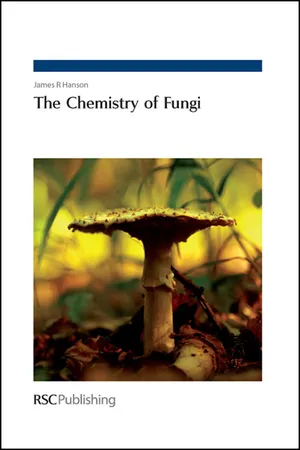
Fungi occupy an important place in the natural world, as non-photosynthetic organisms, they obtain their nutrients from the degradation of organic material. They use many of their secondary metabolites to secure a place in a competitive natural environment and to protect themselves from predation. The diverse structures, biosyntheses and biological activities of fungal metabolites have attracted chemists for many years. Fungi are ubiquitous and their activities affect many aspects of our daily lives whether it be as sources of pharmaceuticals and food or as spoilage organisms and the causes of diseases in plants and man. The chemistry of the fungi involved in these activities has been the subject of considerable study particularly over the last fifty years. Although their ramifications can be large as in the spread of plant diseases, the quantities of the metabolites which could be isolated precluded much chemical work until the advent of spectroscopic methods. Whereas many natural products derived from plants were isolated prior to the 1960s on a scale which permitted extensive chemical degradation, this was rarely the case for fungal metabolites. This book is an introduction to the chemistry of fungal metabolites. The aim is to illustrate within the context of fungal metabolites, the historical progression from chemical to spectroscopic methods of structure elucidation, the development in biosynthetic studies from establishing sequences and mechanisms to chemical enzymology and genetics and the increasing understanding of the biological roles of natural products. The book begins with a historical introduction followed by a description of the general chemical features which contribute to the growth of fungi. There are many thousands of fungal metabolites whose structures are known and the book does not aim to list them all as there are databases to fulfill this role. The book's aim is to describe some of the more important metabolites classified according to their biosynthetic origin. Biosynthesis provides a unifying feature underlying the diverse structures of fungal metabolites and the chapters covering this area begin with a general outline of the relevant biosynthetic pathway before presenting a detailed description of particular metabolites. Investigations into these biosyntheses have utilized many subtle isotopic labelling experiments and compounds that are fungal pigments and those which are distinctive metabolites of the more conspicuous Basidiomycetes are treated separately. Many fungal metabolites are involved in the interactions of fungi with plants and others are toxic to man and some of these are described in further chapters. Fungi have the ability to transform chemicals in ways which can complement conventional reactions and the use of fungi as reagents forms the subject of the final chapter. This book will be particularly useful to anybody about to embark on a career in chemical microbiology by providing an overall perspective of fungal metabolites as well as an essential reference tool for more general chemists.
eBook - PDF
Chemistry of Fungi
About this book
Information
Publisher
Royal Society of ChemistryYear
2008Print ISBN
9780854041367
9780854041367
Edition
1eBook ISBN
9781847558329
Table of contents
- The Chemistry of Fungi
Trusted by 375,005 students
Access to over 1.5 million titles for a fair monthly price.
Study more efficiently using our study tools.
Frequently asked questions
Yes, you can cancel anytime from the Subscription tab in your account settings on the Perlego website. Your subscription will stay active until the end of your current billing period. Learn how to cancel your subscription
No, books cannot be downloaded as external files, such as PDFs, for use outside of Perlego. However, you can download books within the Perlego app for offline reading on mobile or tablet. Learn how to download books offline
Perlego offers two plans: Essential and Complete
- Essential is ideal for learners and professionals who enjoy exploring a wide range of subjects. Access the Essential Library with 800,000+ trusted titles and best-sellers across business, personal growth, and the humanities. Includes unlimited reading time and Standard Read Aloud voice.
- Complete: Perfect for advanced learners and researchers needing full, unrestricted access. Unlock 1.5M+ books across hundreds of subjects, including academic and specialized titles. The Complete Plan also includes advanced features like Premium Read Aloud and Research Assistant.
We are an online textbook subscription service, where you can get access to an entire online library for less than the price of a single book per month. With over 1.5 million books across 990+ topics, we’ve got you covered! Learn about our mission
Look out for the read-aloud symbol on your next book to see if you can listen to it. The read-aloud tool reads text aloud for you, highlighting the text as it is being read. You can pause it, speed it up and slow it down. Learn more about Read Aloud
Yes! You can use the Perlego app on both iOS and Android devices to read anytime, anywhere — even offline. Perfect for commutes or when you’re on the go.
Please note we cannot support devices running on iOS 13 and Android 7 or earlier. Learn more about using the app
Please note we cannot support devices running on iOS 13 and Android 7 or earlier. Learn more about using the app
Yes, you can access Chemistry of Fungi by James R Hanson in PDF and/or ePUB format, as well as other popular books in Biological Sciences & Biochemistry. We have over 1.5 million books available in our catalogue for you to explore.