- 329 pages
- English
- PDF
- Available on iOS & Android
eBook - PDF
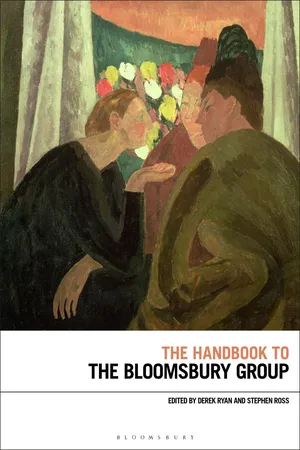
The Handbook to the Bloomsbury Group
About this book
The Handbook to the Bloomsbury Group is the most comprehensive available survey of contemporary scholarship on the Bloomsbury Group – the set of influential writers, artists and thinkers whose members included Virginia Woolf, Leonard Woolf, E.M. Forster, John Maynard Keynes, Vanessa Bell, Clive Bell, Duncan Grant and David Garnett. With chapters written by world leading scholars in the field, the book explores novel avenues of thinking about these pivotal figures and their works opened up by the new modernist studies. It brings together overview essays with detailed illustrative case studies, and covers topics as diverse as feminism, sexuality, empire, philosophy, class, nature and the arts. Setting the agenda for future study of Bloomsbury, this is an essential resource for scholars of 20th-century modernist culture.
Information
Table of contents
- Cover
- Half Title
- Series
- Title
- Copyright
- Contents
- Figures
- Contributors
- Introduction
- Chapter One Bloomsbury and Sexuality
- Case Study: Edward Carpenter’s Radical Integrity and its Influence on E. M. Forster
- Chapter Two Bloomsbury and the Arts
- Case Study: Clive Bell and the Legacies of Significant Form
- Chapter Three Bloomsbury and Empire
- Case Study: Race, Empire, and Performative Activism in Late Edwardian Bloomsbury
- Chapter Four Bloomsbury and Feminism
- Case Study: Bloomsbury, the Hogarth Press, and Feminist Organizations
- Chapter Five Bloomsbury and Philosophy
- Case Study: Bloomsbury, Mulk Raj Anand, and Henri Bergson
- Chapter Six Bloomsbury and Class
- Case Study: Bloomsbury’s Rural Cross-class Encounters
- Chapter Seven Bloomsbury and Jewishness
- Case Study: Leonard Woolf and John Maynard Keynes: Palestine, Zionism, and The State of Israel
- Chapter Eight Bloomsbury and Nature
- Case Study: Eating Animals and the Aesthetics of Meat in Virginia Woolf’s The Years
- Chapter Nine Bloomsbury and Politics
- Case Study: From Bolshevism to Bloomsbury: the Garnett Translations and Russian Politics in England
- Chapter Ten Bloomsbury and War
- Case Study: Bloomsbury’s Pacifist Aesthetics: Woolf, Keynes, Rodker
- Index
Trusted by 375,005 students
Access to over 1.5 million titles for a fair monthly price.
Study more efficiently using our study tools.
Frequently asked questions
Yes, you can cancel anytime from the Subscription tab in your account settings on the Perlego website. Your subscription will stay active until the end of your current billing period. Learn how to cancel your subscription
No, books cannot be downloaded as external files, such as PDFs, for use outside of Perlego. However, you can download books within the Perlego app for offline reading on mobile or tablet. Learn how to download books offline
Perlego offers two plans: Essential and Complete
- Essential is ideal for learners and professionals who enjoy exploring a wide range of subjects. Access the Essential Library with 800,000+ trusted titles and best-sellers across business, personal growth, and the humanities. Includes unlimited reading time and Standard Read Aloud voice.
- Complete: Perfect for advanced learners and researchers needing full, unrestricted access. Unlock 1.5M+ books across hundreds of subjects, including academic and specialized titles. The Complete Plan also includes advanced features like Premium Read Aloud and Research Assistant.
We are an online textbook subscription service, where you can get access to an entire online library for less than the price of a single book per month. With over 1.5 million books across 990+ topics, we’ve got you covered! Learn about our mission
Look out for the read-aloud symbol on your next book to see if you can listen to it. The read-aloud tool reads text aloud for you, highlighting the text as it is being read. You can pause it, speed it up and slow it down. Learn more about Read Aloud
Yes! You can use the Perlego app on both iOS and Android devices to read anytime, anywhere — even offline. Perfect for commutes or when you’re on the go.
Please note we cannot support devices running on iOS 13 and Android 7 or earlier. Learn more about using the app
Please note we cannot support devices running on iOS 13 and Android 7 or earlier. Learn more about using the app
Yes, you can access The Handbook to the Bloomsbury Group by Derek Ryan, Stephen Ross, Derek Ryan,Stephen Ross in PDF and/or ePUB format, as well as other popular books in History & 20th Century History. We have over 1.5 million books available in our catalogue for you to explore.