This book looks at current research and future directions in e-lexicography. Online dictionaries and reference tools are increasingly prevalent in a digitized and internet-led era in language study that has embraced computational linguistics. This book responds with theoretical and practical analysis of key topics, from a global range of contributors.
Since COBUILD in the 1980s, lexicographers have found it essential to engage with and utilize electronic computational tools. Internet dictionaries, online reference tools and even search engine optimization demand a knowledge of electronic lexicography and force a reassessment of the field. This volume looks at, amongst other topics:
• Polyfunctional versus monofunctional dictionary tools
• Developing theories of lexicography for electronic mediums
• Distinguishing between the database and the dictionary
• Online dictionaries not as data repositories but as sophisticated search engines
This volume will appeal to scholars in
lexicography and to practicing lexicographers.
eBook - PDF
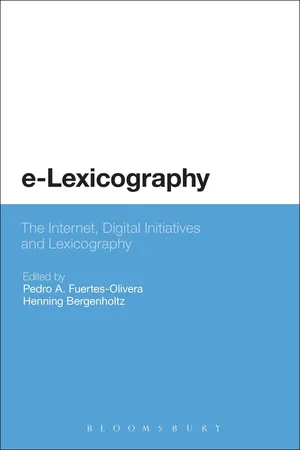
e-Lexicography
The Internet, Digital Initiatives and Lexicography
- 356 pages
- English
- PDF
- Available on iOS & Android
eBook - PDF
e-Lexicography
The Internet, Digital Initiatives and Lexicography
About this book
Information
Table of contents
- Cover
- Contents
- Preface
- Notes on Contributors
- Introduction: The Construction of Internet Dictionaries
- 1 Learning, Unlearning and Innovation in the Planning of Electronic Dictionaries
- 2 Access to and Presentation of Needs-Adapted Data in Monofunctional Internet Dictionaries
- 3 Lexicographical and Other e-Tools for Consultation Purposes: Towards the Individualization of Needs Satisfaction
- 4 Filtering and Adapting Data and Information in an Online Environment in Response to User Needs
- 5 A Multi-Layer Architecture for ‘Pluri-Monofunctional’ Dictionaries
- 6 Change of Paradigm: From Linguistics to Information Science and from Dictionaries to Lexicographic Information Tools
- 7 From Data to Dictionary
- 8 Internet Dictionaries for Communicative and Cognitive Functions: El Diccionario Inglés–Español de Contabilidad
- 9 A Dictionary Is a Tool, a Good Dictionary Is a Monofunctional Tool
- 10 The Technical Realization of Three Monofunctional Phrasal Verb Dictionaries
- 11 Online Dictionaries of English
- 12 e-Dictionaries in the Information Age: The Lexical Constellation Model (LCM) and the Defi nitional Construct
- 13 Modelling Interactive Reading, Translating and Writing Assistants
- 14 Electronic Dictionaries as Tools: Toward an Assessment of Usability
- 15 Conclusions: Ten Key Issues in e-Lexicography for the Future
- References
- Index
Trusted by 375,005 students
Access to over 1.5 million titles for a fair monthly price.
Study more efficiently using our study tools.
Frequently asked questions
Yes, you can cancel anytime from the Subscription tab in your account settings on the Perlego website. Your subscription will stay active until the end of your current billing period. Learn how to cancel your subscription
No, books cannot be downloaded as external files, such as PDFs, for use outside of Perlego. However, you can download books within the Perlego app for offline reading on mobile or tablet. Learn how to download books offline
Perlego offers two plans: Essential and Complete
- Essential is ideal for learners and professionals who enjoy exploring a wide range of subjects. Access the Essential Library with 800,000+ trusted titles and best-sellers across business, personal growth, and the humanities. Includes unlimited reading time and Standard Read Aloud voice.
- Complete: Perfect for advanced learners and researchers needing full, unrestricted access. Unlock 1.5M+ books across hundreds of subjects, including academic and specialized titles. The Complete Plan also includes advanced features like Premium Read Aloud and Research Assistant.
We are an online textbook subscription service, where you can get access to an entire online library for less than the price of a single book per month. With over 1.5 million books across 990+ topics, we’ve got you covered! Learn about our mission
Look out for the read-aloud symbol on your next book to see if you can listen to it. The read-aloud tool reads text aloud for you, highlighting the text as it is being read. You can pause it, speed it up and slow it down. Learn more about Read Aloud
Yes! You can use the Perlego app on both iOS and Android devices to read anytime, anywhere — even offline. Perfect for commutes or when you’re on the go.
Please note we cannot support devices running on iOS 13 and Android 7 or earlier. Learn more about using the app
Please note we cannot support devices running on iOS 13 and Android 7 or earlier. Learn more about using the app
Yes, you can access e-Lexicography by Pedro A. Fuertes-Olivera, Henning Bergenholtz, Pedro A. Fuertes-Olivera,Henning Bergenholtz in PDF and/or ePUB format, as well as other popular books in Filología & Lingüística. We have over 1.5 million books available in our catalogue for you to explore.