This book is available as open access through the Bloomsbury Open Access programme and is available on www.bloomsburycollections.com.
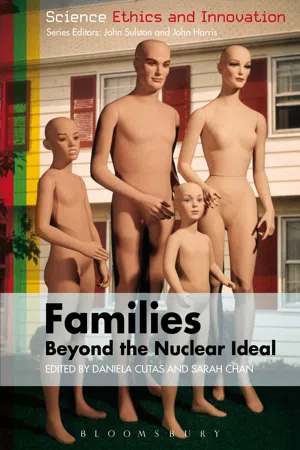
This book examines, through a multi-disciplinary lens, the possibilities offered by relationships and family forms that challenge the nuclear family ideal, and some of the arguments that recommend or disqualify these as legitimate units in our societies.That children should be conceived naturally, born to and raised by their two young, heterosexual, married to each other, genetic parents; that this relationship between parents is also the ideal relationship between romantic or sexual partners; and that romance and sexual intimacy ought to be at the core of our closest personal relationships - all these elements converge towards the ideal of the nuclear family.
The authors consider a range of relationship and family structures that depart from this ideal: polyamory and polygamy, single and polyparenting, parenting by gay and lesbian couples, as well as families created through assisted human reproduction.
- 240 pages
- English
- ePUB (mobile friendly)
- Available on iOS & Android
eBook - ePub
Families – Beyond the Nuclear Ideal
About this book
Trusted by 375,005 students
Access to over 1.5 million titles for a fair monthly price.
Study more efficiently using our study tools.
Information
1
Introduction
Perspectives on private and family life
That children should be conceived naturally, born to and raised by their two young, heterosexual, married to each other, genetic parents; that this relationship between parents is also the ideal relationship between romantic or sexual partners; and that romance and sexual intimacy ought to be at the core of our closest personal relationships – all these elements converge towards the ideal of the nuclear family.
In this book, then, the expression nuclear family will be used to denote families composed of a mother and a father romantically involved with each other, and their genetically related children that they have conceived naturally. We believe it quite uncontroversial to say that these are the core characteristics of the nuclear family standard. Calling units consisting of two parents and their adopted children, or same-sex couples and the children that they raise, nuclear families, corresponds to more generous interpretations of the concept or departures from the ideal, with varying degrees of acceptability.
We will not in this volume investigate how and why this formula came about. The nuclear family may have been the norm for some decades in the Western world, but it has not always been so, historically speaking (see for example Nicholson 1997), and is not so in some other contemporary cultures (see for example Stacey 2011). Whatever the age and coverage of the concept, the way family is defined in legislation as well as in the wider society has a prescriptive component (Archard 2010: 2): it determines whose private life is more, or less, scrutinized; who can be a parent and what sorts of organization of private and family life are encouraged, tolerated or even allowed at all; which associations will be supported, both socially and materially; and so on.
In contrast to the nuclear family ideal, real-life scenarios and choices in the realm of close personal relationships and family formation strategies display a variety of forms: electively or circumstantially single parents, unmarried couples, homosexual partnerships and parenting by homosexual couples, life-long close friendships preferred over sexually intimate alternatives, polyamory, poly-parental families, electively or circumstantially childless families1, families created with medical or social assistance and so forth. These alternative relationship and family structures challenge the privileged status of the nuclear family as the preferable mode of family life for all, and the one to be endorsed and encouraged by society. Efforts to make the concept of family more elastic, however, or even to gain recognition for other forms of organizing one’s private and family life as equally legitimate to the nuclear family, are faced with a variety of forms of resistance. These range from at the mildest tolerant acceptance, to outright rejection, often citing concerns of the threat to family values or the destruction of ‘the family’ that their acceptance represents.
In this book, we explore some of the possibilities offered by various relationship and family structures and examine the arguments to recommend or disqualify them as legitimate family units in our societies. Our aim is to re-examine and critically evaluate the norms and normativities surrounding personal relationships and families in Western societies, and to challenge the widespread assumption that nuclear families are the best, or even the only acceptable units at the core of personal relationships. We address in particular modes of reproduction and parenthood and the consequences for children of being raised in families that do not conform to the nuclear family model, one reason for focusing on this particular aspect being that the issue of parenting raises heightened sensitivity and resistance to alternative lifestyles. We also consider alternative modes of interpersonal relationships, such as romantic or sexual intimate relationships that deviate from widely and explicitly accepted heterosexual, monogamous and marital norms.
The nuclear family: A sexual family
A constitutive part of the nuclear family ideal is the presumption of sexual interaction between the parents. Often, this translates as a presumption of heterosexual interaction. Indeed, in most legislatures parental dimorphism (McCandless and Sheldon 2011; McCandless in this volume) is a required ingredient of bi-parenting: thus the parents of any child have to be of opposite sex (namely, one mother and one father). Even where digressions from this rule are permitted, the parents must not be in kin relationships to each other (for example siblings, parent-child) that would not allow them to form a socially or legally acceptable couple (Ibid.). And, as the conjugal couple is valorized as the ideal (or perhaps even the only legitimate) parental combination for the formation of families, the couple at the heart of the nuclear family remains the ideal (or perhaps even the only legitimate) scenario in which sex should take place.
The concept of the nuclear family as the ‘sexual family’ has been explicated at length by Fineman (1995). Her critique targets the privilege-conferring preference, entrenched in law and policy as well as social, cultural, political and popular discourse, for the ‘appropriate intimacy’ of the sexual family (Fineman 1995: 1), in the form of a husband and wife who are ‘sexually affiliated’ to each other. Intimacy and family connections, Fineman points out, are much more varied than the sexual family, and may include dependent parents, adult children living with their parents, plural sexual groupings and nonsexual intimate connections. There is no reason, she argues, why the sexual family should be privileged economically and legally: the sexual family is an overly simplified paradigm that fails to deliver as an appropriate basis of family theory (Fineman 1995: 160).
In line with this critique, varied experiences in the area of personal relationships suggest that one size does not fit all (Stacey 2011) and that the nuclear family ideal, in fact, does not fit most. Divorce rates have increased in the last decades (on average, 1 in 2.3 marriages in Europe end in divorce; Eurostat 2011), as have the numbers of adults not marrying or not cohabiting with romantic partners. Over 35 per cent of households in a number of countries (for example Norway, Sweden, Finland, Germany) are made of one person. In several European countries (such as Bulgaria, France, Iceland), the number of out-of-wedlock children has topped 50 per cent (Eurostat 2011). These children and adults are outside of the socially and legally protected unit of the nuclear family, at least some of them (the children) as a result of processes and conditions over which they have no control.
This raises difficulties particularly regarding the care of these children, as to how their interests can or should be safeguarded, and the role of the state in ensuring this care. Considering the interests of children over whose parenting several adults compete, decisions have to be made that can realistically be implemented: who should be awarded parenting privileges when several adults have a claim to be awarded them? Who has a right to have access to a child parented by someone else? How far do parental claims to privacy extend? Who should make these decisions? Who should be considered to be a parent, who should be allowed to be a parent, and what influence does the nuclear family ideal have on our thinking in this regard?
Mater semper certa est
The Latin formula embodies a particular, biological, understanding of establishing parentage: we know who the mother is, because she gives birth to the child, but we never really know who the father is. Until relatively recently, it was always the case that the genetic mother (who provided the egg) and the birth mother were one and the same; thus saying that it is always clear who the mother is (i.e. the birth mother) corresponds to equating ‘genetic mother’ with ‘mother’ and, analogously, saying that it is never clear who the father is, equates ‘genetic father’ with ‘father’. Yet social and technological changes make identifying who should be regarded as a child’s parents even less certain: as it seems, mater incerta est, pater incertus est.
Perhaps most commonly, the people deemed to be a child’s parents (with associated rights and responsibilities) have been, by default, those who conceived her or, in the case of married couples, the birth mother and her husband (in spite of the genetic uncertainty). Here again the pervasiveness of the nuclear family ideal can be seen: when the predominant condition of this structure obtains, in the form of the married couple, legal and social presumptions follow suit in deeming any children born to the wife to be a product of that union. Such presumptions have also operated in reverse to dictate that the nuclear family is the proper, the best or the only context in which children ought to be produced. A historical expression of this is found in the social stigma once attached to children born out of wedlock. More recently, law and policy in the area of assisted reproduction have, either through explicit provisions or through their application in practice, reinforced the primacy of the nuclear family as the ideal or most legitimate reproductive environment. In so doing, they have tended to cleave to the nuclear ideal in determining what sorts of environments are appropriate for the creation and raising of children and therefore which sorts of ‘families’ are eligible for reproductive assistance. Yet this model fails to account for many of the contexts in which children are actually born and the ways in which families are formed.
Social practices as well as the use of reproductive technologies have compounded the difficulties associated with any straightforward decision-making criteria for parenting. Who a child’s parents are, or should be, has never been a straightforward determination. Children were conceived by and born to unmarried women, or conceived by married women with men to whom they were not married. People could adopt children. The children’s main attachment figures may have been people other than their legal parents (grandparents, for example). Today, birth mothers need not be either the genetic mothers, or the intending mothers. These separations of reproductive and caretaking contributions, together with their more and more widespread occurrence (and increasing social acknowledgment), force the re-evaluation of assumptions as to who should have priority in parenting claims. Further, they contribute to the increasing separation between reproduction and parenting, as well as, implicitly, to increasing competition over parenting.
When genetic parents, surrogate mothers, commissioning parents, financial, and social parents, all compete for recognition as the legal parents of the same children, whose claims should prevail and on what grounds? There are two main perspectives that have been taken in the process of decision-making in such cases: (a) that of the competitors and their claims to particular children, and (b) that of the children themselves. Some of the research presented in this volume (Scheib and Hastings; Graham; Asch) indicates that, as far as children’s interests are concerned, the most important aspects of parenting seem to consist in the quality of the relationships within the family, rather than in the form that the family takes (whether there are one or two parents in the home; whether or not they are in a romantic relationship with each other; their sex or sexual orientation). From the perspective of children’s interests, then, it may be that the ideal of the nuclear family is misguided or at least not best placed to serve these interests (see Munthe and Hartvigsson, and Lotz, in this volume). From the perspective of those adults who cannot or choose not to conform to the nuclear family model, it is likewise important to be able to find their own ways of leading their private lives within a supportive social environment.
Those who have contributed to a child’s existence or wellbeing may feel they each have relevant claims to being recognized as legal parents or, at the very least, to being allowed to have a relationship with the children. The current status quo in many states is such that once they have been accepted as a child’s legal parents, or custodial parents, people are allowed to prevent others from having access to the child. This is sometimes defended by claims to familial privacy, or by the need to protect the child’s wellbeing. The first claim depends on careful distinctions in the area of the balance between parental discretion and the responsibilities that they have as parents. The strength and justification of both claims depend on what concepts of parental rights and responsibilities we adopt, as well as on outcomes for children of the different possible choices. What they should not depend blindly upon, however, is an assumption that the nuclear family is either most (or solely) deserving of protective privacy, or the best structure to ensure the wellbeing of children.
Policing private life
While the influence of the sexual, nuclear family ideal may be most prominent in the sphere of reproduction and parenting, not least because it is here most strongly and publicly promoted under the banner of children’s interests and rights, it also has powerful and pervasive effects on the lives of people outside their role as parents, or who are not parents. As Fineman describes it, ‘[t]he characterization of some family groupings as deviant legitimates state intervention and the regulation of relationships well beyond what would be socially tolerated if direct...
Table of contents
- Families – Beyond the Nuclear Ideal
- Copyright
- Contents
- Notes on Contributors
- Preface and Acknowledgments
- Abbreviations
- 1 Introduction: Perspectives on private and family life
- 2 The Role of Sexual Partnership in UK Family Law: The case of legal parenthood
- 3 The Two-Parent Limitation in ART Parentage Law: Old-fashioned law for new-fashioned families
- 4 The Best Interest of Children and the Basis of Family Policy: The issue of reproductive caring units
- 5 Donor-conceived Children Raised by Lesbian Couples: Socialization and development in a new form of planned family
- 6 Donor-Conception as a ‘Dangerous Supplement’ to the Nuclear Family: What can we learn from parents’ stories?
- 7 Choosing Single Motherhood?: Single women negotiating the nuclear family ideal
- 8 Surrogacy: Reinscribing or pluralizing understandings of family?
- 9 Licensing Parents: Regulating assisted reproduction
- 10 Liberal Feminism and the Ethics of Polygamy
- 11 Distinguishing Polygamy and Polyamory Under the Criminal Law
- 12 Sex and Relationships: Reflections on living outside the box
- 13 Human Cloning and the Family in the New Millennium
- 14 Moral and Legal Constraints on Human Reproductive Cloning
- Name Index
- Subject Index
Frequently asked questions
Yes, you can cancel anytime from the Subscription tab in your account settings on the Perlego website. Your subscription will stay active until the end of your current billing period. Learn how to cancel your subscription
No, books cannot be downloaded as external files, such as PDFs, for use outside of Perlego. However, you can download books within the Perlego app for offline reading on mobile or tablet. Learn how to download books offline
We are an online textbook subscription service, where you can get access to an entire online library for less than the price of a single book per month. With over 1.5 million books across 990+ topics, we’ve got you covered! Learn about our mission
Look out for the read-aloud symbol on your next book to see if you can listen to it. The read-aloud tool reads text aloud for you, highlighting the text as it is being read. You can pause it, speed it up and slow it down. Learn more about Read Aloud
Yes! You can use the Perlego app on both iOS and Android devices to read anytime, anywhere — even offline. Perfect for commutes or when you’re on the go.
Please note we cannot support devices running on iOS 13 and Android 7 or earlier. Learn more about using the app
Please note we cannot support devices running on iOS 13 and Android 7 or earlier. Learn more about using the app
Yes, you can access Families – Beyond the Nuclear Ideal by Daniela Cutas, Sarah Chan, Daniela Cutas,Sarah Chan in PDF and/or ePUB format, as well as other popular books in Scienze sociali & Studi su tematiche LGBT. We have over 1.5 million books available in our catalogue for you to explore.