- 208 pages
- English
- ePUB (mobile friendly)
- Available on iOS & Android
eBook - ePub
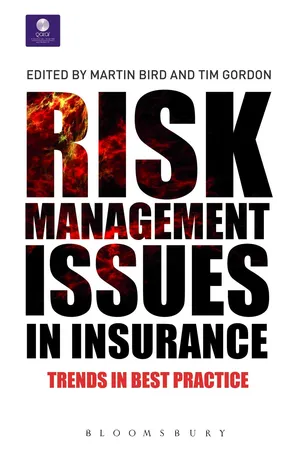
Risk Management Issues in Insurance
About this book
The financial crisis of 2008 had little impact on the insurance industry globally, unlike the solvency issues within other financial sectors. This title looks at the major risk concerns within insurance and how the industry as a whole deals with potential threats to its business in the short, medium, and long term. It will demystify how insurers cope with liquidity risk, counterparty risk, tail-event risk (catastrophe), longevity risk, and the impact of climate change.
Tools to learn more effectively

Saving Books

Keyword Search

Annotating Text

Listen to it instead
Information
ERM for Emerging Risks in General Insurance
by George C. Orros
This Chapter Covers
• An enterprise risk management (ERM) framework model.
• ERM is now accepted as being a part of any general insurer’s modus operandi.
• Three case studies are presented: American International Group (AIG), Long Term Capital Management (LTCM), and the Bhopal pesticide plant, India, owned by a subsidiary of Union Carbide.
• With hindsight, many of the mistakes made by the case study companies were predictable. In practice the situation is not clear cut and responses are inevitably based on imperfect information.
• Conclusions from the case studies.
Introduction
This article focuses on the practical application of enterprise risk management (ERM) principles for general insurance undertakings in our world of “unknown unknowns” and the emergence of unexpected risks over time. Consideration is given to how the chief risk officer (CRO) can focus within an ERM risk and opportunity management framework, balancing risks against opportunities, while being resilient in the face of “unknown unknowns” and their emergence over time to become what are commonly referred to as the “known unknowns” and the “known knowns.”
ERM has been around for many years and yet it has had a chequered history, only recently starting to be fully adopted by companies in the UK insurance and financial service markets and elsewhere around the world. Elements of ERM have also been applied throughout the UK public sector agencies, including the National Health Service and other government departments.
Continued development of the regulatory environment and the sophistication of risk analysis techniques have changed the approaches adopted by general insurance undertakings in the United Kingdom and internationally. ERM is now commonly accepted as being a necessary part of any successful general insurer’s modus operandi, even if what “good ERM” means is not generally understood. ERM appears to be here to stay.
The empirical research used in this article is anchored in three well-documented case studies. These are the general insurance-related features of AIG (American International Group), LTCM (Long Term Capital Management), and Union Carbide. The results underlie the best-practice indications recommended for ERM practitioners.
Consideration has been given to the lessons learned and the early warning indicators that could (and perhaps should) have been used to detect the emerging risks in a timely manner and which could have influenced the CRO to have taken appropriate remedial action. It is recognized that, with the benefit of hindsight, many of the mistakes made by the case study companies appear predictable. In practice, however, in the heat of emerging reality, the situation is not so clear cut and responses are inevitably based on imperfect data and information.
Readers may find it useful to ask themselves the following questions while considering the material presented in this chapter.
• Which key risk indicators and early warning indicators would you have used, why would you have used them, and how would they have informed your decisions?
• How quickly would you have spotted the emergence of the unexpected event, and what would you have done about it?
• What evidence would you have needed to convince the CEO to take the appropriate remedial action before it was too late?
ERM Framework Model
This article assesses the case study experience with reference to an ERM framework model and associated concepts of risk and opportunity management. The reader can make reference to this section to help them to analyze the case study experience and to build their own response to each of the three questions.
Literature reviews of ERM characterize the process as essentially one of risk and opportunity management, as a cycle which involves the main board functions, namely policy formulation, strategic thinking, supervisory management and accountability, and their control cycles. This is shown in Figure 1. Figure 1

The control cycle can be further developed to form an ERM corporate governance model with the following elements:
• corporate governance—board oversight;
• internal control—a sound system of internal control;
• implementation—appointment of external support;
• risk management process—incremental phases of a six-stage iterative process;
• identification of sources of risk—internal and external.
Figure 2 provides an overview of the ERM corporate governance model, which includes feedback loops to allow for iterations at each stage, the rationale being that it is futile to continue the process if the foundation stages are found to be flawed as a result of subsequent research and review stages.

The ERM process is a six-stage iterative process, as illustrated in Figure 3.

Each of the six risk management processes has inputs, outputs, controls, and mechanisms. The modes of data connectivity can be charted using the integrated definition for function modeling (IDEFO) process mapping technique, as illustrated in Figure 4.

Sources of risk exist both internally and externally to the business (Figure 5) and interact to generate new risks. Internal risk has its origin within and may (potentially) be controlled by an organization. An example is financial risk, the exposure to adverse events that can adversely affect profitability and may trigger closure of a business.
External sources of risk are sources of risk that occur at subnational, national, regional, and global/international levels. These sources are largely exogenous to the insurer, such as demographic trends; however, some factors may be influenced by the insurer or its peers (e.g. regulation which addresses market and consumer issues). External sources of risk include the economic, natural/physical, political, legal and regulatory environments, market structures and conditions, legislation, and sociodemographic and cultural factors.

Elucidating a firm’s risk appetite requires a consideration of “downside” and “upside” risks. Viewing risk ap...
Table of contents
- Cover
- Title page
- Table of Contents
- Introduction, by Martin Bird and Tim Gordon
- Contributor Biographies
- A Value-at-Risk Framework for Longevity Trend Risk, by Stephen J. Richards
- The Financial Impact of Longevity Risk, by S. Erik Oppers
- How Should Insurers Optimally Manage Market Risk? by Patrick O. J. Kelliher
- Solvency II—A New Regulatory Framework for the Insurance Sector, by Paul Barrett and Daniel Byrne
- Enterprise Risk Management and Solvency II, by Andy Davies
- Own Risk and Solvency Assessment (ORSA): Strategy, People, and Complexity, by Neil Cantle
- ERM for Emerging Risks in General Insurance, by George C. Orros
- ERM, Best Ratings, and the Financial Crisis, by Gene C. Lai
- Issues in Issuing Insurance-Linked Securities, by Morton Lane
- Obstacles to the Further Development of the Longevity Swaps Market for Pension Funds, by Martin Bird and Tim Gordon
- Longevity and Annuities—The Challenge of Giving a Secure Pension, by Dominic Grimley
- Should Governments Step In and Start Issuing Longevity Bonds? by David Blake, Tom Boardman, and Andrew Cairns
- Climate Change and Alternative Risk Financing: Adapting Current Methods for Assessing and Transferring Weather Risks, by Alex Bernhardt, Tanya Havlicek, and Neal Drawas
- Climate Change and Insurance, by Stephen Haddrill
- Islamic Insurance Markets and the Structure of Takaful, by Suzanne White
- eCopyright
Frequently asked questions
Yes, you can cancel anytime from the Subscription tab in your account settings on the Perlego website. Your subscription will stay active until the end of your current billing period. Learn how to cancel your subscription
No, books cannot be downloaded as external files, such as PDFs, for use outside of Perlego. However, you can download books within the Perlego app for offline reading on mobile or tablet. Learn how to download books offline
Perlego offers two plans: Essential and Complete
- Essential is ideal for learners and professionals who enjoy exploring a wide range of subjects. Access the Essential Library with 800,000+ trusted titles and best-sellers across business, personal growth, and the humanities. Includes unlimited reading time and Standard Read Aloud voice.
- Complete: Perfect for advanced learners and researchers needing full, unrestricted access. Unlock 1.4M+ books across hundreds of subjects, including academic and specialized titles. The Complete Plan also includes advanced features like Premium Read Aloud and Research Assistant.
We are an online textbook subscription service, where you can get access to an entire online library for less than the price of a single book per month. With over 1 million books across 990+ topics, we’ve got you covered! Learn about our mission
Look out for the read-aloud symbol on your next book to see if you can listen to it. The read-aloud tool reads text aloud for you, highlighting the text as it is being read. You can pause it, speed it up and slow it down. Learn more about Read Aloud
Yes! You can use the Perlego app on both iOS and Android devices to read anytime, anywhere — even offline. Perfect for commutes or when you’re on the go.
Please note we cannot support devices running on iOS 13 and Android 7 or earlier. Learn more about using the app
Please note we cannot support devices running on iOS 13 and Android 7 or earlier. Learn more about using the app
Yes, you can access Risk Management Issues in Insurance by Martin Bird, Tim Gordon in PDF and/or ePUB format, as well as other popular books in Business & Insurance. We have over one million books available in our catalogue for you to explore.