- 471 pages
- English
- PDF
- Available on iOS & Android
eBook - PDF
About this book
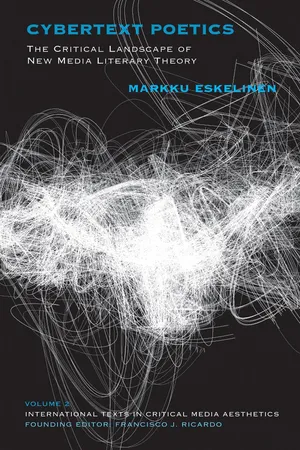
Equally interested in what is and what could be, Cybertext Poetics combines ludology and cybertext theory to solve persistent problems and introduce paradigm changes in the fields of literary theory, narratology, game studies, and digital media. The book first integrates theories of print and digital literature within a more comprehensive theory capable of coming to terms with the ever-widening media varieties of literary expression, and then expands narratology far beyond its current confines resulting in multiple new possibilities for both interactive and non-interactive narratives. By focusing on a cultural mode of expression that is formally, cognitively, affectively, socially, aesthetically, ethically and rhetorically different from narratives and stories, Cybertext Poetics constructs a ludological basis for comparative game studies, shows the importance of game studies to the understanding of digital media, and argues for a plurality of transmedial ecologies.
Information
Table of contents
- Acknowledgments
- 1 Introduction
- 2 Cybertext theory revisited
- 3 Cybertextuality and transtextuality
- 4 The textual whole
- 5 The enigma of the ergodic
- 6 Towards cybertextual narratology
- 7 Towards an expanded narratology
- 8 Tense
- 9 Mood
- 10 Voice
- 11 Ergodic and narrative discourses
- 12 Ludology and the exhaustion of narratology
- 13 Game ecology and the classic game model
- 14 Game ontology
- 15 Rules and configurative practices
- 16 Game time
- 17 Games as configurative practices: models and metaphors
- 18 Transmedial modes and ecologies
- 19 Ergodic modes and play
- 20 Textual instruments and instrumental texts
- Notes
- Bibliography
- Index
Trusted by 375,005 students
Access to over 1.5 million titles for a fair monthly price.
Study more efficiently using our study tools.
Frequently asked questions
Yes, you can cancel anytime from the Subscription tab in your account settings on the Perlego website. Your subscription will stay active until the end of your current billing period. Learn how to cancel your subscription
No, books cannot be downloaded as external files, such as PDFs, for use outside of Perlego. However, you can download books within the Perlego app for offline reading on mobile or tablet. Learn how to download books offline
We are an online textbook subscription service, where you can get access to an entire online library for less than the price of a single book per month. With over 1.5 million books across 990+ topics, we’ve got you covered! Learn about our mission
Look out for the read-aloud symbol on your next book to see if you can listen to it. The read-aloud tool reads text aloud for you, highlighting the text as it is being read. You can pause it, speed it up and slow it down. Learn more about Read Aloud
Yes! You can use the Perlego app on both iOS and Android devices to read anytime, anywhere — even offline. Perfect for commutes or when you’re on the go.
Please note we cannot support devices running on iOS 13 and Android 7 or earlier. Learn more about using the app
Please note we cannot support devices running on iOS 13 and Android 7 or earlier. Learn more about using the app
Yes, you can access Cybertext Poetics by Markku Eskelinen in PDF and/or ePUB format, as well as other popular books in Social Sciences & Literary Criticism. We have over 1.5 million books available in our catalogue for you to explore.