Hundreds of bacterial species make up human gut flora. The intestine has at least 400 different species of bacteria totaling over 1012 organisms. Of these, 99% are anaerobic bacteria. The gastrointestinal tract is then exposed to countless numbers of bacterial species and foreign antigens and has embedded a unique and complex network of immunological and non-immunological mechanisms to protect the host from potentially harmful pathogens. Healthy individuals are generally tolerant to their own microbiota, but such tolerance is impaired in patients with both organic and functional gastrointestinal diseases. The advancement of the knowledge on microbial-gut interactions in health and disease has allowed a more pathophysiologically-oriented approach to several challenging clinical conditions. There are currently two ways to manipulate enteric flora. Antibiotics can selectively decrease tissue invasion and eliminate aggressive bacterial species or globally decrease luminal and mucosal bacterial concentrations, depending on their spectrum of activity. Alternatively, administration of beneficial bacterial species (probiotics), poorly absorbed dietary oligosaccharides (prebiotics), or combined probiotics and prebiotics (synbiotics) can restore a predominance of beneficial commensal flora. These two therapeutic approaches are not, of course, mutually exclusive. Rifaximin, a poorly absorbed antibiotic targeted at the gastrointestinal tract, has been long used in Italy for the treatment of infectious diarrhea in both adults and children. During the past few years the appreciation of the pathogenic role of gut bacteria in several organic and functional gastrointestinal diseases has increasingly broadened its clinical use, which now covers hepatic encephalopathy, small intestine bacterial overgrowth, inflammatory bowel disease and colonic diverticular disease. Other potential clinical indications are being explored and look promising. In this issue, leading scientists (both Spanish and Italian) discuss - in a series of state-of-the-art reviews - the current status of the present knowledge on Microbial Flora in Digestive Diseases and assess the role of rifaximin in several gut-related organic and functional gastrointestinal disorders. Since it includes much information difficult to collect from other scattered sources, this volume will be of interest to infectiologists, gastroenterologists and digestive surgeons alike.
eBook - PDF
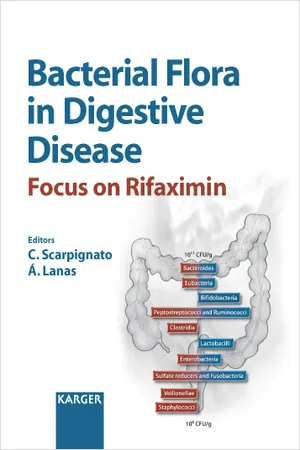
Bacterial Flora in Digestive Disease
Focus on Rifaximin Barcelona, January 2005. Reprint of: Digestion 2006, Vol. 73, Suppl. 1
- 157 pages
- English
- PDF
- Available on iOS & Android
eBook - PDF
Bacterial Flora in Digestive Disease
Focus on Rifaximin Barcelona, January 2005. Reprint of: Digestion 2006, Vol. 73, Suppl. 1
About this book
Information
Table of contents
- Cover
- Contents
- Foreword
- Preface
- Enteric Flora in Health and Disease
- Experimental and Clinical Pharmacology of Rifaximin, a Gastrointestinal Selective Antibiotic
- Pharmacological Treatment of the Irritable Bowel Syndrome and Other Functional Bowel Disorders
- Treatment of Functional Bowel Disorders: Is There Room for Antibiotics?
- Colonic Diverticular Disease: Pathophysiology and Clinical Picture
- Management of Colonic Diverticular Disease
- Inflammatory Bowel Disease: Current Therapeutic Options
- Antimicrobials in the Management of Inflammatory Bowel Disease
- Hepatic Encephalopathy: From Pathophysiology to Treatment
- Management of Hepatic Encephalopathy: Focus on Antibiotic Therapy
- Epidemiology, Etiology and Pathophysiology of Traveler’s Diarrhea
- Prevention and Treatment of Traveler’s Diarrhea
- Helicobacter pylori Infection: Treatment Options
- Eradication of Helicobacter pylori: Are Rifaximin-Based Regimens Effective?
- Microbial Flora in NSAID-Induced Intestinal Damage: A Role for Antibiotics?
- Author Index
- Subject Index
Trusted by 375,005 students
Access to over 1.5 million titles for a fair monthly price.
Study more efficiently using our study tools.
Frequently asked questions
Yes, you can cancel anytime from the Subscription tab in your account settings on the Perlego website. Your subscription will stay active until the end of your current billing period. Learn how to cancel your subscription
No, books cannot be downloaded as external files, such as PDFs, for use outside of Perlego. However, you can download books within the Perlego app for offline reading on mobile or tablet. Learn how to download books offline
Perlego offers two plans: Essential and Complete
- Essential is ideal for learners and professionals who enjoy exploring a wide range of subjects. Access the Essential Library with 800,000+ trusted titles and best-sellers across business, personal growth, and the humanities. Includes unlimited reading time and Standard Read Aloud voice.
- Complete: Perfect for advanced learners and researchers needing full, unrestricted access. Unlock 1.5M+ books across hundreds of subjects, including academic and specialized titles. The Complete Plan also includes advanced features like Premium Read Aloud and Research Assistant.
We are an online textbook subscription service, where you can get access to an entire online library for less than the price of a single book per month. With over 1.5 million books across 990+ topics, we’ve got you covered! Learn about our mission
Look out for the read-aloud symbol on your next book to see if you can listen to it. The read-aloud tool reads text aloud for you, highlighting the text as it is being read. You can pause it, speed it up and slow it down. Learn more about Read Aloud
Yes! You can use the Perlego app on both iOS and Android devices to read anytime, anywhere — even offline. Perfect for commutes or when you’re on the go.
Please note we cannot support devices running on iOS 13 and Android 7 or earlier. Learn more about using the app
Please note we cannot support devices running on iOS 13 and Android 7 or earlier. Learn more about using the app
Yes, you can access Bacterial Flora in Digestive Disease by Scarpignato, Lanas in PDF and/or ePUB format, as well as other popular books in Medicina & Malattie infettive. We have over 1.5 million books available in our catalogue for you to explore.