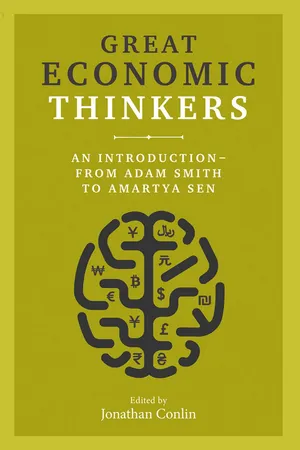
Great Economic Thinkers presents an accessible introduction to the lives and works of the most influential economists of modern times: Adam Smith, David Ricardo, John Stuart Mill, Karl Marx, Alfred Marshall, Joseph Schumpeter, John Maynard Keynes, and Nobel Prize winners Friedrich Hayek, Milton Friedman, John Forbes Nash Jr, Daniel Kahneman, Amartya Sen and Joseph Stiglitz.
Free from jargon and equations, the book describes key economic concepts – from the role played by the division of labour to wages and rents, cognitive biases, game theory and liberalism – showing how they have come to shape our society today.
- English
- ePUB (mobile friendly)
- Available on iOS & Android
eBook - ePub
About this book
Trusted by 375,005 students
Access to over 1.5 million titles for a fair monthly price.
Study more efficiently using our study tools.
Information
REFERENCES
Introduction
1 John Maynard Keynes, The General Theory of Employment, Interest and Money (London, 1936), Chapter 24.
2 T. S. Kuhn, The Structure of Scientific Resolutions, 2nd edn (Chicago, IL, 1970).
3 Charles Whitworth, ed., The Political and Commercial Works of that celebrated writer Charles Davenant (5 vols, London, 1771), vol. I, p. 98.
ONE Adam Smith
1 Adam Smith, Lectures on Jurisprudence, ed. R. L. Meek, D. D. Raphael and P. G. Stein [1762–3] (Oxford, 1978), p. 105; Adam Smith, Correspondence of Adam Smith, ed. E. C. Mossner and I. S. Ross, Glasgow Edition of the Works and Correspondence of Adam Smith (Oxford, 1987), p. 245.
2 Adam Smith, An Inquiry into the Nature and Causes of the Wealth of Nations [1776], ed. William B. Todd (Oxford, 1975), p. 648.
3 Ibid., p. 493.
4 Smith, Correspondence, p. 192.
5 Mark Blaug, Economic Theory in Retrospect, 4th edn (Cambridge, 1982), p. 35.
6 David Gauthier, Morals by Agreement (Oxford, 1986), p. 13 (quote); George Stigler, ‘Economics or Ethics?’, in Tanner Lectures on Human Values, ed. S. McMurrin (Salt Lake City, UT, 1981), vol. II, p. 188.
7 Jerry Evensky, ‘“Chicago Smith” versus “Kirkcaldy Smith”’, History of Political Economy, XXXVII/2 (2005), pp. 197–203.
8 Jacob Viner, ‘Adam Smith and Laissez-Faire’, in Adam Smith, 1776–1926, ed. J. M. Clark et al. (New York, 1928), pp. 116–20.
9 George Stigler, ‘Smith’s Travels on the Ship of State’, History of Political Economy, III (1971), p. 265.
10 Smith, The Wealth of Nations, p. 28.
11 Smith, Correspondence, p. 68.
12 Adam Smith, The Theory of Moral Sentiments [1759], ed. A. L. Macfie and D. D. Raphael (Indianapolis, in, 1984), p. 22.
13 Ibid., p. 117.
14 Francis Hutcheson, An Essay on the Nature and Conduct of the Passions and Affections, with Illustrations on the Moral Sense [1728], ed. Aaron Garrett (Indianapolis, IN, 2002), p. 17.
15 Smith, Theory of Moral Sentiments, p. 305.
16 Ibid., pp. 126–7.
17 Ibid., p. 309.
18 Ibid., p. 129.
19 Ibid., p. 84.
20 Ibid., p. 92.
21 Ibid., p. 110.
22 Ibid., p. 234.
23 See Steven L. Kaplan, Bread, Politics and Political Economy in the Reign of Louis XV (The Hague, 1976).
24 Smith, The Wealth of Nations, pp. 14–15.
25 Ibid., p. 25.
26 Ibid., pp. 26–7.
27 Ibid., p. 37.
28 Ibid., p. 44.
29 Ibid., p. 48.
30 Ibid., p. 82.
31 Ibid., p. 73.
32 Ibid., p. 98.
33 Ibid., pp. 111–13.
34 Blaug, Economic Theory, pp. 39–49.
35 James Tobin, ‘The Invisible Hand in Modern Macroeconomics’, in Adam Smith’s Legacy: His Place in the Development of Modern Economics, ed. Michael Fry (London, 1992), pp. 122–4.
36 Lawrence E. Klein, ‘Smith’s Use of Data’, in Adam Smith’s Legacy, ed. Fry, pp. 15–28.
37 Smith, The Wealth of Nations, p. 321.
38 Ibid., pp. 324, 308–9.
39 Ibid., p. 324.
40 Ibid., p. 380.
41 Ibid., p. 415.
42 Ibid., pp. 418–19.
43 Ibid., pp. 421, 422.
44 Ibid., p. 456.
45 Emma Rothschild, Economic Sentiments: Adam Smith, Condorcet, and the Enlightenment (Cambridge, MA, 2001), pp. 135 (ironic), 137 (trinket).
46 Smith, Theory of Moral Sentiments, p. 87.
47 Ibid., pp. 183–4.
48 Karl Marx, Economic and Philosophic Manuscripts of 1844, trans. Martin Mulligan (Moscow, 1959), p. 63.
49 Smith, The Wealth of Nations, pp. 781–2.
50 Ibid., p. 785.
51 Patricia Werhane, Adam Smith and His Legacy for Modern Capitalism (Oxford, 1991), pp. 134–6.
52 Smith, Theory of Moral Sentiments, p. 213.
53 Ibid., p. 216.
54 Jean-Jacques Rousseau, The Social Contract and Discourses [1762], trans. G.D.H. Cole (London, 1973), p. 116.
55 Smith, Theory of Moral Sentiments, p. 216.
56 Ibid., pp. 86–7.
TWO David Ricardo
1 Richard F. Teichgraeber III, ‘“Less abused than I had reason to expect”: The Reception of The Wealth of Nations in Britain’, Historical Journal, XXX/2 (1987), p. 351.
2 David Ricardo, On the Principles of Political Economy and Taxation [1817] (London, 1911).
3 D. P. O’Brien, The Classical Economists (Oxford, 1978), p. xii.
4 Accominotti and Flandreau counsel that Ricardo would have opposed bilateral treaties. Olivier Accominotti and Marc Flandreau, ‘Bilateral Treaties and the Most-Favored-Nation Clause: The Myth of Trade Liberalization in the Nineteenth Century’, World Politics, LX/2 (2008), pp. 147–88.
5 Adam Smith, The Wealth of Nations, Books I–III [1776] (London, 1986), pp. 109–17.
6 ‘It is not from the benevolence of the butcher, the brewer, or the baker that we expect our dinner, but from their regard to the...
Table of contents
- Front Cover
- Half Title
- Title Page
- Copyright
- Contents
- INTRODUCTION
- ONE: ADAM SMITH
- TWO: DAVID RICARDO
- THREE: JOHN STUART MILL
- FOUR: KARL MARX
- FIVE: ALFRED MARSHALL
- SIX: JOSEPH SCHUMPETER
- SEVEN: JOHN MAYNARD KEYNES
- EIGHT: FRIEDRICH HAYEK
- NINE: MILTON FRIEDMAN
- TEN: JOHN FORBES NASH JR
- ELEVEN: DANIEL KAHNEMAN
- TWELVE: AMARTYA SEN
- THIRTEEN: JOSEPH STIGLITZ
- REFERENCES
- FURTHER READING
- LIST OF CONTRIBUTORS
- ACKNOWLEDGEMENTS
Frequently asked questions
Yes, you can cancel anytime from the Subscription tab in your account settings on the Perlego website. Your subscription will stay active until the end of your current billing period. Learn how to cancel your subscription
No, books cannot be downloaded as external files, such as PDFs, for use outside of Perlego. However, you can download books within the Perlego app for offline reading on mobile or tablet. Learn how to download books offline
We are an online textbook subscription service, where you can get access to an entire online library for less than the price of a single book per month. With over 1.5 million books across 990+ topics, we’ve got you covered! Learn about our mission
Look out for the read-aloud symbol on your next book to see if you can listen to it. The read-aloud tool reads text aloud for you, highlighting the text as it is being read. You can pause it, speed it up and slow it down. Learn more about Read Aloud
Yes! You can use the Perlego app on both iOS and Android devices to read anytime, anywhere — even offline. Perfect for commutes or when you’re on the go.
Please note we cannot support devices running on iOS 13 and Android 7 or earlier. Learn more about using the app
Please note we cannot support devices running on iOS 13 and Android 7 or earlier. Learn more about using the app
Yes, you can access Great Economic Thinkers by Jonathan Conlin in PDF and/or ePUB format, as well as other popular books in Business & Business General. We have over 1.5 million books available in our catalogue for you to explore.