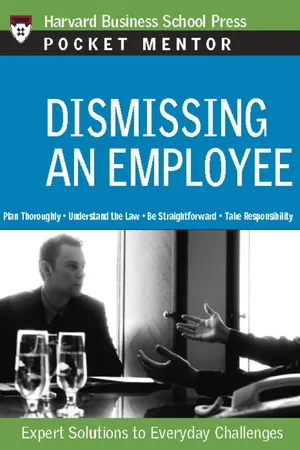
While no one likes to be the bearer of bad news, managers are sometimes faced with the difficult task of having to dismiss an employee. In this book, you'll learn how to effectively manage a dismissal--including making key decisions before, during, and after the critical event. Handled skillfully, dismissing an employee can set your team--and your company--on a positive new path.
- 81 pages
- English
- ePUB (mobile friendly)
- Available on iOS & Android
eBook - ePub
About this book
Trusted by 375,005 students
Access to over 1.5 million titles for a fair monthly price.
Study more efficiently using our study tools.
Information
Tips and Tools
Tools for Dismissing an Employee
| DISMISSING AN EMPLOYEE | |
|---|---|
| List of Dos and Don’ts for Dismissing an Employee | |
| Use this list as a quick reminder of what you should do or not do as part of the process of dismissing an employee. You can add to this list specific policies and practices within your company, as well as tips you’ve learned from experience. | |
| Do... | Don’t... |
| Do become familiar with your company’s poli cies and procedures. | Don’t tell a dismissed employee that the dis missal is part of a layoff if it isn’t. |
| Do be informed about the legal implications of dismissing an employee. Be sure to seek legal ad vice from a knowledgeable attorney. | Don’t use statements that could leave the im pression that the employee is being dismissed for discriminatory reasons, such as being too |
| Do involve a human resource professional, if possible, in the plan and termination meeting. | old, married, pregnant, and so forth. |
| Don’t use humor or make light of the situation. | |
| Do document the terms of the employee’s dis- missal and create a separation letter. | |
| Don’t threaten an employee who implies that he or she may challenge the dismissal. | |
| Do acknowledge the emotional impact of this process on yourself and the employee. | Don’t withhold the person’s final paycheck. |
| Do be dispassionate, direct, and focused in the meeting, but deliver the message in a way that preserves the person’s dignity. | Don’t go it alone: have a human resource pro fessional at the meeting, if possible. |
| Don’t make potentially damaging statements | |
| Do keep the meeting short and private. | about the employee to fellow employees. |
| Do deliver a severance package, if possible, to ease employee concerns about security. | Don’t make potentially damaging statements about the dismissed employee to his or her reference checks. |
| Do make arrangements for the employee to re trieve his or her personal belongings. | Don’t apologize or reconsider your decision if the employee protests. |
| Do set up an exit interview, if possible. | |
| Do listen as well as talk; the employee may share more freely important information. | Don’t sugarcoat your message. |
| Don’t make promises you can’t keep. | |
| Do honor employment contracts such as a union’s collective-bargaining agreements, non compete or nondisclosure agreements, or a service letter. | Don’t just shut off the employee’s e-mail and voice mail without careful decisions about what channels you want to keep open or closed. |
| Do concisely communicate to other workers ap propriate information concerning the dismissal, including your plans for seeking a replacement. | |
| Do redistribute the dismissed employee’s work, if necessary, in a way that enables others to re main productive. | |
| Do follow company policy regarding notifying external contacts. | |
| Additional Dos and Don’ts | |
| DISMISSING AN EMPLOYEE | |||
| Dismissal Preparation Checklist | |||
| Use this checklist to help you prepare for dismissing an employee. You can add company-specific procedures or your own personal items to this list. | |||
| Have You? | Yes | No | |
| 1. | Determined that dismissal is now the best means of going forward for this employee, and that there are no other viable alternatives? | ||
| 2. | Reviewed company policies and procedures on dismissing an employee? | ||
| 3. | Sought legal advice on the soundness of your reasons and on how to manage the dismissal? | ||
| 4. | Kept adequate records to document the employee’s inadequate performance and measures taken to address it? | ||
| 5. | Avoided making judgmental or discriminatory statements about the person that could end up being harmful to you or the company? | ||
| 6. | Recognized and tried to deal with the emotional impact of making this decision on yourself and the other person? | ||
| 7. | Sought appropriate support and guidance if this is your first dismissal? | ||
| 8. | Thought through how you will present this situation to the employee and how you will handle difficult questions or behaviors? | ||
| 9. | Asked a human resource professional, if possible or needed, to sit in on the dismissal session with you? | ||
| 10. | Arranged a private place and reserved a time to have the conversation with the employee? | ||
| 11. | Thought through how you will announce this dismissal to others in your work group? | ||
| 12. | Made a plan to handle the dismissed employee’s workload? | ||
| 13. | Consulted with human resources about finding a replacement? | ||
| 14. | Prepared all the necessary paperwork? | ||
| 15. | Developed an exit plan for the employee that makes the dismissal day his or her last day and includes how e-mail or other communications will be handled internally or externally, how he or she can retrieve his or her belongings, who will accompany him or her out of the building, and so forth? | ||

Test Yourself
This section offers ten multiple-choice questions to help you identify your baseline knowledge of dismissal essentials. Answers to the questions are given at the end of the test.
- To dismiss an employee is to:
- Terminate an individual’s employment with a company owing to inadequacies or problems with his or her performance or behavior.
- Terminate an individual’s employment with a company owing to the firm’s desire to take a new strategic direction or cut costs.
- Terminate an individual’s employment with the company owing to the fact that the worker and his or her manager do not get along on a personal level.
- Which of the following statements would not be appropriate to make when explaining to your team why someone was dismissed?
- Julia was dismissed because she was chronically late and abused sick leave privileges.
- Max was dismissed after many months of unsuccessful attempts to improve his performance.
- Trevor was dismissed because he falsified expense reports and could no longer be trusted.
- Putting a problem employee on probation means:
- Putting the employee on a paid or unpaid leave from work, during which he or she must create a plan for addressing the problem performance or behavior, clarify expectations, and establish new goals.
- Temporarily suspending certain workplace benefits (such as flextime or the opportunity to work from home) until the employee can demonstrate that he or she has corrected his or her problem performance or behavior.
- Issuing an oral and written warning to the employee in which you set a date by which he or she must improve the problem performance or behavior; the warning then gets documented and stored in the employee’s personnel file.
- True or false: You must provide a reference for a dismissed employee if he or she (or if a potential new employer) asks for one.
- True.
- False.
- Which of the following statements would not be appropriate to make when dismissing an employee?
- “The job hasn’t worked out. You’ve continued to have unexcused absences over the past several months.”
- “The job hasn’t worked out. We set new sales goals for you six months ago, and you still haven’t met them.”
- “The job just has not worked out. We need someone who can project a high-energy, up-and-coming image.”
- In many companies, which of the following employee behaviors might constitute grounds for immediate dismissal?
- An employee arrives at the office late several times in one week.
- An employee steals a computer from his or her department.
- An employee gossips with other workers on several occasions in one week.
- There are certain employee behaviors for which a manager cannot legally dismiss the worker. Which of the following behaviors does not fall into that category?
- The employee has taken time off from work to v...
Table of contents
- Pocket Mentor Series
- Title Page
- Copyright Page
- Table of Contents
- Mentors′ Message: Handling a Dismissal Skillfully
- A Difficult - Moment
- A Closer Look at - Dismissals
- Taking Care of Yourself During a Dismissal
- Understanding the Grounds for a Dismissal
- Making the Decision
- Handling a Dismissal Professionally
- Handling the Legal Details After a Dismissal
- Leading Your Team After a Dismissal
- Learning from a Dismissal
- Tips and Tools
- To Learn More
- Sources for Dimissing an Employee
- How to Order
Frequently asked questions
Yes, you can cancel anytime from the Subscription tab in your account settings on the Perlego website. Your subscription will stay active until the end of your current billing period. Learn how to cancel your subscription
No, books cannot be downloaded as external files, such as PDFs, for use outside of Perlego. However, you can download books within the Perlego app for offline reading on mobile or tablet. Learn how to download books offline
Perlego offers two plans: Essential and Complete
- Essential is ideal for learners and professionals who enjoy exploring a wide range of subjects. Access the Essential Library with 800,000+ trusted titles and best-sellers across business, personal growth, and the humanities. Includes unlimited reading time and Standard Read Aloud voice.
- Complete: Perfect for advanced learners and researchers needing full, unrestricted access. Unlock 1.5M+ books across hundreds of subjects, including academic and specialized titles. The Complete Plan also includes advanced features like Premium Read Aloud and Research Assistant.
We are an online textbook subscription service, where you can get access to an entire online library for less than the price of a single book per month. With over 1.5 million books across 990+ topics, we’ve got you covered! Learn about our mission
Look out for the read-aloud symbol on your next book to see if you can listen to it. The read-aloud tool reads text aloud for you, highlighting the text as it is being read. You can pause it, speed it up and slow it down. Learn more about Read Aloud
Yes! You can use the Perlego app on both iOS and Android devices to read anytime, anywhere — even offline. Perfect for commutes or when you’re on the go.
Please note we cannot support devices running on iOS 13 and Android 7 or earlier. Learn more about using the app
Please note we cannot support devices running on iOS 13 and Android 7 or earlier. Learn more about using the app
Yes, you can access Dismissing an Employee by in PDF and/or ePUB format, as well as other popular books in Business & Management. We have over 1.5 million books available in our catalogue for you to explore.