![]()
1
BUILDER PERSONALITY
The Essential Force for Growth
Building for growth is the business imperative for every entrepreneur, leader, manager, and company. So, are you built for growth? Because who you are shapes how you build.
If you’re a builder of a new business—whether you’re running an independent startup or a new venture inside an existing company—you face a unique set of challenges. You must convert your ideas into products, galvanize individual talent for collaborative impact, transform buyers into partners, align financial and executive support, and elevate your business to meaningful scale. And all the while, you’re fighting the status quo—often meeting powerful resistance to your new idea from people who don’t get it.
We’ve been intrigued with these challenges—as advisers and consultants to organizations and startups, as investors in new businesses, as professors, and as business builders ourselves. Over our careers, we have shared with hundreds of management teams and thousands of Princeton and Berkeley students the principles of starting and growing new businesses, and we have made investment decisions on dozens of fast-growing startups across the market landscape. Through each of these vantage points, we are constantly amazed by the variety of paths leaders and entrepreneurs take to build successful, growing ventures.
Probably like you, we wondered if it’s possible to codify the different paths of success. Who succeeds, and how? Are there hidden patterns that determine the success of building and growing a new business? How can someone get better at it?
To answer these questions, we employed a patented research methodology to better understand who builds successful new businesses and how they do so (see “Our Research Approach” and Appendix A for a discussion of our research methodology). In addition, we reviewed the literature on successful entrepreneurs and conducted in-depth interviews with dozens of seasoned business builders.
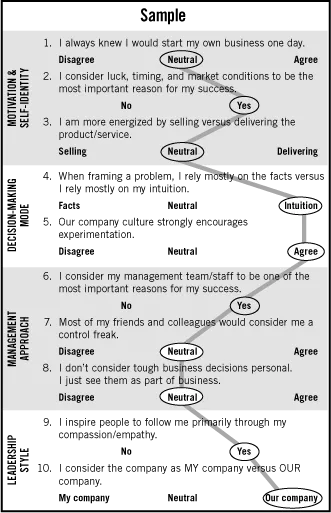
Our conclusion—and the core idea on which this book is based—is that the personality of the leader or founder is the animating force in building any new business. That is, the particular combination of beliefs and preferences that reflects his or her motivation, decision-making mode, management approach, and leadership style. These factors play out dramatically throughout the startup and scaling of a new business. The Builder’s Personality is the essential engine of shaping the team, product, and overall business—but can also be a formidable obstacle to them. Anyone involved in leading, supporting, or funding new businesses needs to understand how the force of the Builder Personality impacts the growth process.
Of course, many elements shape the success or failure of a new business, whether it’s a stand-alone startup or a new venture inside a larger corporation. Regardless of the setting, both builders are engaged in “the pursuit of opportunity beyond resources controlled,” as Howard Stevenson, the renowned Harvard Business School professor, defined entrepreneurship.1 But unlike the other resources you need to successfully grow a business, personality is the one directly—and quintessentially—in your control.
This book decodes the interplay between the business founder’s personality and the dynamics of growing a business. Our research has revealed four Builder Personalities, and we demonstrate how each one succeeds and fails in different ways in growing a new business. In this practical book, we provide you with tools and examples for assessing your own personality and blueprints to help you apply these ideas to grow your business, build your team, and win.
The Four Business Builder Personalities
Our research has discovered there is no single type of highly successful business builder, but rather four distinct Builder Personalities. We call them the Driver, Explorer, Crusader, and Captain. Each Builder Personality Type builds for growth in markedly different ways, based on four discriminating factors—their motivation to become an entrepreneur and their styles of decision-making mode, management approach, and leadership style. Chapters 2 through 5 discuss each of these builder personalities and give examples and stories illustrating how they work. For now, here are brief descriptions of each personality. Which one sounds most like you? After you have read these summaries of the four types, look for the section “Which Builder Personality Is Most Similar to Yours?” for guidance on deciding which personality you are most like.
Driver:
Relentless, Commercially Focused, and Highly Confident
Drivers can’t help themselves. They have to become builders of business or social ventures of their own as a means of self-validation. Entrepreneurship is almost hardwired into their very identity. They are supremely confident individuals, relentless in pursuing commercial success based on their uncanny anticipation of what markets and customers are looking for.
Drivers often don’t last long as employees in other people’s organizations. They eschew rules and bureaucracy, seeing them as tools to focus the average person, yet often confine the truly gifted, independent-thinking actor. Drivers are willing to do whatever it takes to realize the commercial success inherent in what they believe is their unbounded potential, in fact their destiny.
While not universally the case, the Driver often has something to prove. Perhaps he or she has been thwarted—passed over or even fired—in an earlier job. Or perhaps having grown up in modest circumstances, the Driver is fueled by a desire to apply his or her innate skills to build enormous value and, in so doing, enjoy a better life. Mark Cuban is a famous example. The son of a car upholsterer, he always believed he could and should build a stronger future for himself and, eventually, his family through his drive and innate commercialization skills.2 This chip on a Driver’s shoulder fuels an inner need to prove him or herself to others.
Drivers are not dreamers caught up in the world of ideas; they are doers, willing to outwork, outthink, and outsell anybody in their path. As Ben Weiss of Bai Brands, a new fast-growing healthy beverage company, said, “There’s a tenacity to who I am, that gave birth to this product . . . I’m the most persistent guy in the world. I don’t pretend to be the smartest guy in the room. Everyone has ideas—I just take them a little further than most people. And then when they fail, I don’t get disillusioned. I just pick up the pieces and keep going.”3
However, the Drivers’ intensity and focus come at a cost. They can burn out their teams, depriving them of both the nurturing and sense of ownership that deepen their skills and form the basis for scaling the enterprise.
The Explorer:
Curious, Systems-Centric, and Dispassionate
Builders who are Explorers are not necessarily motivated to build a new business from scratch, but they are inveterate problem seekers and solvers. Whether the problem is designing better pantyhose (Sara Blakely of Spanx) or unlocking the potential of e-commerce (Jeff Bezos at Amazon), their solutions may focus on product or process, or both. These men and women become stand-alone entrepreneurs or builders of new ventures inside existing corporations because building new businesses seems the best way to solve and commercialize their solutions.
Once hooked by the problem, they fixate on execution, at least until the next intriguing problem emerges in search of solution. Their management style is hands-on to the point of being overly controlling at times.
Explorers are systems thinkers who like to tinker with how a system works to develop a better approach. As a result, they tend to be quite empirical in their decision making, relying on the relevant facts and underlying logic of the issue, rather than emotion or intuition.
These builders attract similar problem solvers, who build their own confidence after demonstrating their particular systems-thinking chops. Explorers can be rather dismissive of areas in their companies that don’t relate directly to their primary passion for solution design. For example, they may feel that sales and marketing are necessary nuisances (after all, their brilliant solutions should practically sell themselves).
The Crusader:
Audacious, Mission-Inspired, and Compassionate
Crusaders are primarily motivated by an intense desire to make the world a better place—by solving problems that matter to markets and society. The crusade may be ice cream with Ben & Jerry’s socialmission, a designer dress made affordable for a special occasion by Jenny Fleiss and Jenn Hyman’s Rent the Runway, or a more responsible approach to managing garbage, as it is for Nate Morris’s Rubicon Global—the Uber of the waste management business. Anchored in a deep-seated ability to empathize with others, Crusaders create mission-based companies with bold, long-range vision.
They have a clear mission, and appreciate—indeed, even look forward to—the opportunity to invite others to help bring it to life. In that sense, Crusaders have an unusual mixture of both sensitivity and humility, combined with a confidence in their animating vision for their business. Unlike Explorers, their decision-making mode is highly intuitive and anchored in their almost instinctive sense of what is right.
Crusaders are guided by their founding mission; however, they can struggle with tough people issues. While they are quite effective in attracting dedicated followers inspired by the company’s mission, they frequently avoid conflict, allowing devoted underperformers to languish rather than removing them from the business. On the operational side, Crusaders often find themselves out of their element and don’t always provide the clear direction that other Builder Types do.
The Captain:
Pragmatic, Team-Enabling, and Direct
Captains are as much team assemblers as catalysts. These builders are intent on creating a company culture around values and mutual accountability. Comfortable with leading from behind, they trust their colleagues and culture to fulfill the vision for the company whose future they share. Unlike Explorers and Drivers, they find gratification in the we rather than the me.
But these men and women are Captains nonetheless, with a clear notion of where they want the ship to go and what needs to be done to get there—although they are more willing than their three builder counterparts to hear ideas from others first. They are motivated to build enterprises of enduring value through unleashing the productive potential of the individuals and teams around them.
As leaders, Captains believe in setting clear goals and expectations, then delegating responsibility for execution. While they prefer consensus-rooted decisions, they sometimes manifest an iron fist in a velvet glove when their teams underperform.
Their decision-making style tends to be unemotional and focused on growth, while they are careful to be consistent with mission, vision, and prior personal commitments. Captains are arguably the most fully developed leaders in terms of direct, honest, and consistent communication among the individuals and teams they manage. But their more consensus-based approach can lead to a form of incrementalism that may miss the necessity or opportunity for more dramatic, disruptive innovation in their markets.
The Dynamic Challenges Every Business Builder Faces
In this book, you’ll see how each of the four Builder Personalities handles the challenges and opportunities in creating long-lasting, large-scale business value for customers, investors, employees and themselves. Regardless of the setting in which the builders work, they all face a set of recurring dynamics that test their ability to succeed. Whichever Builder Personality you are, you are likely to encounter five dynamic challenges that stand above the rest. Each deals with trans...